Song Stories: MGMT: Time to Pretend
MGMT wrote ‘Time to Pretend’ about pretending to be rock stars. Then it helped turn them into exactly that.
Long before ‘Oracular Spectacular’ made Andrew VanWyngarden and Ben Goldwasser international stars, MGMT had begun life as two college students experimenting with electronic music, performance art and the idea of what a band was supposed to look like. They played in tiny rooms, dressed in ridiculous clothes, acting out an exaggerated version of rock-star excess while barely having an audience.
‘Time to Pretend’ became their mission statement.
What initially sounded like a fantasy about money, models, drugs and fame gradually reveals itself as something much more complicated: a satire of rock-star mythology, a song about leaving youth behind and, eventually, an unexpectedly sincere reflection on everything success might cost.
The joke became even better when the song itself became a hit.
What does ‘Time to Pretend’ mean?
At its heart, ‘Time to Pretend’ is about fantasising about becoming famous while already understanding that the fantasy might destroy everything that made life meaningful in the first place. MGMT exaggerate every cliché of rock stardom. There is money, excess, beautiful people, drugs, expensive possessions and the romantic mythology of living quickly enough that ordinary adulthood never catches up with you.
It initially sounds euphoric. But the further the song goes, the more the fantasy begins to crack.
Behind all of the imagined excess is the knowledge that becoming somebody new also means leaving something behind. Childhood, family, friendships and ordinary routines are treated almost like casualties of the transformation.
That is what makes ‘Time to Pretend’ more than a party song. Goldwasser later reflected that many listeners missed the joke entirely, interpreting the song as encouragement to abandon responsibility and chase excess, when MGMT had actually been poking fun at exactly that kind of rock-star fantasy.
The satire works because something sincere lies underneath it.
Andrew VanWyngarden and Ben Goldwasser were young enough to still be imagining what fame might look like, but old enough to recognise how ridiculous many of its clichés were. And then reality caught up with the joke.
Two college students pretending to be rock stars
MGMT formed while VanWyngarden and Goldwasser were students at Wesleyan University in Connecticut. At the time, the project was as much about experimentation and making each other laugh as it was about building a conventional music career.
Their early performances could be deliberately absurd.
The pair embraced costumes, electronic experimentation and the theatrical language of rock stardom while playing to tiny audiences. Goldwasser later described their approach as using pop music partly because they genuinely loved it and partly because its clichés were so much fun to play with.
That tension between affection and satire became central to ‘Time to Pretend’. Two students essentially wrote the song, imagining what would happen if the ridiculous persona they had created actually worked.
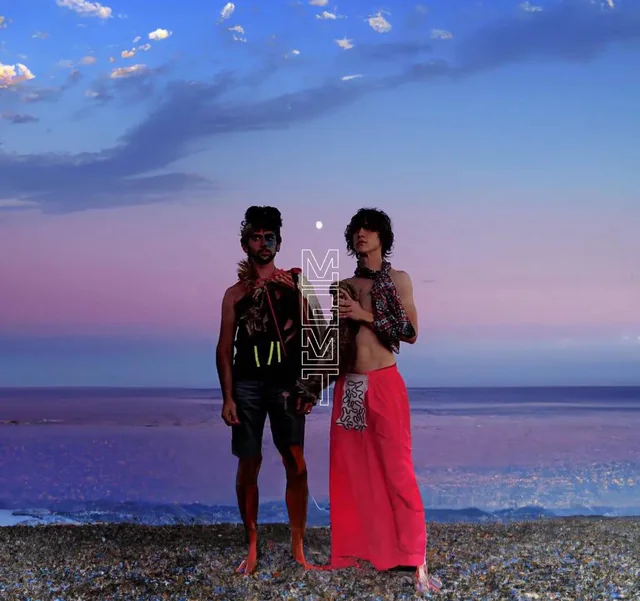
There is something wonderfully strange about listening to it now. MGMT are pretending to imagine fame before fame arrives. They do not know about the record deal, television appearances, festival stages or the huge success of ‘Oracular Spectacular’ yet. The fantasy is still safely hypothetical.
For more on where MGMT fitted into the wider collision between indie, electronic music and pop during the decade, they also feature in my history of British and international guitar music in the second half of the 2000s.
The praying mantis that helped start it all
The origins of ‘Time to Pretend’ are even stranger than the lyrics suggest. An early version of the song was known as ‘The Mantis Sailing Home’.
VanWyngarden had acquired a model pirate ship and, remarkably, a praying mantis became part of the strange domestic world surrounding the band. After the mantis laid eggs, its offspring eventually appeared around the ship. The surreal scene fed into the music VanWyngarden and Goldwasser were making.
What began partly as a joke about a praying mantis gradually evolved into the song millions would eventually know as ‘Time to Pretend’.
That sense of absurdity never completely disappeared.
Even the song's famous opening synthesiser has something strange and almost cartoonish about it. VanWyngarden later described MGMT's fascination at the time with simple, childlike melodies, while comparing the sound itself to something resembling insect wings.
It is hardly the normal origin story for a breakthrough single.
Which makes it perfect for MGMT.
From college recording to ‘Oracular Spectacular’
‘Time to Pretend’ first appeared officially on MGMT's 2005 EP of the same name.
At that point, the band had no reason to assume it would become an international hit.
When Columbia Records became interested, however, MGMT returned to the song while preparing what would become ‘Oracular Spectacular’.
Rather than completely start again, they reworked the existing recording with producer Dave Fridmann. Fridmann was already known for his work with The Flaming Lips, whose adventurous production had strongly influenced MGMT. The pair were particularly attracted to the enormous drum sounds on those records and wanted somebody who could retain the weirdness of what they had created while giving it enough scale to exist outside college bedrooms and house parties.
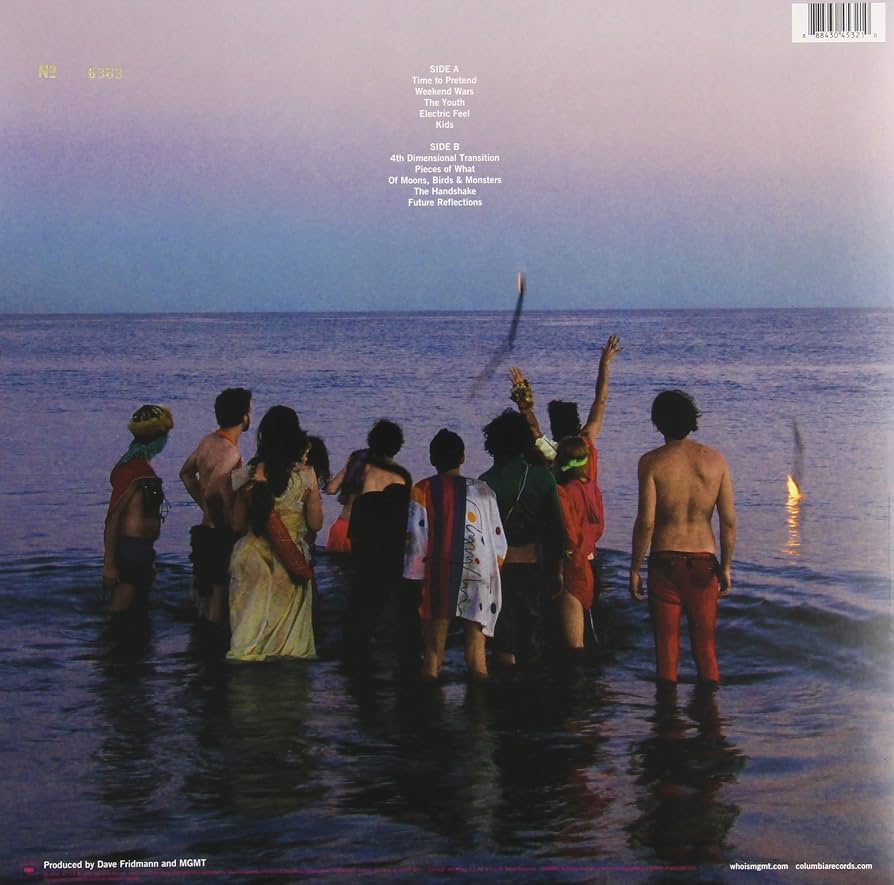
The resulting version keeps the playful strangeness of the original but makes everything bigger. The drums hit harder. The synthesisers feel wider.
And the entire track develops the strange mixture of cheap electronics and enormous psychedelic production that would come to define much of ‘Oracular Spectacular’.
Another unlikely reference point also appears. MGMT deliberately wanted the track to run at the same tempo as ABBA’s ‘Dancing Queen’.
They even worked a subtle musical nod to the song into the recording.
It is one of those details that makes complete sense once you know it.
Beneath all the psychedelia and irony, ‘Time to Pretend’ is an exceptionally well-built pop song.
Making indie kids dance again
By the late 2000s, the boundary between guitar music and dance music had become increasingly difficult to locate. British bands such as Franz Ferdinand had already demonstrated that indie music could be built around rhythm as much as riffs, something explored in my Song Story on ‘Take Me Out’.
Then artists including Klaxons pushed guitars further into rave and electronic culture. MGMT arrived from the United States with something stranger.
‘Time to Pretend’ could sit comfortably on an indie playlist while sounding nothing like the conventional guitar bands dominating the decade. Its synths were psychedelic, electronic and deliberately artificial, while its melodies were immediate enough to work as pure pop.
Alongside ‘Kids’ and ‘Electric Feel’, it helped make ‘Oracular Spectacular’ one of the defining alternative records of the late 2000s.
MGMT had found a way of making experimental music feel enormous.
When pretending became reality
Perhaps the most fascinating part of ‘Time to Pretend’ is what happened after its release. The song had been written as an exaggerated fantasy about becoming rock stars, but MGMT soon found themselves living increasingly surreal versions of the life they had imagined. They signed to a major label, ‘Oracular Spectacular’ became an international success, television appearances followed and festival stages grew larger. Suddenly, the two students who had once dressed up like fake rock stars for tiny audiences were being expected to behave like actual ones.
VanWyngarden later remembered performing ‘Time to Pretend’ on David Letterman while wearing druid capes and becoming acutely aware that what had once been a private joke was now being broadcast on national television. It almost perfectly sums up MGMT’s early career. Something that began in irony had escaped their control, and the song about pretending had helped make the pretence real.
More than a song about excess
It would be easy to reduce ‘Time to Pretend’ to a satire of drugs, celebrity and rock-star behaviour, but there is something much sadder underneath it. The song is also about the moment when youth begins giving way to adulthood, when the fantasy of leaving everything behind is suddenly accompanied by the realisation that ordinary life contains things worth missing.
That is why one of the song’s most important lines is also one of its simplest: “Everything must run its course.”
For me, that line gets remarkably close to the heart of the song. The fantasy cannot last forever, but neither can childhood, youth or the life being left behind. Everything moves forward eventually. What initially sounds like resignation becomes something closer to acceptance: you can want change while still mourning what change takes away.
The imagined rock-star life offers an escape from normality, but normality contains family, friends, home and all the familiar pieces of life that seem insignificant until you picture them disappearing. That gives ‘Time to Pretend’ an emotional weight that its ridiculous imagery initially disguises. The narrator may fantasise about abandoning ordinary life, but part of him is already nostalgic for it before it has even gone.
That contradiction is what makes the song so affecting. It is excited by the future while mourning a version of the present that cannot remain untouched. For a song written by two young people standing on the edge of adulthood, there is something remarkably honest about that.
A joke that became an anthem
‘Time to Pretend’ could easily have remained an artefact of the late 2000s, but it has endured. Part of that comes from the production: those enormous synthesisers still sound strange enough to feel distinctive, while the melody is immediate enough to work almost anywhere. More importantly, though, the fantasy at the centre of the song is universal.
You do not have to dream of becoming a rock star to recognise the desire to escape the life in front of you. Most people reach a point where they imagine becoming somebody else, somewhere else, free from the jobs, responsibilities and ordinary routines that define everyday life. The fantasy is seductive precisely because everything difficult disappears and is replaced by something bigger, brighter and more exciting.
‘Time to Pretend’ understands both sides of that feeling. It captures the thrill of imagining another life while recognising that getting everything you think you want might require giving up things you did not realise mattered. That is where the song's humour gradually gives way to something more poignant.
MGMT began with a joke about becoming rock stars, only for the joke to come true. Behind the synths, excess and satire is a song written by two young people immediately before their lives changed forever, already sensing that whatever happened next would come at the expense of something they could never quite return to.
Everything had to run its course.
They pretended, but not for long.