Don't Drink the Tent Water: Geese: Reading 2026
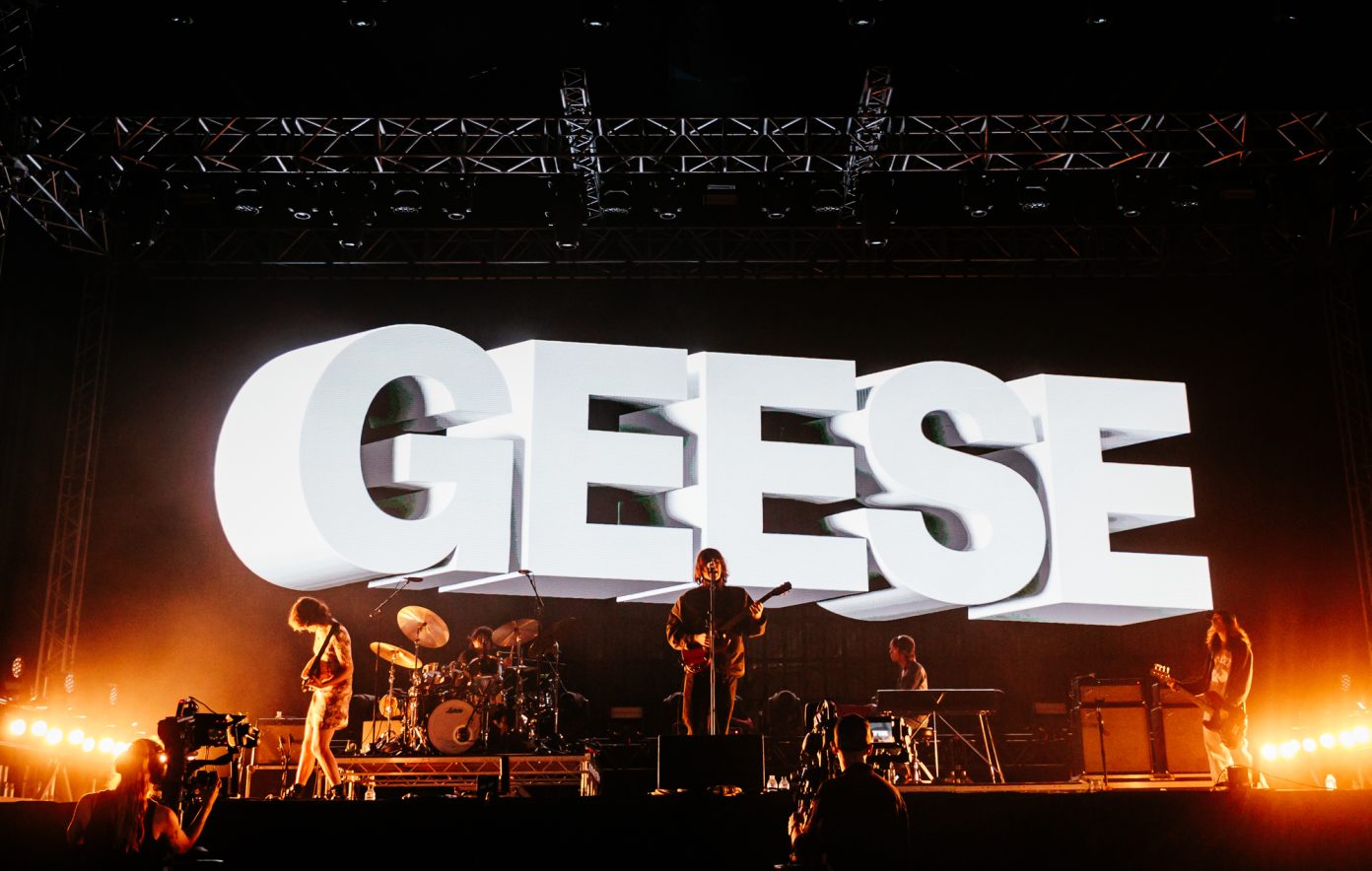
Since the release of ‘Getting Killed’ towards the end of 2025, Geese have become one of Britain’s favourite new imports. More than that, they have started to occupy a position once held by The Strokes: the strange American band that British indie kids discover and immediately want to make their entire personality. The music is less tidy, considerably more deranged, and almost impossible to imitate, but the excitement around them has become hard to miss.
At Reading on Friday 28 August, thousands squeezed into the Gallery Tent to see what all the fuss was about. Naturally, after a summer spent complaining about heatwaves and scorched festival fields, the heavens opened. Rain hammered against the roof, mud swallowed trainers, and eventually the tent itself sprang a leak, creating a metre-by-metre shower in the middle of the crowd. People simply shuffled around it and carried on. Fear not: the British Festival Experience lives.
Cameron Winter acknowledged the situation with considerably less drama. “Don’t drink the tent water,” he mumbled. “It’s not good for you.”
Geese had at least dressed appropriately. The band appeared in raincoats that made them look as though they had taken a wrong turn somewhere between Britpop revivalists and an exceptionally gloomy church outing. Winter’s high collar only added to the impression. He already performs like a man who might either start a sermon or announce the end of the world, so the outfit suited him.
That imagery follows Geese around because ‘Getting Killed’ is full of it. God, death, serpents, horses, crucifixes and various impending catastrophes arrive without much warning, usually alongside something far more mundane. Winter writes as though somebody has mixed up the Bible, a New York pavement argument and several particularly unpleasant dreams, then asked him to sing whatever pages he pulls out first. On record it can be difficult to tell where sincerity ends, and absurdity begins.
Live, he appears even less interested in clearing things up.
The Gallery Tent therefore becomes his temporary church, although Winter is an unreliable preacher. He does not command the stage in the conventional sense. He wanders through it, mutters to himself, changes melodies, stretches words until they barely resemble English and occasionally seems surprised by the noises coming out of his own mouth. The congregation, meanwhile, knows exactly when to lose its mind.
They begin with ‘Husbands’, one of the strangest possible ways to open a festival set. There is no immediate sprint for the throat. Instead, the song lurches forward while Winter toys with the vocal, mumbling and groaning before the band gradually opens it into that enormous final passage. Just as it appears capable of swallowing the whole tent, they stop.
That refusal to behave as a normal rock band runs through the set. During ‘100 Horses’, Winter suddenly lets out a noise somewhere between a war cry, an exorcism and a man discovering he has trapped his hand in a car door. Later, before ‘2122’, he gives every impression that he is about to address the audience, pauses theatrically and then abandons whatever thought may have been forming. Seconds later everyone is screaming “Get out, get under!” back at him.
‘Trinidad’ is even more ridiculous. Winter delivers its succession of grisly images with a puzzled inflexion, as though someone else handed him the lyrics and he is only now discovering what they contain. Emily Green adds to the sense that the whole thing could come apart at any moment, teasing out a filthy guitar riff before the song reaches its “BOMB IN MY CAR!” detonation.
For all Winter’s unpredictability, none of this would work if the band behind him were equally chaotic. Geese sound as though they are permanently half a second away from falling down the stairs, yet somehow everybody lands at the same time. Green is particularly important to that illusion. Her guitar scrapes, stabs and occasionally produces something genuinely beautiful before somebody kicks the song in another direction, while Dominic DiGesu and Max Bassin provide enough stability underneath it all for Winter to wander wherever he wants without taking the songs with him.
That tension between control and collapse is all over ‘Getting Killed’. The title track arrives with the menace of something barely being held together, its repetition becoming increasingly hypnotic as the tent starts moving with it. ‘Cobra’ is stranger still, but by this point nobody appears remotely bothered by it. One of the great pleasures of watching Geese in 2026 is seeing music that looked so peculiar on paper become completely physical in front of thousands of people.
There are circle pits for songs full of awkward rhythms and sudden changes, performed by a band whose frontman released a largely piano-led solo record barely eighteen months earlier. British indie culture works in mysterious ways.
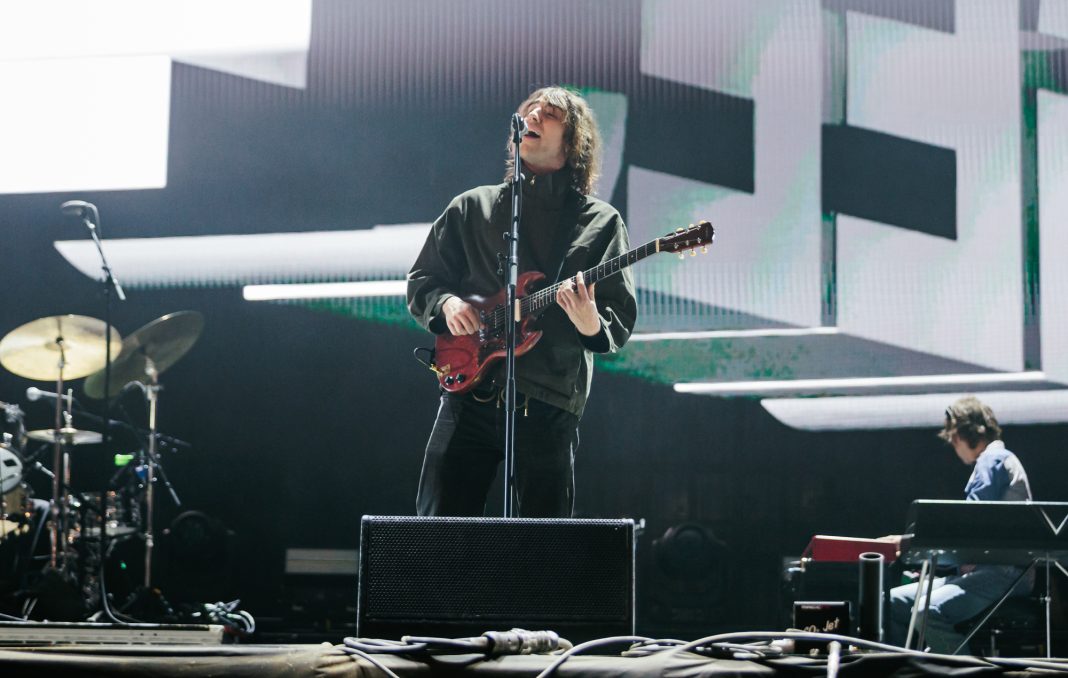
‘Au Pays du Cocaine’ offers one of the few chances to catch your breath. Beneath the grotesque imagery, strangled vocals and deliberate ugliness, Geese can be unexpectedly beautiful. A huge part of that comes from Winter’s voice, which is almost impossible to mistake for anybody else’s. He can sound cracked, theatrical, soulful and completely unhinged within the same verse, stretching words into strange shapes before suddenly landing on something genuinely affecting. It is a voice that should probably be too odd for songs this big, yet it has become one of the band’s greatest strengths. The attraction is that he never seems interested in using it conventionally for very long.
Then there is ‘Taxes’. It has become one of the songs most responsible for Geese’s extraordinary rise, and inside the Gallery Tent it sounds considerably bigger than the circumstances in which it was made. The song eventually slips into a loose, Stone Roses-style breakdown, all baggy rhythm and elastic guitar, the band relaxing into the groove without losing any of the tension that makes Geese so unpredictable. Around the tent, people who presumably had no idea who Geese were eighteen months ago are now moving with it, while rain continues hammering against the roof.
The crowd is almost as interesting as the band. This does not feel like a gathering of curious festival-goers arriving early to investigate the group everybody online keeps talking about. They are already converted. Teenagers are on shoulders, pits repeatedly open in the mud and songs from one of the oddest guitar records to break through in years are treated as though they have been festival standards for a decade.
That is where The Strokes comparison begins to make more sense. Geese don't particularly sound like them, and trying to force the comparison would miss the point. It is about the relationship between an eccentric New York guitar band and a British audience that has decided to adopt them. Twenty-five years ago, The Strokes crossed the Atlantic, and suddenly British kids were wearing Converse, buying leather jackets and starting bands. Geese arrive in a completely different musical landscape. Still, a similar feeling of discovery surrounds them: the sense that young listeners have found something sufficiently strange, exciting, and different that they want their own music to become stranger as a result.
You suspect people are standing somewhere inside the Gallery Tent already wondering whether their own band needs to get considerably weirder.
Even the weather suits Geese. Sunshine would have been too straightforward. Water pouring through the roof, trainers disappearing into mud, and Cameron Winter prowling around dressed like a priest who has lost control of his congregation feels much more appropriate.
By the end, the Gallery Tent is wet, filthy and completely theirs. I'll stake this claim now: the next time Geese are at Reading & Leeds, they'll be headlining. Their counterparts from this side of the Atlantic did just that this year.