No One Lasts Forever: Charli XCX: Reading 2026
‘Brat’ turned Charli XCX into a phenomenon. After years spent chasing her own version of pop perfection, it was the record that seemed least interested in behaving like conventional pop that finally made her a megastar.
It returned to the London rave world she had known as a teenager without trying to recreate those nights as nostalgia. The production was abrasive, clipped and physical.
Synths rubbed against one another, bass distorted, and several songs sounded designed for the point in the night when everybody has stopped pretending they are leaving early. Charli described it as her most aggressive and confrontational record, but beneath all that noise the writing was unusually exposed. Partying, womanhood, envy, friendship, ageing, insecurity and self-destruction existed beside one another without being cleaned into a more flattering portrait.
Once the ‘Brat’ era had run its course, she resisted the obvious temptation to make it again.
Her first major move afterwards was an album of original songs for Emerald Fennell’s adaptation of ‘Wuthering Heights’, leaving fluorescent club music behind for something darker and more cinematic. ‘House’, featuring John Cale, brought one of The Velvet Underground’s defining voices into Charli’s world, while ‘Chains of Love’, ‘Wall of Sound’ and the Sky Ferreira collaboration ‘Eyes of the World’ surrounded the film’s obsession and violence with music that could feel gothic without pretending it had been recorded in the nineteenth century. The soundtrack reached number one in Britain in February, giving Charli another chart-topping record without requiring her to make anything resembling ‘Brat’.
Then came ‘Music, Fashion, Film’ in July. Distorted guitars and harder drums moved towards the front, although A. G. Cook, Finn Keane and the electronic instincts of the previous decade remained underneath it all. ‘Rock Music’ made the change obvious, but Charli was never likely to start treating guitars as proof that she had discovered something more authentic. ‘SS26’, ‘Camera’, ‘Wink Wink’, ‘Card Declined’ and ‘No One Lasts Forever’ simply belonged to another version of her. The album went straight to number one in Britain, making 2026 another year in which following Charli meant accepting that the previous record was unlikely to provide instructions for the next one.
That left her first Reading headline set in an unusual position.
Charli had visited the festival as a teenager and understood what the occasion meant, but she arrived at the top of the bill while deliberately dismantling the era that had finally pushed her there. Ignore ‘Brat’ and thousands of people miss the songs they came to hear. Spend ninety minutes recreating it, and the reset suddenly does not look much like a reset at all.
Her answer is to give Reading a bit of everything.
The distinction is visible as much as audible. For the new material, including the glitching ‘Rock Music’ and faux-coy ‘Wink Wink’, live guitarists appear behind her. When the clipped electronics of ‘Brat’ return, they disappear again. Charli moves between the two worlds without pretending they are the same thing.
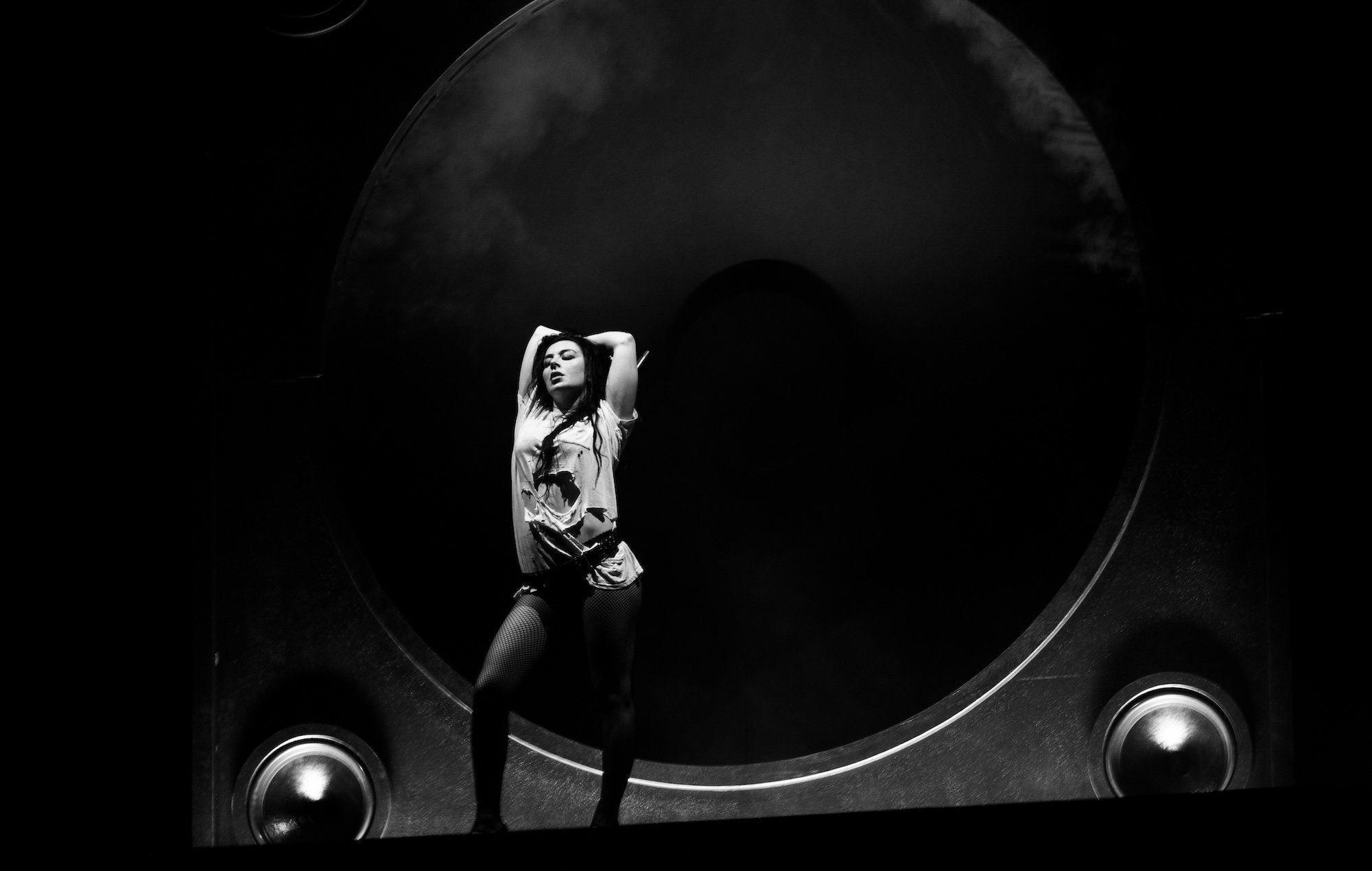
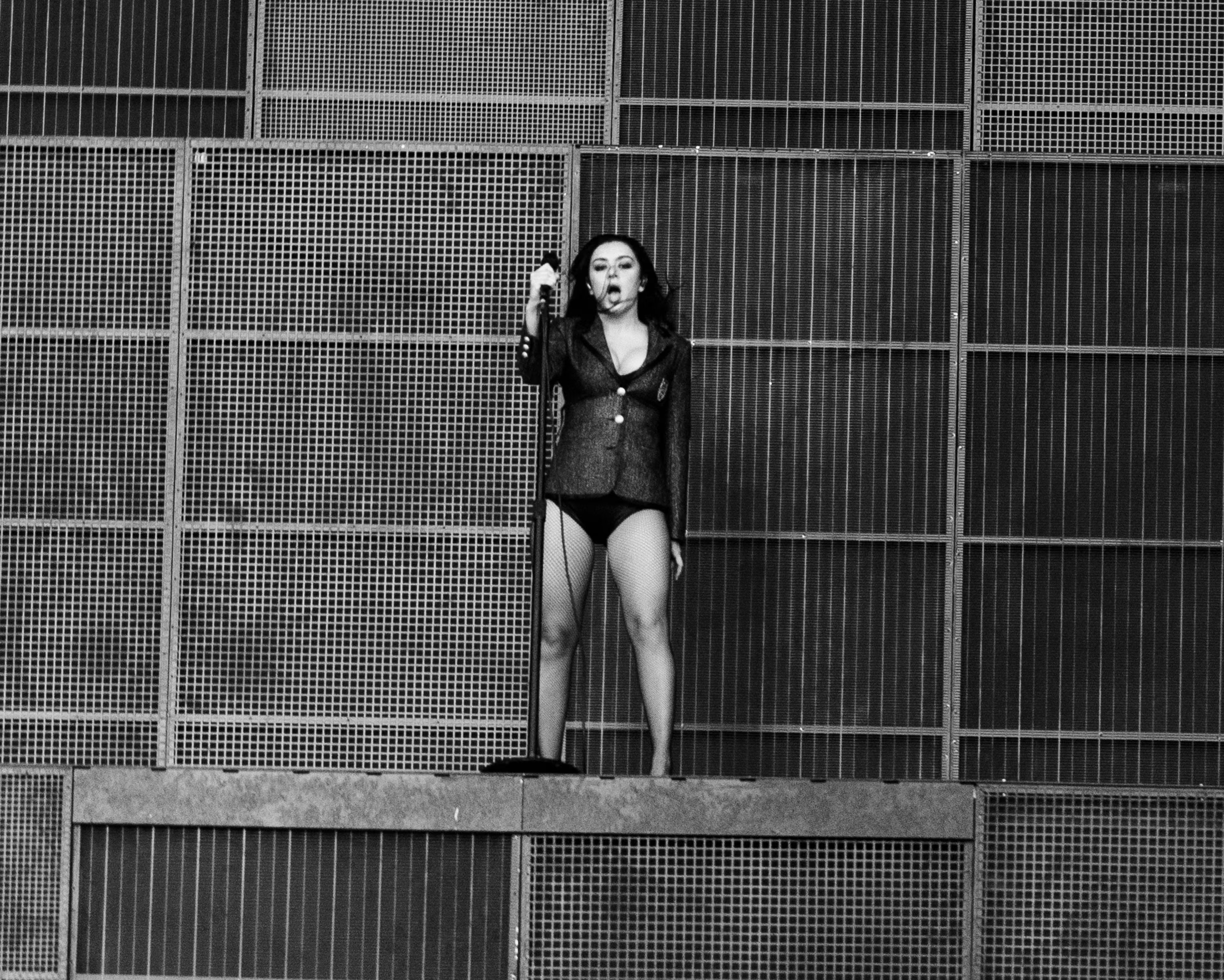
Visually, the show belongs firmly to ‘Music, Fashion, Film’. Her outfits play with late-2000s trashy glamour: glittering blazers, fishnets, ripped T-shirts and low-slung belts. The screens remain monochrome, extending the black-and-white imagery of the record across the stage, while dancers stalk the platforms like models during ‘Card Declined’. At times it looks less like a conventional headline show than a fashion show that has begun to malfunction.
Charli herself says very little. She does not need to spend the evening explaining the transition because the set is already doing it for her.
The ‘Brat’ songs remain enormous.
‘Club Classics’ and ‘365’ immediately drag the field back into the sweaty club world that made the album such a phenomenon, while ‘360’ still carries that odd mixture of self-mythology and complete self-awareness that Charli has always been good at. None of them feels diminished because she has already moved on stylistically. If anything, hearing them alongside the new material makes their impact even clearer.
‘Sympathy Is a Knife’ sounds massive. Beneath all the sharp edges and insecurity, it has grown into one of Charli’s great festival songs, the chorus landing with the force of something that already belongs on stages this size.
‘Von Dutch’ brings one of the night’s funniest callbacks. Charli once again goes for the BBC camera and knocks it aside, recreating the moment from her Glastonbury headline performance in 2025. It is a small piece of continuity between two enormous festival appearances and exactly the sort of self-referential joke Charli can get away with because so much of the audience already understands the mythology surrounding her.
Then comes ‘Guess’.
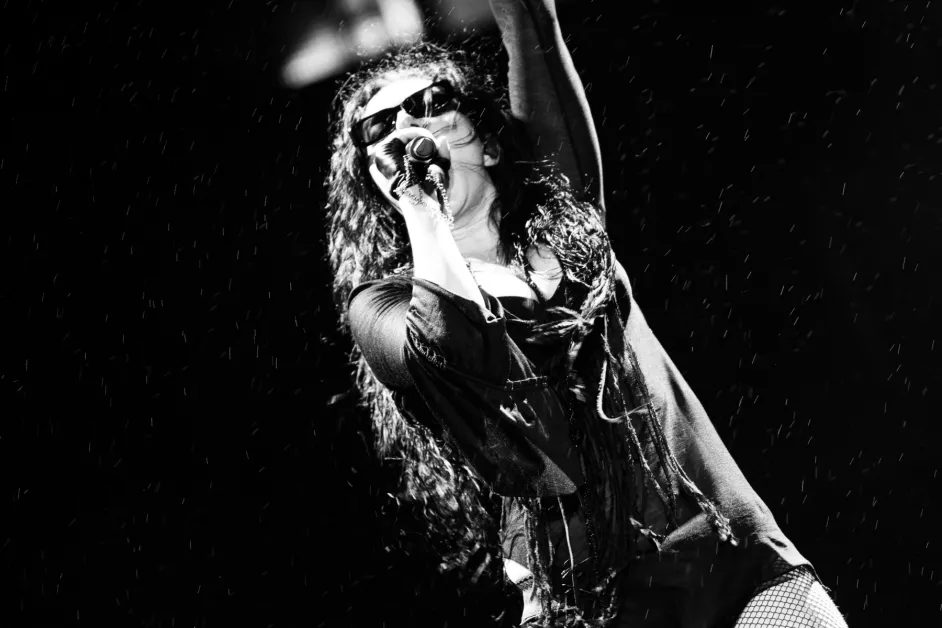
The reaction is probably the biggest of the night. The opening alone sends the field into an uproar before the song descends into the kind of glorious stupidity that made ‘Brat’ such fun in the first place, with underwear eventually firing into the air above the crowd. For all the discussion about Charli moving beyond that record, Reading reacts to its biggest songs as though they have already become festival standards.
Even ‘Apple’ has reached that strange stage. “Here’s a classic for you, Reading,” Charli drawls before starting it. The song is barely two years old, which should make the introduction ridiculous. Judging by the response, she is not wrong.
There is also room for ‘Track 10’, reaching back to 2017’s ‘Pop 2’. It has become one of Charli’s great fan favourites, the kind of deep cut that gets a reaction far beyond what its place in the catalogue might suggest. You can hear that immediately at Reading: the opening is recognised almost at once, voices rise around the field and, for a few minutes, the set belongs to the people who were there long before ‘Brat’ turned Charli into a phenomenon.
‘House’ begins with John Cale’s recorded voice booming through the PA while the screens fall black. Charli eventually reappears crawling across one of the platforms as lights flash around her, before sparks fall from above and flames burst behind the stage. It is theatrical without feeling like a conventional exercise in making everything bigger. Rather than simply increasing the spectacle, she makes it stranger.
‘Dying For You’ follows, bringing the ‘Wuthering Heights’ material closer to pop before the set suddenly accelerates back through ‘Brat’. Charli is effectively racing through several versions of herself in front of an audience that arrived through several different doors.
One of the best moments comes with ‘If You Take Away The Music Then What Has She Got?’, a song good enough that it probably should have made ‘Music, Fashion, Film’ rather than being left as a B-side. Live, it feels more sincere than almost anything around it.
Charli delivers the title as though she is asking the audience the question directly. Strip away the records, fashion, mythology, parties, celebrity and everything that has accumulated around Charli XCX over the past decade, and what exactly is left?
Musically, it is one of the most unexpected things she has done. There is something almost ’90s Britpop about the guitars, their wiry attack recalling Elastica, but they sit over a dance beat rather than replacing the electronic world Charli has spent years building. It doesn't sound like she suddenly decided to become a rock artist. It sounds more interesting than that: guitar music dragged into Charli’s world and made to obey her rules.
She punches the air and throws herself around the stage, but there is little of the knowing detachment that surrounds some of the bigger pop moments. The song feels heartfelt, almost vulnerable, as though the question in the title has stopped being conceptual and become something she genuinely wants answered.
‘Camera’ keeps her in that uneasy headspace. After the swagger and spectacle elsewhere, doubt begins bubbling back towards the surface.
Then comes ‘No One Lasts Forever’.
Throughout the set, fragments of David Cronenberg’s voice have appeared between songs, talking about art, death, freedom and oblivion. Here those fragments finally come together. His words are chopped and repeated until “They are dead. They are gone. No one lasts forever” hangs over the stage.
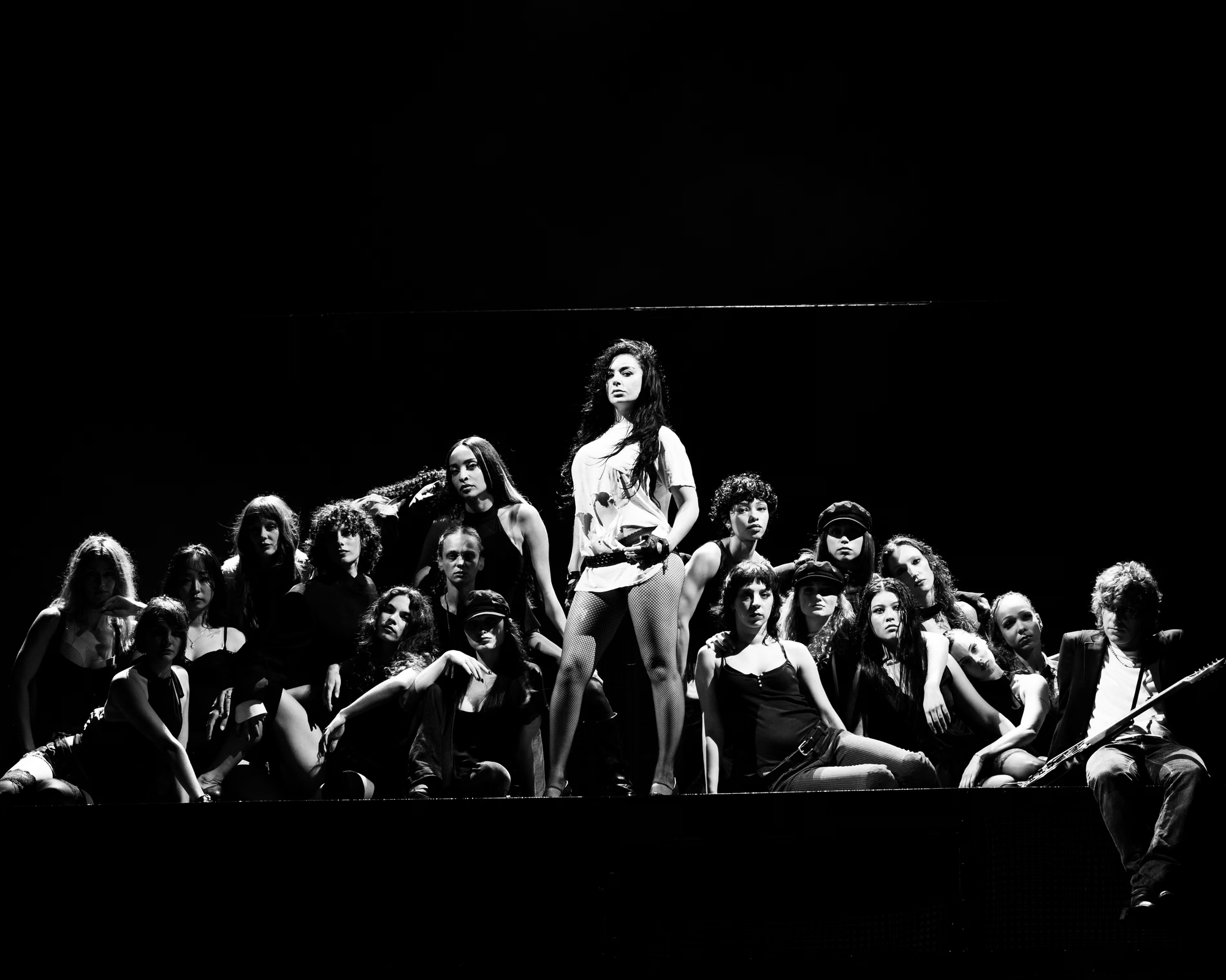
Charli and her dancers gather on one platform, Charli planted in the middle in a power stance, staring straight out at the crowd while everything around her seems to stop.
It is an unexpectedly severe ending for a performer whose biggest era became synonymous with fluorescent green, club nights and the idea of being a “365 party girl”. Earlier, ‘Club Classics’, ‘365’, ‘360’, ‘Sympathy Is a Knife’, ‘Von Dutch’ and ‘Guess’ had shown just how much life remains in ‘Brat’. ‘Guess’ may have produced the loudest reaction of the entire night.
Yet Charli refuses to finish there.
Instead, her first Reading headline performance ends on impermanence.
‘Brat’ got her to this stage, but she clearly has no intention of allowing it to define what she does once she is standing on it. That record made her bigger than ever, but Reading feels less like the end of its victory lap than the point where she begins proving she can survive without it.
For years Charli XCX seemed to be chasing the moment when the wider pop world would finally catch up with her.
Then it did.
At Reading, the most interesting thing is watching her move on first.