You Say You Want a Revolution- The 60s
I'm not naive; I know music existed long before the 1960s. However, I see this decade as a natural starting point. Culturally and musically, the 60s were pivotal. The war was over, young people had more freedom, and the world seemed to burst into technicolour. It was a time when art, culture, and society began to intertwine in ways that reshaped the modern world. Music, in particular, became a dominant force in expressing the aspirations, frustrations, and dreams of a generation. Alongside the music, shifts in fashion, new attitudes toward sexuality, and experimentation with drugs like cannabis and LSD began to define the era, further fuelling the sense of liberation and boundary-pushing creativity.
In the 1950s, rationing was still widespread, and many people were still grappling with the physical and emotional scars of World War II. By the 60s, however, a sense of optimism had emerged. Conscription had ended, attitudes were shifting, and the mood was one of looking forward. This newfound optimism fuelled creativity, leading to an explosion of artistic expression in music, fashion, and art.
The previous generations had endured great hardships, but they seemed determined to create a brighter future for the youth of the time. Fashion began to undergo dramatic changes, with young people leading the charge and rejecting traditional norms.
Women, for instance, began to adopt more liberated styles, with the iconic miniskirt, bold geometric prints, and go-go boots making headlines. Men experimented with colourful shirts, slim-fit suits, and longer hair. Influential designers like Mary Quant and boutiques such as Biba set the trends, while Swinging London became the epicentre of this cultural shift.
Alongside fashion, recreational drug use became more visible, contributing to a sense of experimentation and freedom. Psychedelic patterns and vibrant colours reflected the influence of mind-altering substances on both style and music.
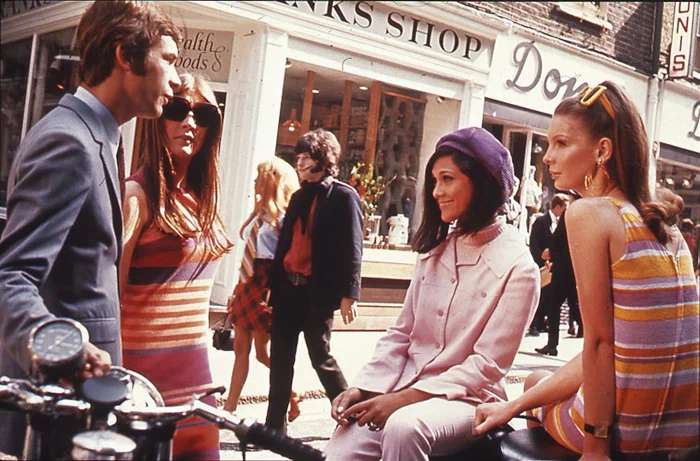
The 60s were not just about rebellion but also about innovation. Music reflected this sense of possibility, breaking free from the confines of the past. Rock and roll morphed into something deeper and more experimental, folk music became a voice for social change, and genres like soul and Motown gave rise to anthems of empowerment and joy. The decade wasn’t merely a starting point for modern music; it was the birth of the contemporary world.
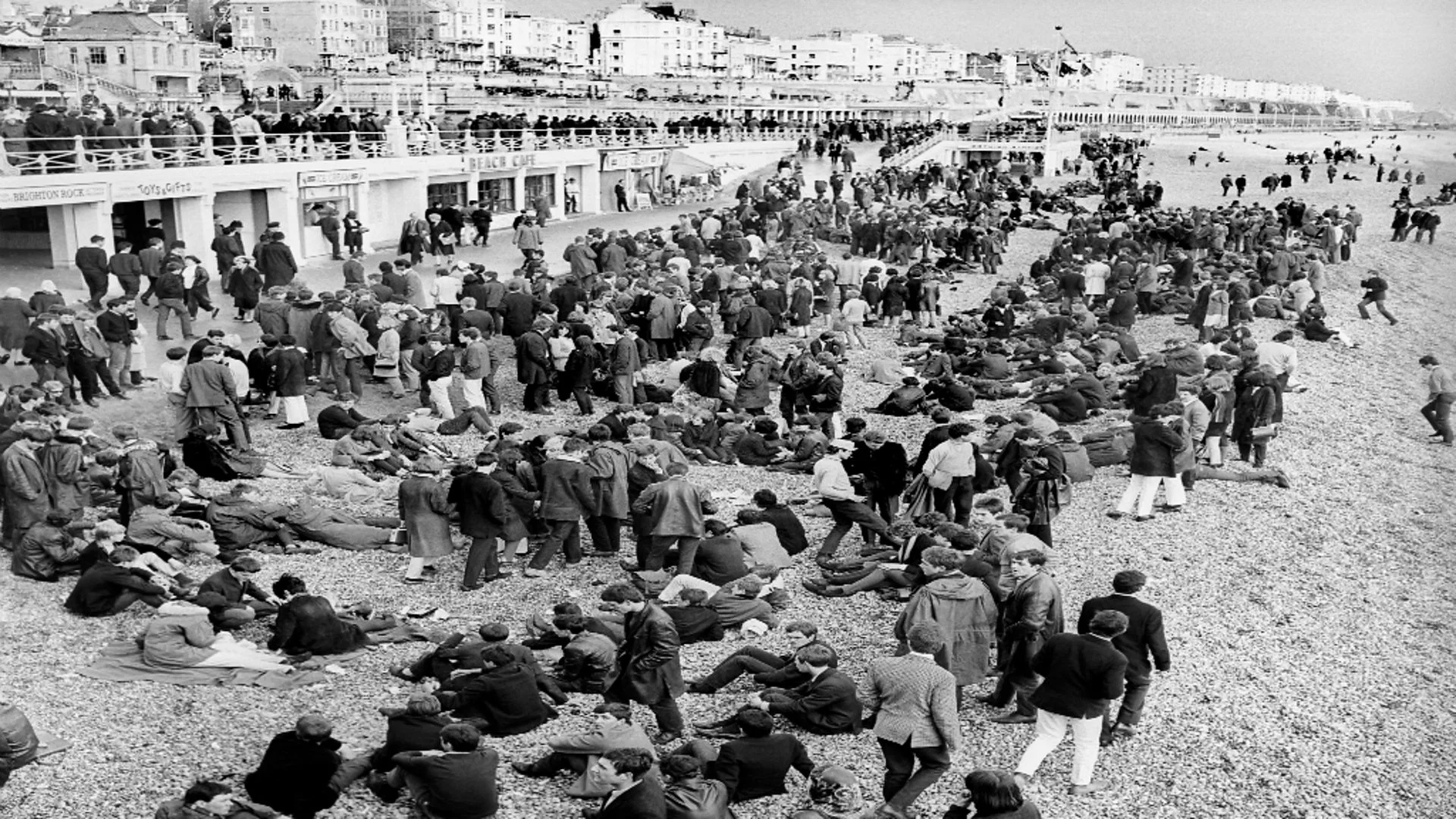
Subcultures began to emerge in the 1960s, shaping youth identity and cultural expression in profound ways. Among the most iconic were the Mods and Rockers, who formed distinct groups defined by their fashion, vehicles, and especially their music. Mods gravitated towards sharp suits, sleek scooters, and the sounds of soul, jazz, rhythm and blues, and British beat bands such as The Who, The Small Faces, and The Kinks. In contrast, Rockers embraced leather jackets, powerful motorcycles, and the raw energy of rock 'n' roll pioneers like Elvis Presley and Gene Vincent. The visual contrast between the neatly dressed Mods and the rebellious Rockers became a symbol of broader social changes sweeping through post-war Britain.
These subcultures often clashed, most famously in seaside towns like Brighton and Margate, where their rivalries culminated in widely publicised skirmishes that captured the nation’s attention. Media coverage of these confrontations sometimes exaggerated the violence, fueling a sense of moral panic and making the Mods and Rockers household names. Despite their differences, both groups left an indelible mark on British culture. Their influence is evident not only in fashion and music but also in shifting attitudes towards authority, individualism, and rebellion. The legacy of the Mods and Rockers paved the way for future youth movements such as punk, skinheads, goths, and New Romantics, each building on and reacting to the subcultural foundations laid in the 1960s.
The 1960s marked a turning point in music, birthing some of the most influential artists of all time on both sides of the Atlantic. In the UK, legends like The Beatles, The Rolling Stones, The Who, Cream, Led Zeppelin, and Black Sabbath emerged. Meanwhile, America gave us icons such as Simon & Garfunkel, Jimi Hendrix, The Mamas & The Papas, Jefferson Airplane, Bob Dylan, and The Beach Boys. To name a few. Music became a cultural phenomenon. It was no longer just something played on jukeboxes; concerts grew in scale, record sales soared, and musicians were elevated to an almost godlike status.
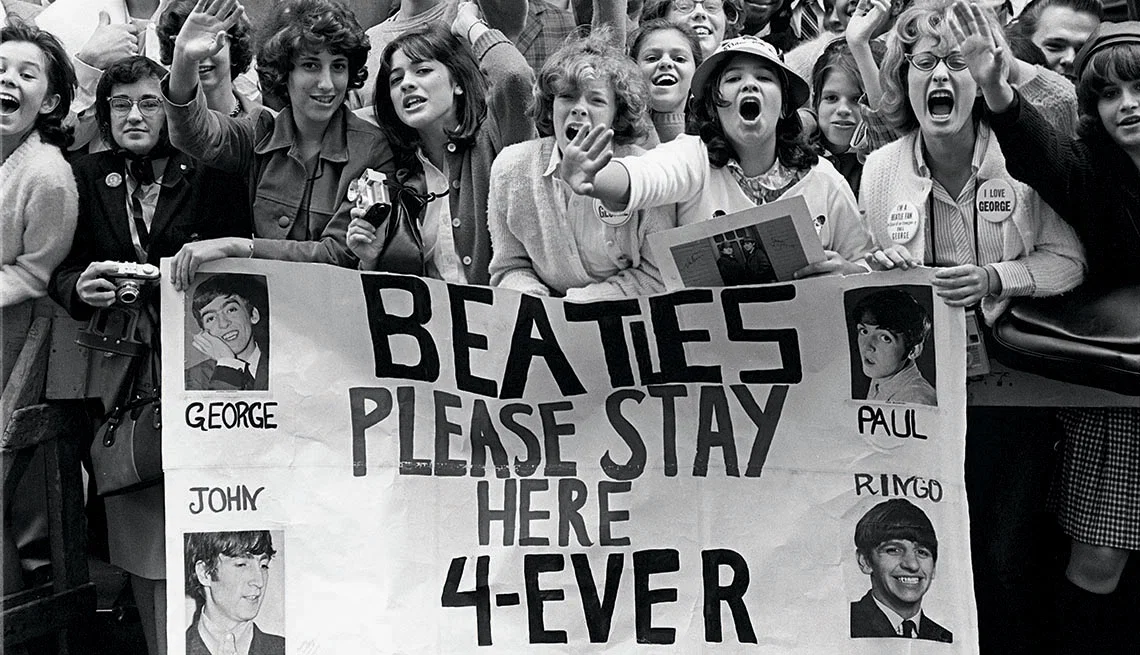
Beatlemania was a defining feature of the 1960s: four lads from Liverpool. John Lennon, Paul McCartney, George Harrison, and Ringo Starr took the world by storm. Their fanbase adored and worshipped them, sparking a global movement that transcended music to become a cultural phenomenon. When they appeared on 'The Ed Sullivan Show' in 1964, an astonishing 73 million people tuned in. A record-breaking moment that not only cemented their status as cultural icons but also underscored the power of television in uniting audiences around the world. This event heralded the British Invasion in America, where British bands dominated the charts, and it marked the birth of modern celebrity culture, creating a blueprint for global stardom.
The Beatles’ songs from this era are a testament to their unparalleled ability to craft timeless music. Early hits like 'Love Me Do' and 'Please Please Me' captured their youthful exuberance and charm, setting the stage for a pop revolution. With 'She Loves You' and 'I Want to Hold Your Hand', they perfected the art of infectious melodies, delivering anthems that resonated with a generation hungry for optimism and joy in the wake of post-war austerity. Their knack for innovative songcraft became evident as their songwriting matured, with tracks like 'A Hard Day's Night' showcasing sophisticated chord progressions and groundbreaking use of jangly guitar riffs.
As the decade progressed, songs like 'Ticket to Ride' and 'Help!' began to reflect a deeper emotional complexity, signalling their transition from cheerful love songs to more introspective themes. The Beatles weren’t just writing catchy pop; they were pushing the boundaries of what popular music could be.
Their ability to combine innovation with accessibility ensured their dominance, not only on the charts but in shaping the very fabric of 1960s culture. Beatlemania wasn’t just about screaming fans; it was about the rise of a band that changed everything, leaving an indelible mark on music, fashion, and the global zeitgeist.
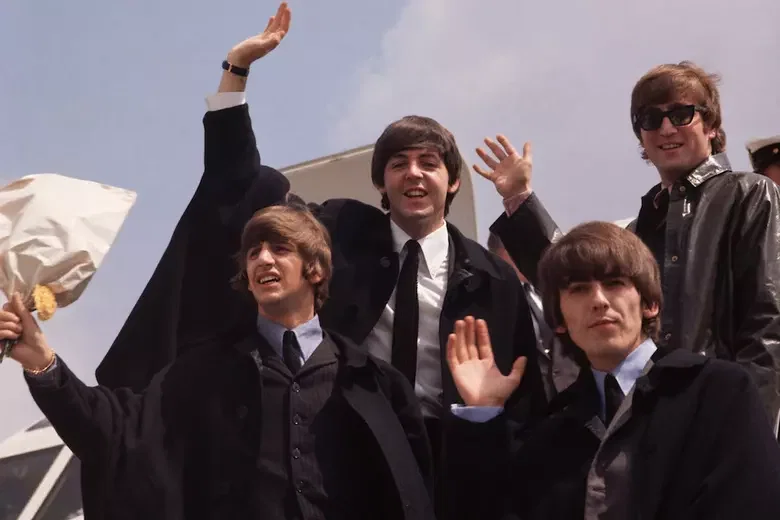
By the mid-60s, their creativity truly flourished. Songs like 'Yesterday' with its hauntingly simple arrangement, and 'Norwegian Wood', which introduced Western audiences to the sitar, hinted at their growing experimentation. 'Help!' and 'We Can Work It Out' combined introspective lyrics with irresistible hooks. At the same time, 'Drive My Car' and 'Nowhere Man' reflected a shift toward more narrative-driven and socially conscious themes.
With these songs, the band would tour the world. The hysteria surrounding the band was unprecedented; fans camped outside hotels, mobbed airports, and screamed so loudly at concerts that the band struggled to hear themselves on stage.
However, the Beatles were more than just screaming fans and mass hysteria. By 1965, exhausted by the chaos of touring and unable to hear themselves play over the deafening crowds, they made the bold decision to abandon live performances. This shift allowed them to channel their creativity into the studio, where they revolutionised music production. They blended rock with elements of classical, Indian, and experimental music. Albums like 'Revolver' and 'Sgt. Pepper's Lonely Hearts Club Band' hold a unique place in the evolution of modern music.
'Revolver' is often celebrated for its bold sonic experimentation, signalling a significant turning point in The Beatles' creative evolution. Tracks like 'Tomorrow Never Knows' showcased pioneering tape-loop techniques, reversed audio, and Eastern influences, drawing from Timothy Leary's psychedelic ideas and the rhythmic drones of Indian classical music. The song's hypnotic drum pattern, manipulated vocals fed through a Leslie speaker, and kaleidoscopic sound collage marked a radical departure from traditional pop structures.
Elsewhere on the album, songs like 'I'm Only Sleeping' employed reversed guitar solos to create a dreamy, surreal atmosphere, and 'Yellow Submarine' featured innovative use of sound effects and vocal manipulation. 'Eleanor Rigby' featured string octets instead of guitars, while 'I'm Only Sleeping' employed reversed guitar solos to create a dreamy, surreal atmosphere.
Working closely with producer George Martin and innovative engineer Geoff Emerick, The Beatles embraced the studio as an instrument in itself. They often recorded elements piecemeal, layered overdubs, and experimented with mic placement and tape manipulation. Their meticulous approach to sound design, treating each track as a distinct sonic world, is a testament to their musical depth. 'Revolver' wasn't just an album of songs; it was a bold exploration of what recorded music could be.
Its blend of avant-garde techniques with sharp songwriting redefined the possibilities of studio recording. It signalled the arrival of the modern, studio-based artist. The album laid the groundwork for the increasingly experimental direction the band would take and left a lasting imprint on the evolution of rock, pop, and electronic music.
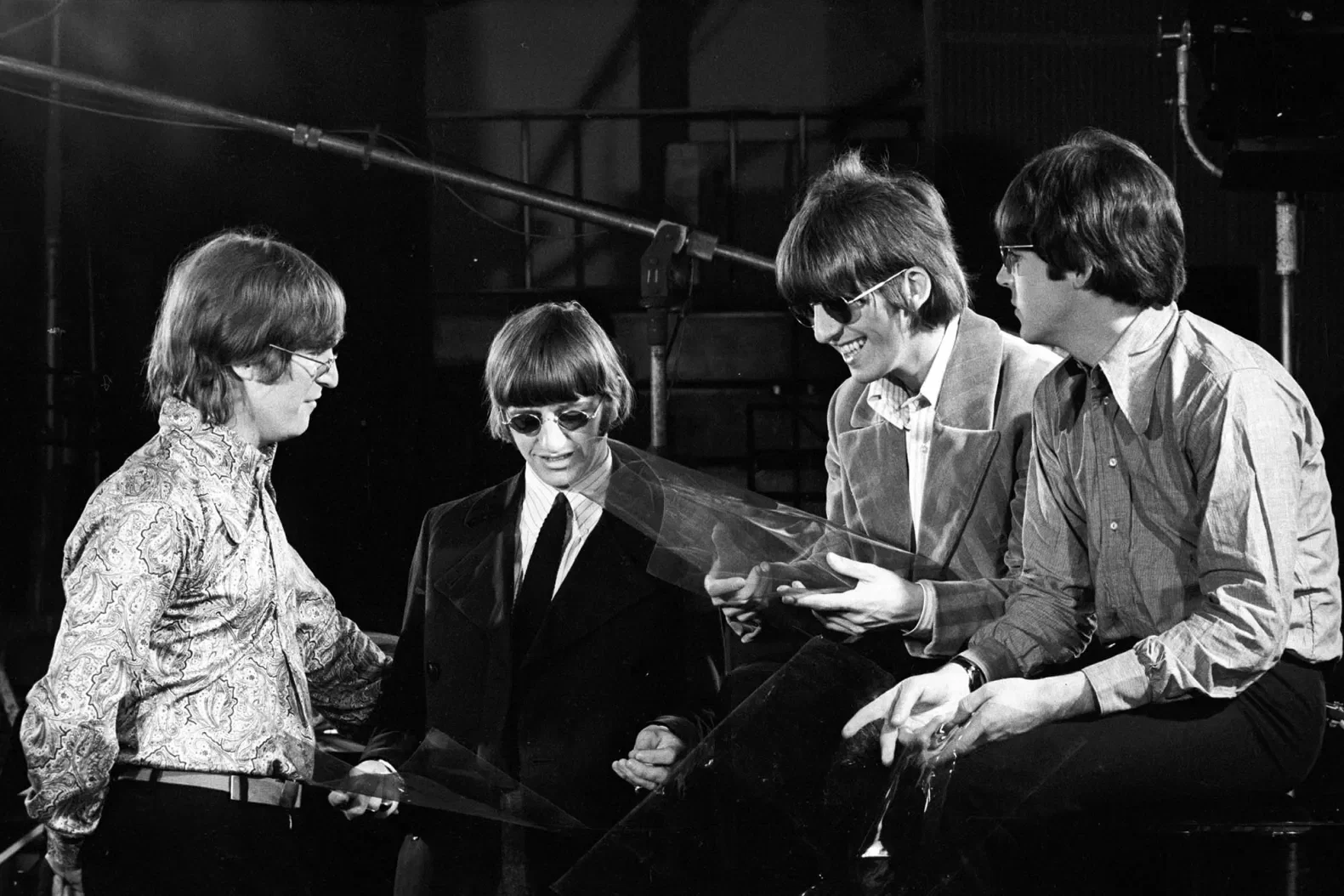
'Sgt. Peppers' took that experimentation to a grander, more theatrical level. Embracing the freedom that came with leaving the stage behind, The Beatles immersed themselves in a months-long studio journey, using multitrack recording, orchestral overdubs, and imaginative effects to build a self-contained world. Songs like 'Lucy in the Sky with Diamonds' and 'A Day in the Life' pushed the boundaries of songwriting and production, blending surreal lyricism with pioneering studio wizardry.
They used techniques such as automatic double tracking, tape speed manipulation, and layering of non-traditional instruments from harpsichords to sitars to entire orchestras, all of which contributed to the album’s kaleidoscopic sound. The Beatles, along with producer George Martin, treated the studio as a playground for sonic exploration, meticulously sculpting textures and transitions to create something that transcended the conventional pop album. The conceptual unity of 'Sgt. Peppers' presenting the band as a fictional ensemble and framing the record as a staged performance introduced the idea of the studio LP as a fully immersive artistic statement.
It was a landmark moment not just in music but in popular culture, signalling the arrival of the album as a more serious art form and opening the door for generations of musicians to think of recording as a form of narrative and expression, not just documentation.
Following this, 'The Beatles' widely known as 'The White Album' marked a departure from the psychedelic polish of earlier works and showcased the band’s voices more starkly than ever before. Recorded during a period of growing personal tension, the sessions produced a sprawling, genre-defying double album that ranged from the acoustic fragility of 'Blackbird' to the raw energy of 'Helter Skelter'. The sheer diversity of styles reflected both their creative restlessness and their deepening divide as collaborators, yet the result was an album of astonishing range and influence.
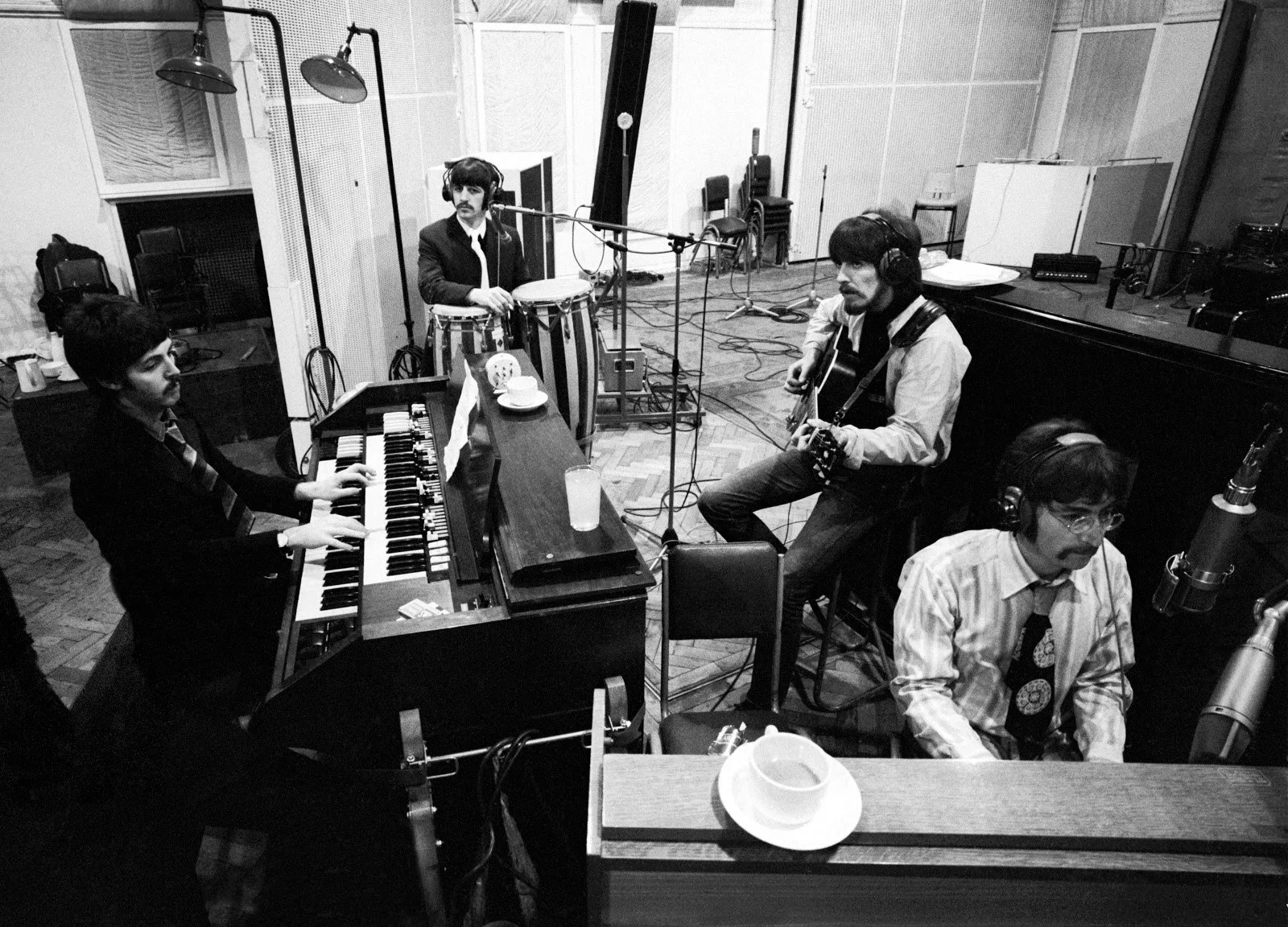
'Abbey Road', recorded shortly after, was a return to cohesion and studio sophistication. The band, aware that their time together might be coming to an end, approached the album with a sense of purpose and craft. George Harrison emerged as a major songwriting force with 'Here Comes the Sun' and 'Something', while the album’s second side featured an ambitious medley of song fragments that flowed seamlessly into one another, culminating in 'The End', a symbolic farewell from a band at the height of its powers.
Finally, 'Let It Be', shaped by the fraught and famous Get Back sessions, was an attempt to return to basics, to capture the band playing live with minimal studio trickery. However, the process revealed deep fractures in their relationships. Though the sessions were marked by creative tension, they still produced enduring songs like 'Let It Be', 'Across the Universe', and 'Get Back'. The accompanying film, and later Peter Jackson’s 'The Beatles: Get Back' documentary, revealed both the struggles and camaraderie of those final days. Despite the friction, the music remained transcendent, offering a glimpse of what still connected them beneath the surface.
The impact of The Beatles cannot be understated. They did change the world. From reshaping pop music to inspiring social and cultural movements, their influence extends far beyond the music industry. They left behind some of the best songs ever written, with timeless tracks that continue to resonate across generations. Whether through the introspective beauty of 'Eleanor Rigby', the groundbreaking sounds of 'Strawberry Fields Forever', or the universal appeal of 'Hey Jude', they left behind some of the best songs ever written.
The Beatles created a legacy in music that remains unmatched in its scope and significance. Their output and legacy are unrivalled even today.
The 1960s were not just about The Beatles; countless other bands and artists played pivotal roles in shaping the music and culture of the decade. The Rolling Stones stood as one of the era's defining forces, embodying the raw energy and rebellious spirit of the time. Alongside them, bands like The Kinks, The Who, and The Yardbirds further expanded the British music scene, while American acts such as The Doors, Jefferson Airplane, and Jimi Hendrix brought psychedelic sounds and electrifying performances to the forefront.
Like The Beatles, The Rolling Stones were innovators, creating music that not only defined the decade but transcended it. Songs such as 'You Can’t Always Get What You Want', 'Gimme Shelter', and 'Street Fighting Man' are timeless contributions that remain as impactful today as they were during the height of the 60s
The era’s cultural landscape was also shaped by shifting fashions—think paisley shirts, velvet jackets, and bell-bottom trousers, and the increased visibility of recreational drug use, especially cannabis and LSD, which influenced both the music and the lifestyle of many artists and fans.
The band’s sound and identity were forged by a distinct, formidable lineup of individual personalities. Mick Jagger was the ultimate, hyper-kinetic frontman, blending camp theatricality with raw, predatory sexuality. Keith Richards acted as the band's musical anchor, weaving open-tuned, syncopated guitar riffs with a dangerous, outlaw mystique. Brian Jones, the band's brilliant but tragic multi-instrumentalist, injected unique textures into their sound, playing everything from sitars to marimbas. Holding the groove together was the jazz-inflected, effortlessly cool drumming of Charlie Watts and the steady, unflappable basslines of Bill Wyman
Live in the 1960s, they were a menacing contrast to the clean-cut Beatles. Their shows were chaotic, loud, and thick with a palpable threat of violence. Jagger snarled at the audience, Richards prowled the stage like a switchblade, and audiences routinely rioted, tearing up theatre seats as the band delivered a raw, hyper-charged R&B assault that felt genuinely dangerous to the establishment.
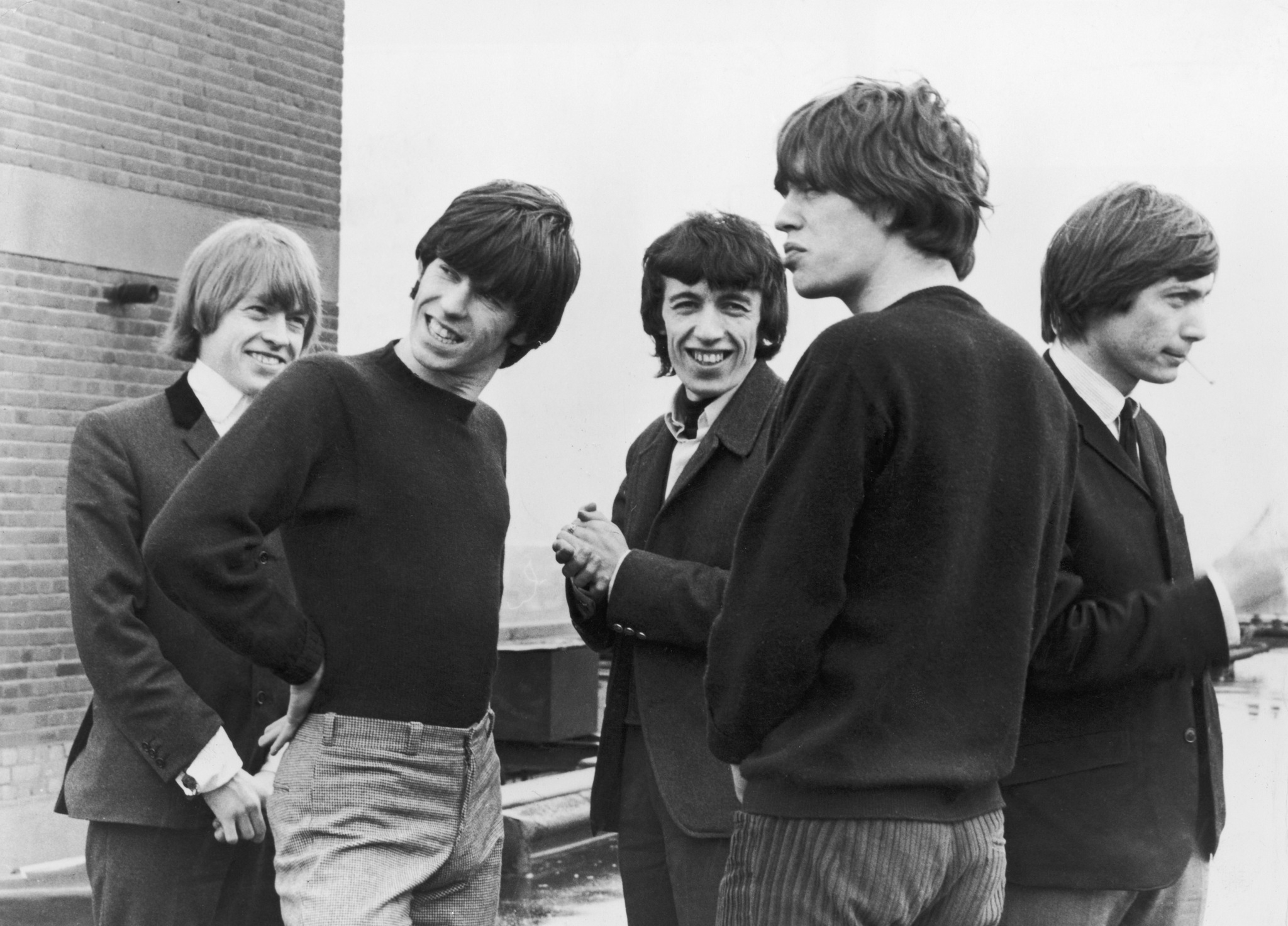
The band’s studio output continually evolved throughout the decade, transitioning across a dense catalogue of 1960s albums. From their self-titled debut, 'The Rolling Stones' (1964), and its quick follow-up, 'The Rolling Stones No. 2' (1965), they drew heavily on American blues legends like Muddy Waters and Howlin' Wolf. They captured the raw energy of their live sets by recording quickly in single takes, heavily relying on Brian Jones to arrange the authentic Chicago blues harmonica and slide guitar parts
They rapidly transformed into cultural provocateurs and pop icons as Jagger and Richards took over the songwriting, releasing 'Out of Our Heads' (1965), which featured the career-defining fuzz-riff of '(I Can't Get No) Satisfaction'. This shift toward original material allowed them to move away from American covers and establish an independent British identity, positioning them as the direct rivals to the more melodic pop style of the Beatles.
They pushed into entirely original territory with 'Aftermath' (1966), their first album composed entirely of original material, showcasing Jones’s exotic instrumentation on tracks like 'Paint It Black'. Brian Jones transformed their musical palate by introducing the sitar, dulcimer, and marimba, which added a haunting, multi-layered texture to the darker themes in the Jagger and Richards lyrics.
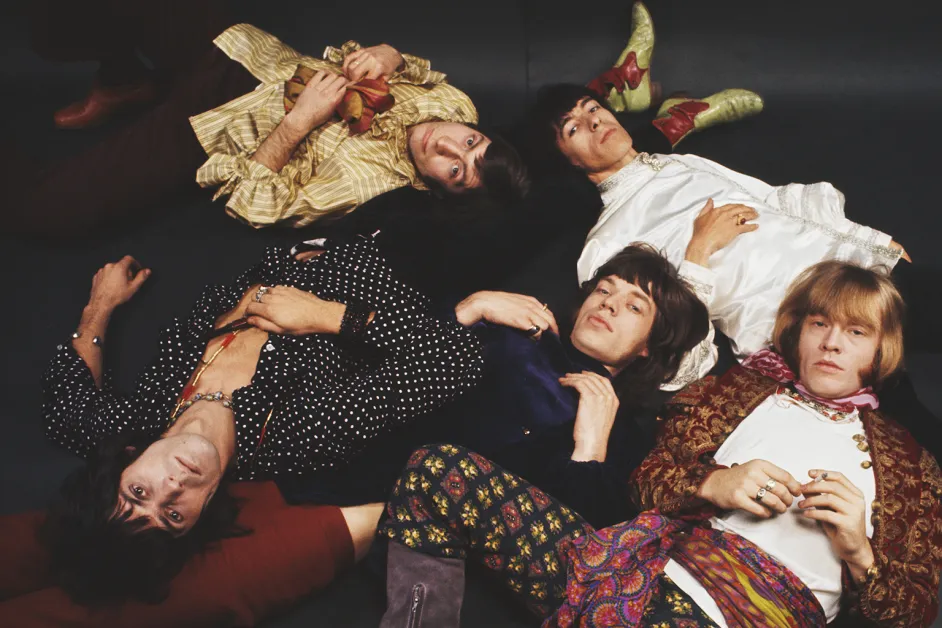
They leaned further into pop-art experimentation and music hall styles with 'Between the Buttons' (1967) before fully immersing themselves in the era's countercultural psychedelia with the chaotic, lysergic tapestry of 'Their Satanic Majesties Request' (1967). This psychedelic period was a direct, drug-fueled response to the Beatles' studio innovations, and it pushed the band into surrealistic soundscapes that tested the limits of their traditional rhythm and blues roots. Tracks like 'She's a Rainbow' highlighted this shift, blending a vibrant, classical piano riff by Nicky Hopkins with a swirling string arrangement and carnival-like sound effects. In stark contrast, the dark, outer-space atmosphere of '2000 Light Years from Home' relied heavily on Brian Jones's eerie Mellotron chords and Bill Wyman's pulsing bassline, proving the band could craft both whimsical pop-psych and deeply ominous, space-rock soundscapes
Realising that their true strength lay in the dirt, they stripped away the psychedelic studio trickery to enter a legendary creative streak. Albums like 'Beggars Banquet' (1968), which opened with the samba-driven, provocative 'Sympathy for the Devil', and 'Let It Bleed' (1969) showcased their absolute mastery of blending blues, country, rock, and folk influences into something entirely their own, a dark gospel for a bleeding decade. This rootsy redirection was heavily anchored by Keith Richards's discovery of his signature open-G guitar tuning, which stripped his playing down to its rawest and most visceral elements. On 'Beggars Banquet', tracks like 'No Expectations' brought acoustic slide guitar to the forefront, highlighting Brian Jones's final beautiful contribution to the band before his departure. The momentum carried directly into 'Let It Bleed', where they brought in powerhouse guest musicians, including singer Merry Clayton, whose piercing, desperate backing vocals on 'Gimme Shelter' perfectly captured the dread of the late 1960s. By fusing American delta blues with a gritty, dangerous urban realism, these records defined the dark peak of the counterculture era.
This historic decade culminated in July 1969 with their legendary free concert at London's Hyde Park. Originally planned to introduce their brilliant new guitarist, Mick Taylor, the massive open-air gig took place just two days after the tragic death of Brian Jones. Performing in front of an estimated half a million fans, Jagger famously read excerpts from Percy Bysshe Shelley's poem 'Adonaïs' and released thousands of white butterflies into the sky as a tribute to their fallen co-founder. The monumental gig serves as a cultural bookend to the 1960s, transforming from a mournful wake into a triumphant declaration of the band’s survival and their future as stadium-rock royalty
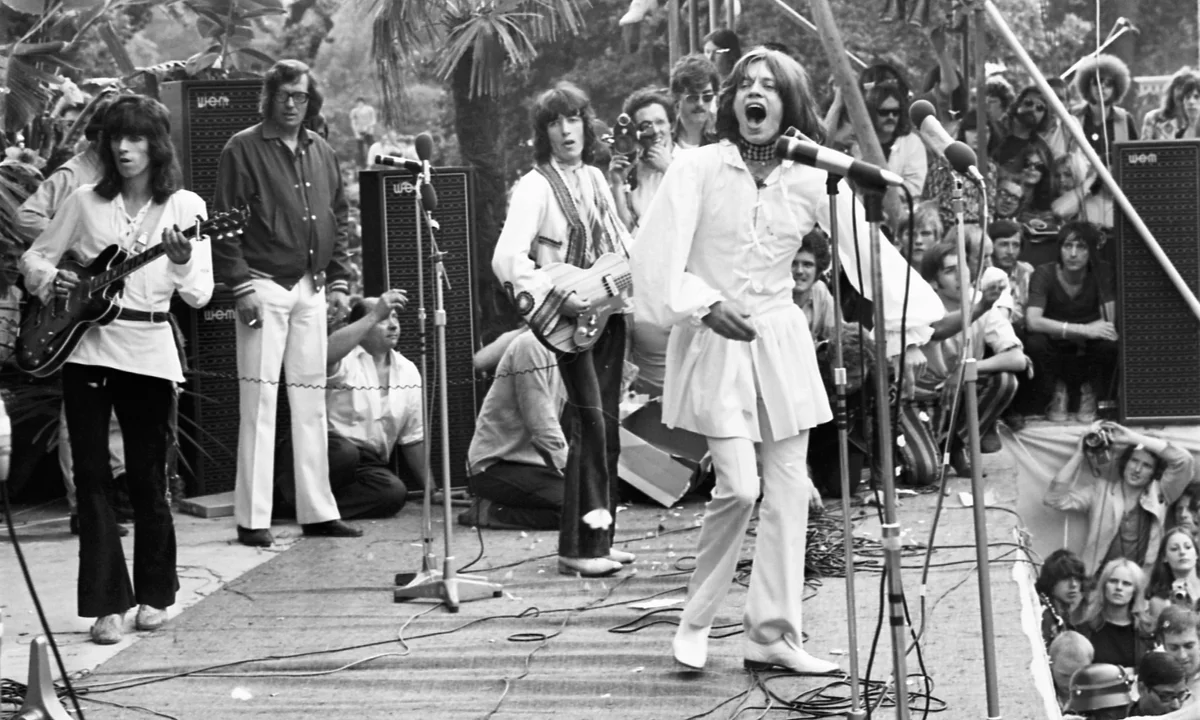
Their music often mirrored the era's social and political upheavals, addressing themes of disillusionment, rebellion, and protest. The 1960s saw massive demonstrations against the Vietnam War, civil rights marches, and growing demands for racial and gender equality. These events deeply influenced the lyrics and mood of the time, with ‘Street Fighting Man’ becoming an anthem for the countercultural movement, capturing the spirit of resistance and the desire for change. Meanwhile, ‘Gimme Shelter’ reflected the darkness and uncertainty of a turbulent world through its haunting melodies and an urgent, apocalyptic tone. The band’s music resonated with listeners who were grappling with the assassinations of major political figures, student protests, and a general sense of upheaval that defined the decade.
The songs were more than just chart hits; they were cultural milestones that resonated deeply with a generation seeking expression in a time of transformation. Against a backdrop of anti-war protests, the civil rights movement, second-wave feminism, and the beginnings of LGBTQ+ activism, music became a powerful vehicle for social commentary and collective identity. The influence of mass gatherings, like the Monterey Pop Festival and Woodstock, helped forge a sense of community and solidarity among young people pushing for change.
By the end of the decade, The Rolling Stones had firmly established themselves as one of the most significant and enduring bands in rock history. Their bold lyrics, edgy sound, and experimental approach to music pushed the boundaries of the genre, setting new standards for what rock could achieve. Through their music and public personas, they reflected and contributed to the era’s radical spirit, helping to define not just the sound but the social conscience of the 1960s. They, along with their contemporaries, became icons of a broader cultural revolution that included radical shifts in fashion, such as flamboyant stage attire, bold prints, and gender-fluid styles, and the exploration of altered consciousness through psychedelic drugs.
More than that, their ability to channel the zeitgeist of the 1960s, its upheavals, desires, and contradictions, was a testament to their lasting influence. With their uncompromising attitude and unrelenting creativity, The Rolling Stones didn’t just contribute to the decade's soundtrack; they helped shape its spirit and legacy, influencing everything from popular style to social attitudes and youth identity.
The Rolling Stones would continue long past the 1960s, still recording and touring today. As the new decade dawned, the dark blues-rock foundation they perfected at the end of the '60s reached a roaring, decadent zenith. They entered the 1970s by releasing 'Sticky Fingers' (1971), a swaggering masterpiece defined by Mick Taylor's fluid lead guitar work on 'Brown Sugar' and 'Can't You Hear Me Knocking', famously wrapped in Andy Warhol's provocative zipper cover.
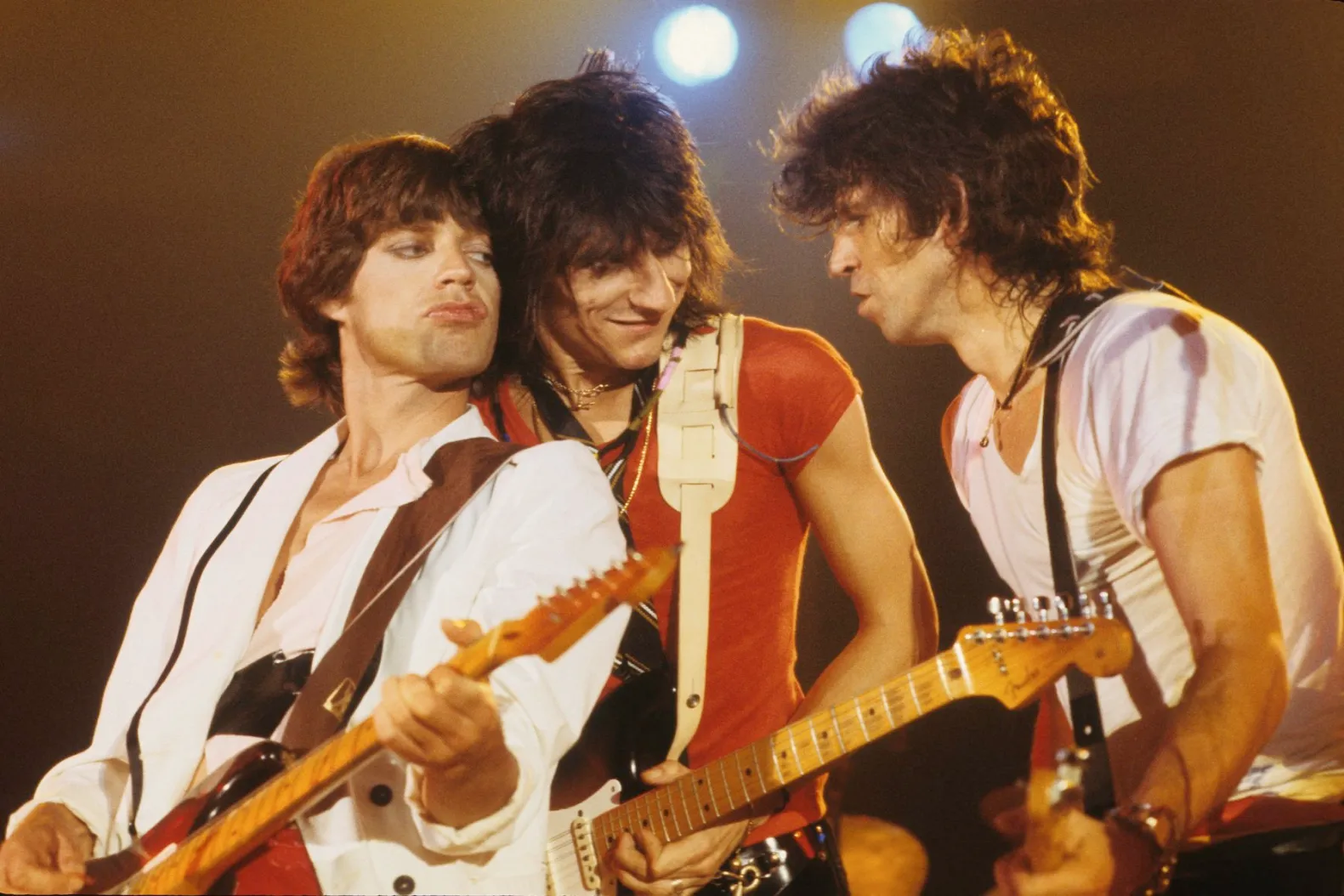
They followed this immediately with the muddy, sprawling, and fiercely independent double-album 'Exile on Main St.' (1972), recorded in the basement of a villa in the south of France. 'Exile on Main St.' became the ultimate testament to their rock 'n' roll lifestyle, a murky cocktail of lo-fi rock, gospel, and country that stands as one of the greatest albums ever made. Across the following decades, they would reinvent themselves repeatedly, from the swaggering rock of the ’70s to the polished stadium anthems of the ’80s and beyond.
Their longevity is unmatched; few bands have remained as culturally relevant or as consistently active. Despite lineup changes, personal struggles, and shifting musical landscapes, the core of the band- Mick Jagger’s charisma, Keith Richards’ riff-driven guitar work, and their unmistakable chemistry- has endured
Another band emerged from London in the swinging sixties: The Who, a powerhouse quartet that carved out their own space as one of the loudest, most dynamic, and most innovative bands of the decade. Known for their high-energy performances and instrument-smashing antics, The Who epitomised the rebellious spirit of the 1960s, a defiance that resonated with the youth of the era.
Their live shows were legendary, fueled by a chaotic ritual of auto-destructive art. Pete Townshend regularly splintered his Gibson and Rickenbacker guitars into splinters against the stage floors and amplifiers, a habit that began accidentally at the Railway Tavern in 1964 and quickly became a mandatory climax for their sets. Matching this violence, drummer Keith Moon loaded his bass drums with cherry bombs and gunpowder, most notoriously during a 1967 live broadcast of The Smothers Brothers Comedy Hour, which permanently damaged Townshend's hearing and sent shrapnel flying into the audience.
Frontman Roger Daltrey anchored this madness with his muscular, bare-chested stage presence and dangerous mic-swinging bravado, while John Entwistle’s virtuoso bass playing provided the immovable foundation for their explosive sound. Earning the nickname "The Ox" for his large physique and ability to stand completely still amidst the onstage wreckage, Entwistle ran his bass through massive Marshall stacks, essentially playing a lead-bass style that filled the sonic void left by Townshend's rhythm work.
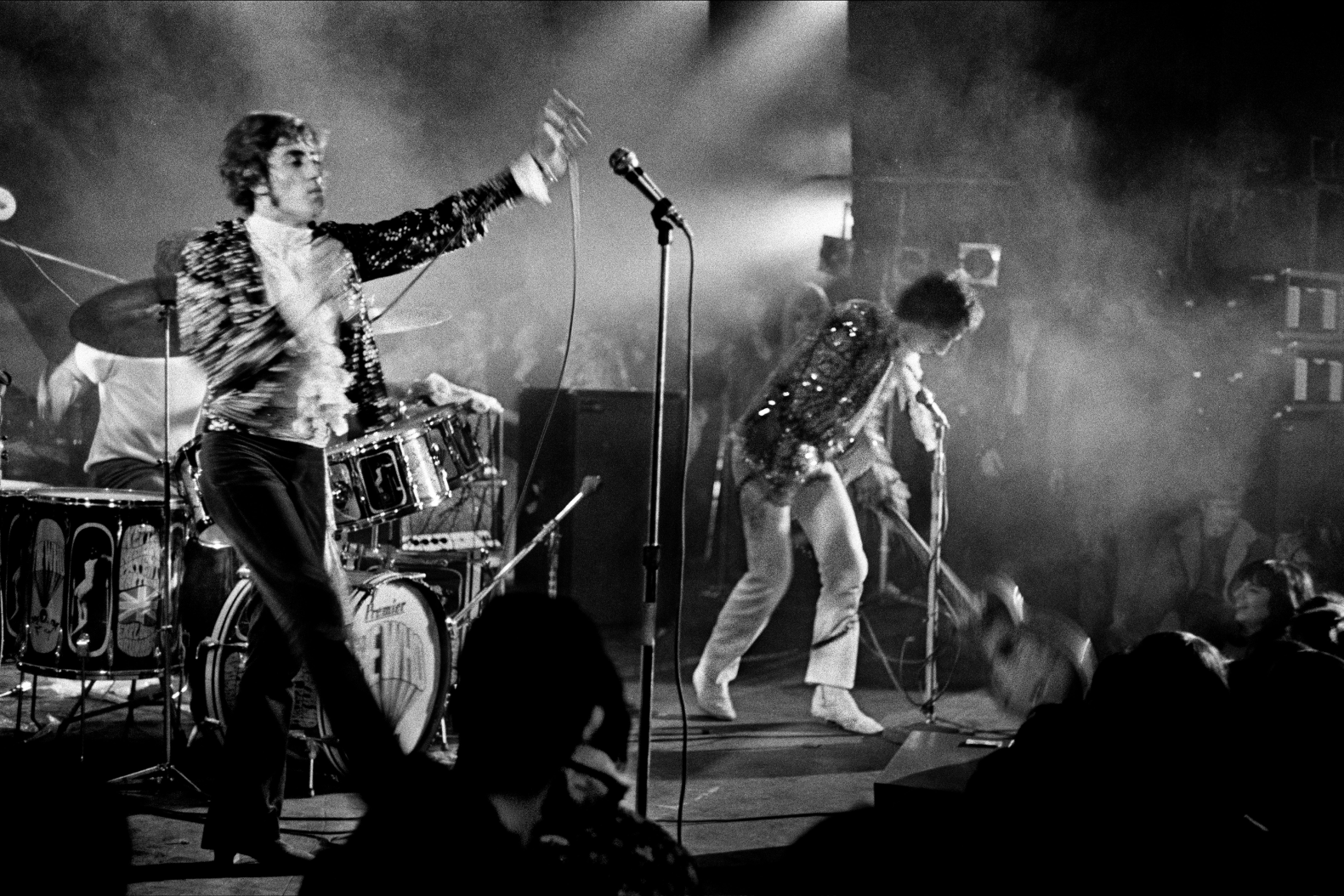
Offstage, the band lived a volatile, quintessential rock 'n' roll lifestyle defined by extreme excess, hotel destruction, and internal warfare. Keith Moon, nicknamed "Moon the Loon," became the poster boy for rock star decadence. His exploits included flushing powerful cherry bombs down hotel toilets to blow up the plumbing, driving a Lincoln Continental into a Holiday Inn swimming pool, and consuming vast quantities of horse tranquilisers and alcohol. The band members were rarely at peace with one another; dressing room fistfights between Daltrey and Moon were common, and they frequently travelled in separate vehicles to avoid tearing each other apart.
Their early singles captured this internal and external angst like no other. "I Can’t Explain" delivered a sharp, riff-driven look at teenage frustration and the inability to articulate feelings, heavily influenced by the Kinks' gritty garage rock. Then came 'My Generation,' with its iconic stuttered vocals, simulating a Mod youth jacked up on amphetamines, and Entwistle's pioneering, thunderous bass solo. The song's rebellious rallying cry of "hope I die before I get old" became a defining anthem for the 1960s counterculture. These songs weren’t just hits; they were statements, channelling the frustrations of a generation eager to break free from societal norms. As they moved through the decade, tracks like 'Substitute' showcased Townshend’s emerging genius for writing deeply existential lyrics disguised as catchy pop-art singles, dealing with identity crises and fraudulence.
The Who’s influence on rock music extends far beyond these early singles. They were instrumental in pioneering the rock opera, pushing the genre to new artistic heights. Their 1969 album 'Tommy' was a revolutionary work that intertwined narrative and music to narrate the story of a "deaf, dumb, and blind" boy who rises to become a pinball prodigy and spiritual leader.
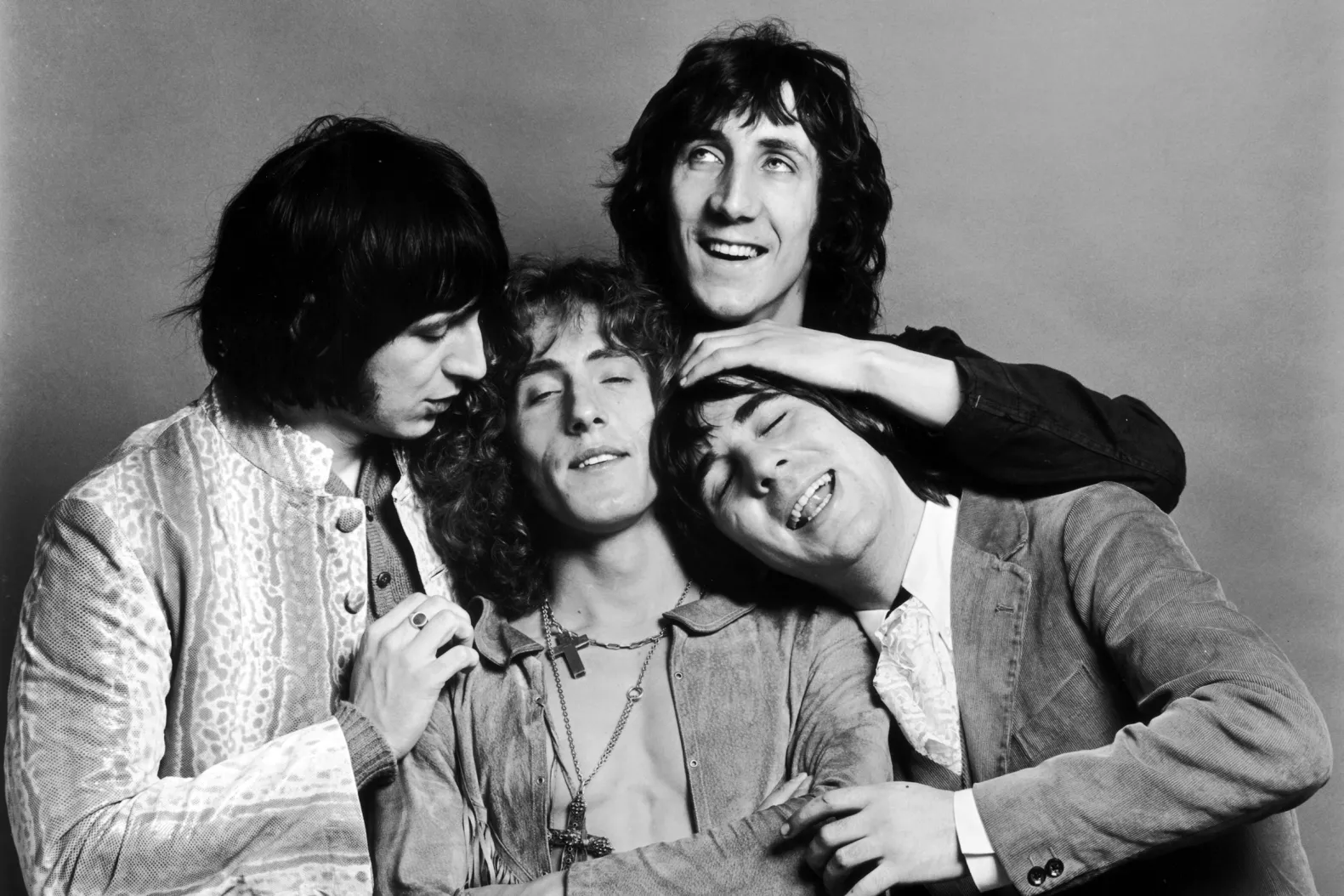
Tracks like 'Pinball Wizard', driven by Townshend's furious acoustic flamenco strumming and an iconic electric riff, showcased the band's unmatched kinetic energy. 'The Acid Queen' introduced a dark, psychedelic edge to the narrative, while the triumphant 'See Me, Feel Me' offered a soaring, spiritual climax that highlighted Daltrey's incredible vocal evolution from a tough R&B shouter to a majestic rock god. Together, these tracks proved that rock music could be as ambitious, theatrical, and complex as any other art form.
'Tommy' was not just a commercial success but also a cultural milestone, solidifying The Who’s status as pioneers in the rock world. The album marked a turning point in how rock music was perceived. No longer just a vehicle for rebellion or catchy hooks, Tommy introduced a new level of conceptual depth to popular music, opening the door for future albums to explore sophisticated themes and larger narratives.
The band's live performances, particularly their historic, gruelling 5:00 AM set at Woodstock and their explosive appearance at the Isle of Wight Festival, became legendary, further blurring the line between rock concert and dramatic performance. Pete Townshend’s vision, combined with Roger Daltrey’s commanding vocals, John Entwistle's roaring basslines, and Keith Moon’s frantic, octopus-like drumming, gave Tommy an emotional and sonic power that few could rival
By the end of the decade, The Who had solidified their place as one of the most important bands of their time. They didn’t just reflect the chaos and excitement of the ’60s; they amplified it, delivering a sound and spirit that was unapologetically loud, defiant, and forward-thinking. Their contributions to music, both in sheer energy and groundbreaking innovation, left an indelible mark on the decade and paved the way for rock's explosive evolution in the years to come. Their influence can be heard in the music of countless bands that followed, from the raw aggression of punk rock to the grand arrangements of progressive rock, cementing their place in music history.
And they weren’t done. As the ’70s began, The Who would continue to build on their legacy with even more ambitious projects, anchored by the ferocious energy of Live at Leeds. They reached a peak of stadium-rock perfection with 'Who's Next' (1971), which featured the synth-driven masterpieces 'Baba O'Riley' and 'Won't Get Fooled Again', and returned to their Mod roots with the sweeping masterpiece 'Quadrophenia' (1973). Yet, it was Tommy that first proved they were capable of transforming rock into something truly theatrical, philosophical, and deeply human.
While London bands like The Who were pushing the boundaries of theatrical rock, Newcastle gave birth to a much grittier, working-class rhythm and blues sound with The Animals. Fronted by the deep, roaring baritone of Eric Burdon and anchored by Alan Price's driving Vox Continental organ, the band specialised in a dark, fierce brand of electric blues. They scored monumental hits with intense reworkings of American blues and folk standards, including the desperate urban grit of 'We Gotta Get Out of This Place' and the intense, driving frustration of 'It's My Life'.
The Animals became a global phenomenon and conquered America during the height of the 1964 British Invasion, riding high on the massive wave of success initially generated by The Beatles. After the Fab Four broke open the American market early that year, US audiences became absolutely obsessed with UK talent, allowing The Animals to spearhead the second wave of this musical cultural import
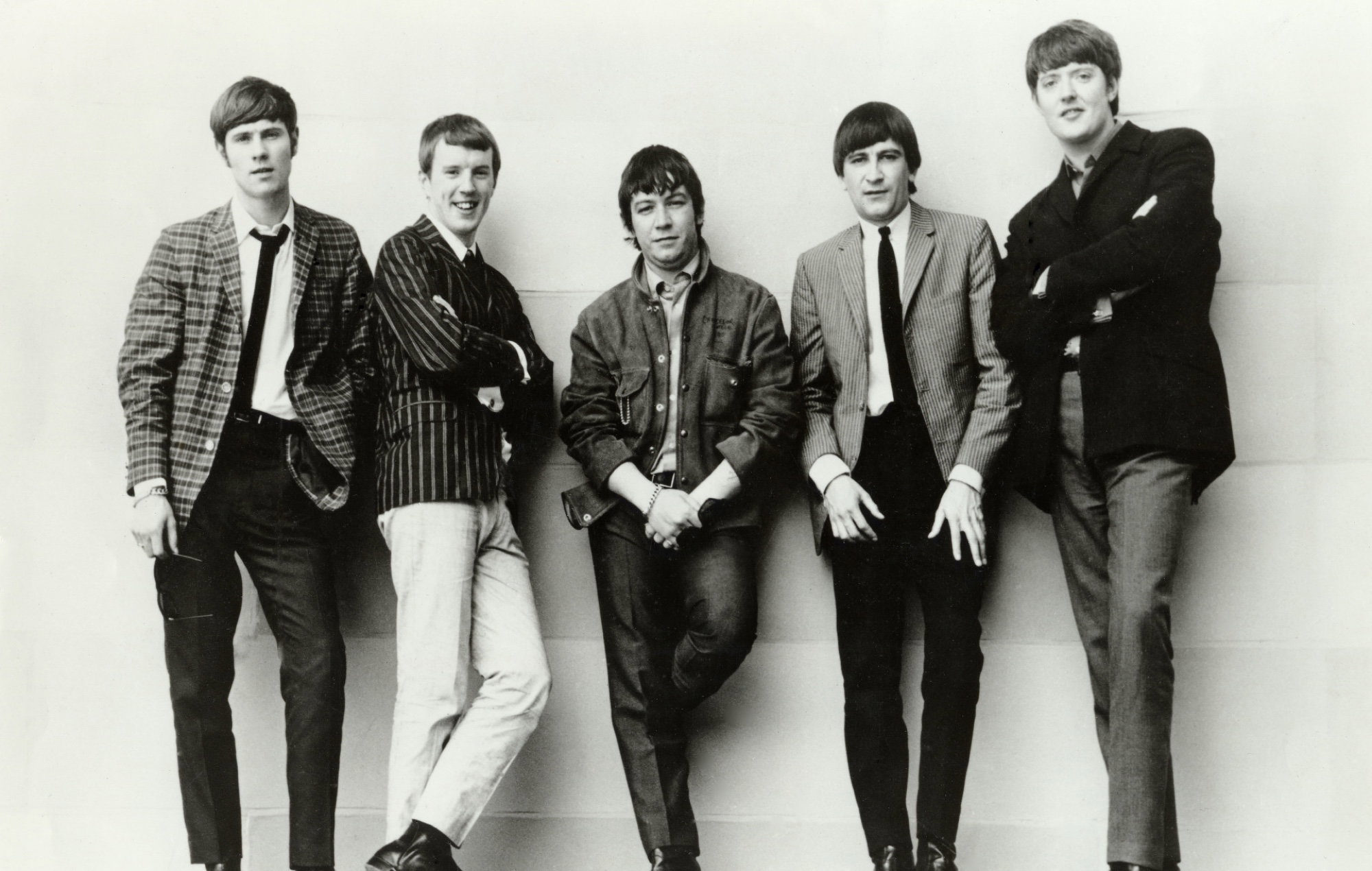
Their breakthrough was sparked entirely by their definitive masterpiece, 'The House of the Rising Sun'. By transforming an old acoustic folk lament about a New Orleans brothel into a soaring, electric rock epic defined by Price's haunting organ arpeggios and Burdon's howling vocals, they topped the American charts. This massive success earned them a historic appearance on 'The Ed Sullivan Show' alongside other British Invasion icons, completely shifting the landscape of American pop music and proving that British bands could successfully sell American roots music back to the United States with an unprecedented, dangerous edge
Sharing this obsession with the blues but focusing heavily on instrumental virtuosity, The Yardbirds emerged from London as the ultimate training ground for the greatest guitarists in rock history. Operating as a relentless laboratory for sonic innovation, the band sequentially featured Eric Clapton, Jeff Beck, and Jimmy Page within their ranks. Under the leadership of frontman Keith Relf, the group developed their signature rave-up technique during live shows, a frantic musical climax where the rhythm section accelerated into a hyper-speed frenzy to allow the guitar to solo wildly. While Clapton anchored their early blues-purist era on driving covers like 'I'm a Man', he grew increasingly alienated by the band's desire for mainstream chart success. He abruptly quit the group in early 1965 when they shifted toward commercial pop with the hit single 'For Your Love', a track that famously used a harpsichord instead of a blues guitar riff.
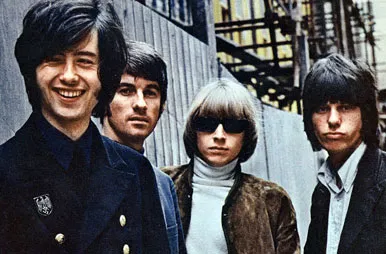
This departure opened the door for Jeff Beck, who immediately pushed the band into pioneering psychedelic, avant-garde, and garage-rock territory. Beck was an aggressive gear innovator who used his Fender Telecaster to experiment with feedback, fuzz pedals, and echo chambers. On the hit single 'Heart Full of Soul', he used a fuzz box to successfully mimic the droning sound of an Indian sitar, a trick that heavily influenced the development of raga rock. He pushed these boundaries even further on the frantic, politically conscious track 'Shapes of Things', delivering a blazing, distorted guitar solo that relied heavily on feedback control, effectively rewriting the rules of what an electric guitar could do in a pop format.
By 1966, studio wizard Jimmy Page joined the lineup, initially playing bass before switching to guitar to create a formidable, short-lived dual-guitar attack alongside Beck. This legendary twin-lead configuration was captured on the menacing, heavy track 'Happenings Ten Years Time Ago', which featured both guitarists trading chaotic, psychedelic solos. Following Beck's departure due to health issues and erratic behaviour on tour, Page took full control of the band's final days, steering them toward a much heavier, blues-based proto-metal direction. When the rest of the original members quit in 1968 due to exhaustion and creative differences, Page was left with the rights to the band's name. He quickly recruited singer Robert Plant, drummer John Bonham, and bassist John Paul Jones to fulfil outstanding tour dates as the New Yardbirds, eventually morphing the remnants of the group into another band, more on them later.
When Eric Clapton left The Yardbirds, his search for pure musical expression eventually led him to form Cream in 1966, a group widely recognised as rock music's first true supergroup. Joining forces with virtuoso jazz-blues drummer Ginger Baker and powerhouse bassist and vocalist Jack Bruce, the trio created an explosive, heavily amplified sound that laid the direct groundwork for heavy metal. Each member brought a distinct, highly sophisticated expertise to the lineup. Ginger Baker fused traditional jazz sensibilities with complex African polyrhythms, changing the role of the drums from a background metronome into a driving musical focal point. Jack Bruce, a classically trained cellist and vocalist, anchored their sound with sweeping, hyper-melodic basslines. Eric Clapton, already revered as a blues prodigy, pushed the limits of the electric guitar.
Their studio albums, such as 'Fresh Cream' (1966) and the psychedelic masterpiece 'Disraeli Gears' (1967), produced iconic, riff-heavy hits like 'Sunshine of Your Love', 'White Room', and 'I Feel Free'. These studio tracks beautifully married pop hooks with technical brilliance, notably featuring Clapton's pioneering use of the wah-wah effects pedal to create entirely new, vocal-like guitar textures.
Live on stage, Cream became legendary for their staggering, improvisational power. They routinely expanded simple three-minute blues tracks into massive, twenty-minute instrumental duels, showcasing an unparalleled level of technical skill that pushed their equipment to its absolute volume limits. This live approach effectively brought the basic concept of jazz improvisation into the volatile world of rock music, inspiring a whole generation of listeners to appreciate long, freewheeling jams. To achieve the unprecedented sonic weight necessary for a three-piece band to fill massive arenas, Clapton and Bruce ran their Gibson guitars and basses through wall-to-wall configurations of 100-watt Marshall amplifiers. This setup created a wall of sound where Bruce's overdriven bass and Clapton's thick, sustaining woman tone actively competed with Baker's thunderous, double-bass drum kit.
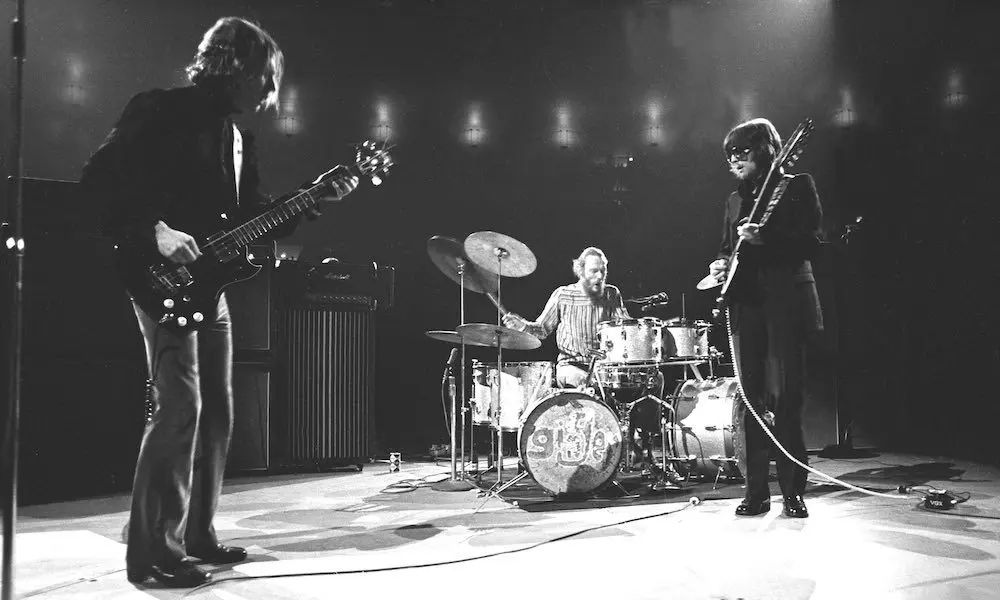
Despite their massive commercial success and profound influence on heavy rock, the band was plagued by volatile internal warfare, primarily driven by the legendary, violent animosity between Baker and Bruce. The constant backstage friction made the project entirely unsustainable, forcing the trio to break up after just two turbulent years following a final, emotional farewell concert at London's Royal Albert Hall in late 1968
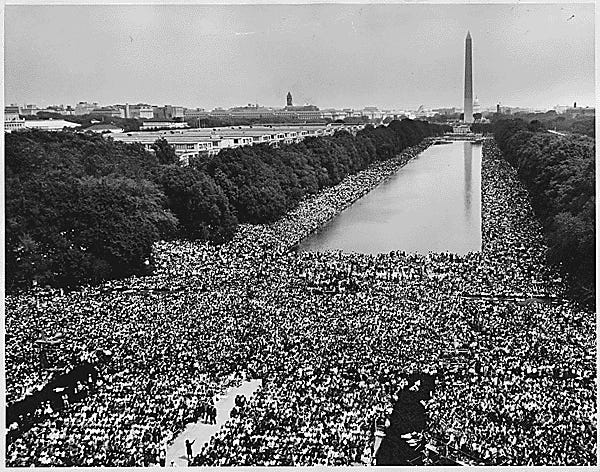
The 1960s were a decade when young people began to find their voice, addressing societal issues and challenging the status quo. Movements like the Civil Rights Movement in America and the anti-war protests against the Vietnam War saw young people standing up for what they believed in. Artists and bands such as The Rolling Stones and Bob Dylan provided the soundtrack for this wave of revolution. The Who's music, with its rebellious spirit and innovative sound, was a perfect reflection of this cultural and political climate.
As Bob Dylan famously sang, 'The Times They Are A-Changin,' and they truly were.
One of the most poignant Vietnam War protest songs was 'Fortunate Son' a blistering indictment of class privilege and military conscription recorded by Creedence Clearwater Revival. Fronted by songwriter, lead guitarist, and vocalist John Fogerty, the California-based quartet became one of the most successful and prolific American rock bands of the late 1960s. Alongside Fogerty, the lineup consisted of his brother Tom Fogerty on rhythm guitar, Stu Cook on bass, and Doug Clifford on drums. Together, they rejected the sprawling, self-indulgent studio experimentation of the era's psychedelic movement. Instead, they focused on crafting tight, high-energy, three-minute singles that blended raw rock 'n' roll with country, folk, and traditional rhythm and blues. This distinct style earned them the label of swamp rock, as John Fogerty's growling, soulful vocals and Southern-fried imagery made many listeners believe the band hailed from the bayous of Louisiana rather than the suburbs of San Francisco.
Lyrically, 'Fortunate Son' directly targeted the institutional inequality of the military draft system during the Vietnam War, serving as an angry voice for the working-class Americans who bore the brunt of the fighting. John Fogerty wrote the track out of a deep sense of anger after being drafted into the military himself, noticing that the sons of elite politicians, wealthy businessmen, and high-ranking officials routinely received draft deferments or safe domestic placements. The song's biting opening lines confront the false patriotism of the upper class, while the repeated, desperate refrain of "it ain't me" captures the frustration of everyday citizens who had no choice but to go to war. Rather than protesting the soldiers themselves, the track was a fierce critique of a political system that sent poor young men to fight and die in a conflict manufactured by a wealthy ruling class who remained completely untouched by its consequences.
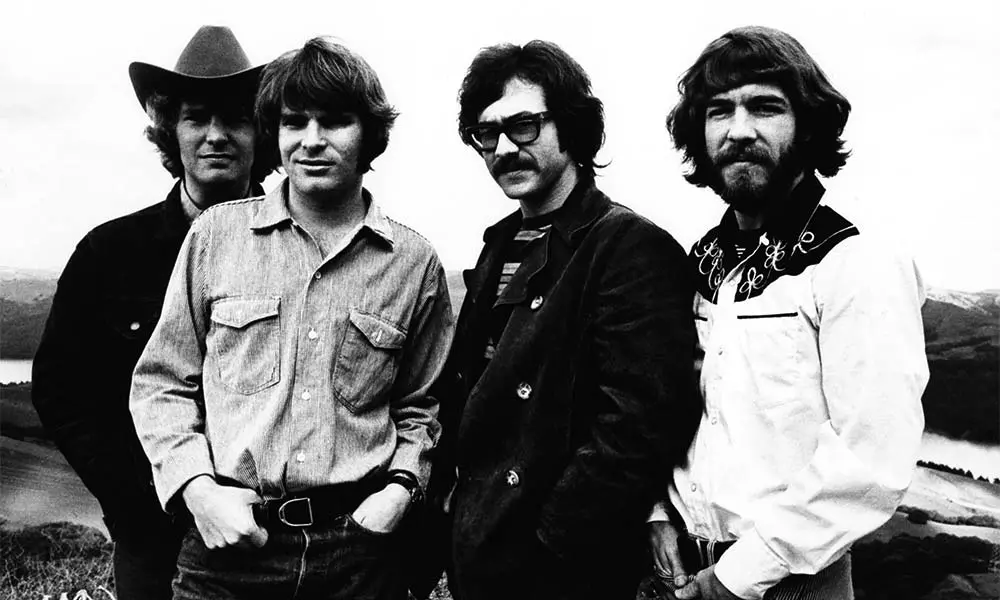
The band's commercial and creative peak arrived across an astonishingly dense run of 1969 album releases, including 'Bayou Country', 'Green River', and 'Willy and the Poor Boys'. These records produced a relentless string of chart-topping hits like 'Proud Mary', 'Bad Moon Rising', and 'Down on the Corner', which established them as radio staples and global superstars. Live on stage, they were a tight, no-nonsense touring machine, delivering an exceptionally loud and precise wall of sound that made them a highlight at major gatherings, including a late-night set at the 1969 Woodstock Festival. By the time they entered the 1970s with their acclaimed album 'Cosmo's Factory', they had firmly cemented their legacy as masters of roots rock, proving that popular music could be commercially dominant while remaining deeply connected to working-class realities and the social conscience of a turbulent decade
You can't mention drugs when talking about this decade, as previously mentioned, drugs like marijuana and LSD became widely available and more and more people were using them. Both substances were believed to enhance creativity and alter perception, which in turn led many musicians to take them to push past the boundaries of conventional songwriting. This shift gave rise to entirely new musical subgenres, most notably psychedelic rock and acid rock, where artists attempted to recreate the sensory distortions of a trip through sound.
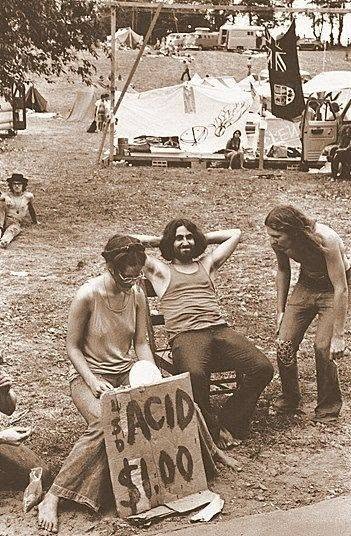
Musicians began abandoning traditional verse-chorus structures in favour of sweeping, improvisational jams and surreal lyrics heavily influenced by Eastern philosophy and literature. In the studio, this search for an altered consciousness sparked a technological revolution, forcing engineers to invent new ways to manipulate audio. Bands began reversing tape loops, incorporating Indian sitars, pumping vocals through rotating Leslie speakers, and utilising heavy echo effects to mimic the auditory hallucinations caused by lysergic acid diethylamide.
If we're being honest, 'Sgt. Pepper's Lonely Hearts Club Band' wasn't exactly written over cups of tea. The Beatles openly admitted that substances heavily fueled the production of the 1967 masterpiece, with tracks like 'Lucy in the Sky with Diamonds' and 'A Day in the Life' capturing a swirling, multi-layered dream state that perfectly encapsulated the countercultural zeitgeist. This drug-fueled experimentation expanded far beyond London, serving as the primary fuel for the entire San Francisco scene, where bands like Grateful Dead and Jefferson Airplane constructed their entire musical identities around communal, drug-infused gatherings. While this heavy usage ultimately took a tragic toll on the health of many iconic figures by the end of the decade, the initial intersection of drug culture and popular music completely shattered old songwriting conventions, turning the recording studio into a playground for mind-expanding art
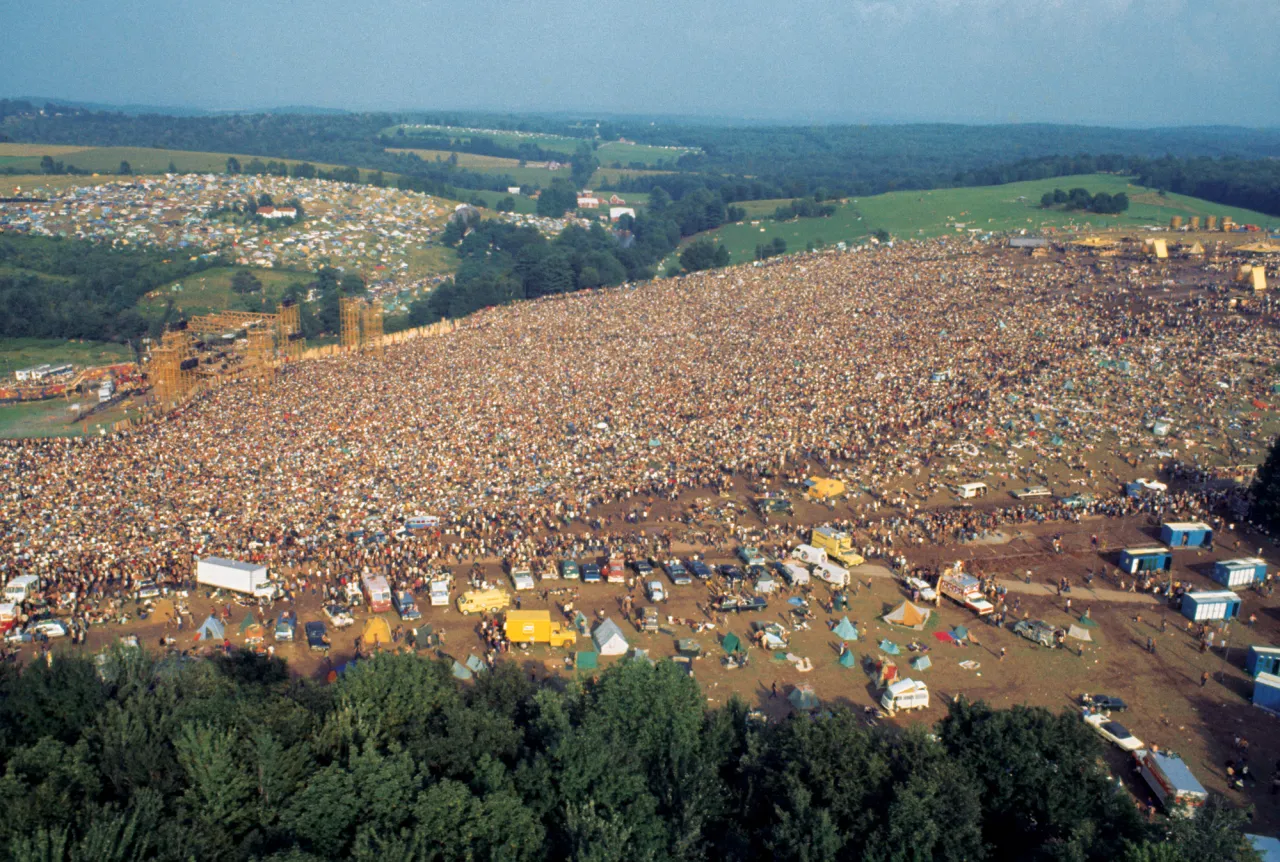
One of the most defining moments of the 1960s counterculture era was the Woodstock Music and Art Fair in August 1969. This gathering permanently cemented itself as a historic cultural touchstone. The festival featured legendary performances by a monumental lineup of groundbreaking artists, each contributing immensely to the event’s mythic status. It drew a staggering, unexpected audience of over 400,000 people to Max Yasgur's dairy farm in Bethel, New York.
Amidst the beautiful chaos of an event that ran drastically behind schedule, grew into a free concert after fences were torn down, and suffered from torrential rainstorms, the musical sets became legendary. The historical weekend kicked off with Richie Havens, who famously captivated the opening-day crowd by improvising the powerful anthem 'Freedom' on the spot when the festival ran out of scheduled acts. Joan Baez closed out the first night by performing a stirring, solo acoustic version of 'We Shall Overcome' in the middle of a heavy downpour.
As the weekend progressed, The Who delivered a furious, early-morning performance of their rock opera 'Tommy', while Santana shocked the crowd with their blistering, Latin-infused percussion jam 'Soul Sacrifice'. Janis Joplin brought her raw, whiskey-soaked vocal power to the stage with a devastating rendition of 'Piece of My Heart', Jefferson Airplane greeted the Sunday sunrise with an improvisational wall of sound, and the newly formed Crosby, Stills, Nash & Young delivered a fragile, beautiful acoustic and electric set featuring 'Suite: Judy Blue Eyes'. Sly and the Family Stone completely electrified the midnight audience by turning the muddy fields into a massive dance party with 'I Want to Take You Higher', and Arlo Guthrie got the crowd singing along to his counterculture narrative 'Coming into Los Angeles'.The
The Band delivered a roots-heavy, storytelling set that included their iconic track 'The Weight', and the British blues-rockers Ten Years After left the audience stunned by a full-tilt, hyper-speed guitar showcase on 'I'm Going Home'. Joe Cocker also scored a defining moment of the weekend with his ecstatic, deeply soulful reinterpretation of the Beatles' hit 'With a Little Help from My Friends', a performance that was famously followed by a massive thunderstorm that temporarily halted the entire festival
The inevitable rumour at Woodstock was that the Fab Four were going to turn up and perform live in front of the hundreds of thousands of festival attendees, capping the decade that made them famous. As the figureheads of the counterculture, it seemed appropriate that they would crown this monumental gathering, but it didn’t happen, of course. The Fabs were actually across the Atlantic in the studio in London, putting the finishing touches to their 'Abbey Road' album, which would serve as their own sonic farewell to the era.
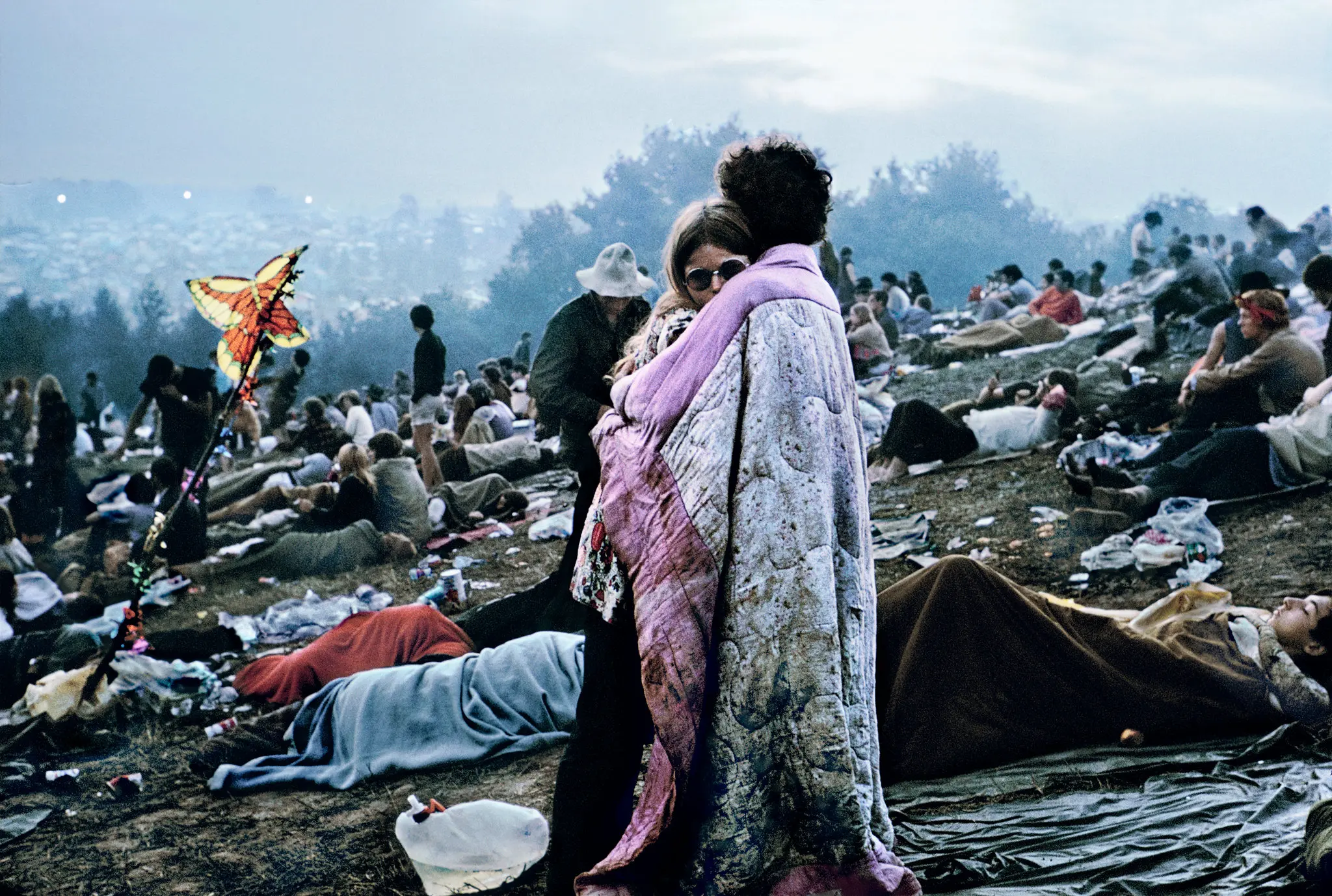
Woodstock was far more than just a massive music festival; it became a living symbol of peace, love, and communal survival, epitomising the countercultural ideals of the decade. The festival’s atmosphere perfectly reflected the era’s unique mixture of optimism and turbulence. Attendees faced freezing rain, severe food shortages, lack of sanitation, and extreme overcrowding, yet they still came together in a remarkable spirit of non-violent unity and mutual hope. This endurance of human connection was perfectly captured in Life photographer Burk Uzzle's iconic dawn portrait of Nick Ercoline and Bobbi Kelly, a young couple huddled together on a muddy hillside, wrapped in a pink and white comforter. At the time of the snapshot, they had been dating for only ten weeks and had no idea they were being photographed. This candid embrace later became the legendary front cover for the 1970 triple-vinyl soundtrack album, 'Woodstock: Music from the Original Soundtrack and More', cementing them as the ultimate visual symbol of the festival’s peaceful, loving spirit. Mirroring the extraordinary endurance of the festival's legacy, Nick and Bobbi married two summers later and remained happily together for over fifty years, eventually raising a family and serving as volunteer guides at the festival's historic site.
Beyond the music, Woodstock echoed the profound social and political upheavals of the late 1960s. Many artists used their stage time to voice fierce opposition to the Vietnam War, advocate for civil rights, and celebrate new freedoms in lifestyle, flamboyant fashion, and sexual expression.
Because of the severe weather and scheduling delays, Jimi Hendrix's closing performance did not actually begin until early Monday morning, long after most of the exhausted crowd had departed. Only around 30,000 devoted, mud-soaked fans remained scattered across the hillside to witness what would become one of the most iconic performances in rock history. Fronting a temporary, expanded backing band called Gypsy Sun and Rainbows, Hendrix delivered a searing and transformative rendition of 'The Star-Spangled Banner', a moment that captured the rebellious spirit of the era, a spirit portrayed by a total rejection of traditional values and a fierce desire for social change.
Through his white Fender Stratocaster guitar, Hendrix conveyed both a fierce critique of the Vietnam War and a profound, complex love for America. He used extreme audio feedback, dramatic whammy-bar dives, and screeching amplifier distortion to mimic the terrifying sounds of falling bombs, machine guns, and human screams, turning the national anthem into a wordless, avant-garde anti-war statement. It was an electrifying and symbolic moment, showcasing the tension, hope, and above all, the resilience of a generation seeking change. Their resilience in the face of societal pressure was a testament to their determination to make a lasting difference in the world
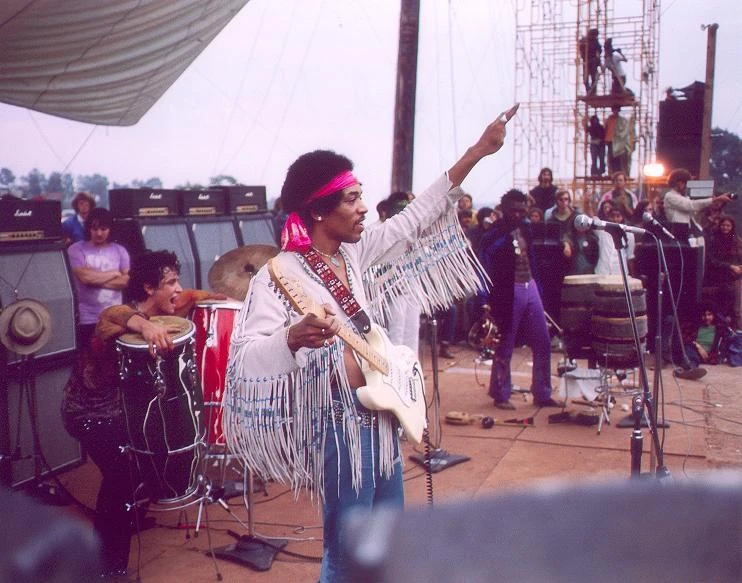
Hendrix's impact stretched far beyond Woodstock, though. His journey to becoming a global icon began in Seattle, Washington, where he was born in 1942. He discovered his obsession with music early, teaching himself to play guitar on a cheap acoustic instrument before acquiring his first electric model. After a brief stint in the military with the 101st Airborne Division, he spent the early 1960s touring relentlessly as a backing guitarist on the grueling Chitlin' Circuit. Performing under the name Jimmy James, he honed his sharp rhythm skills and flamboyant showmanship while playing behind R&B legends like Little Richard, Isley Brothers, and Wilson Pickett. Despite his immense talent, Hendrix felt creatively suffocated by the rigid rules of these backing bands, which strictly forbade any experimental soloing or wild stage theatrics.
His life changed forever in late 1966 when Linda Keith, who was dating Keith Richards of the Rolling Stones, witnessed Hendrix playing a tiny club in New York's Greenwich Village. Blown away by his raw talent, she introduced him to Chas Chandler, the former bassist for the Animals, who was looking to transition into management. Chandler convinced the young guitarist to move to London, promising to turn him into a star. Upon arriving in the UK, Chandler helped him recruit bass player Noel Redding and jazz-trained drummer Mitch Mitchell, officially forming The Jimi Hendrix Experience.
Hendrix immediately took the British music scene by storm through an unparalleled mix of instrumental virtuosity, flamboyant showmanship, and a fluid, hyper-expressive playing style. At his very first London showcase, rock royalty like Paul McCartney, Eric Clapton, Mick Jagger, and Pete Townshend packed the club, watching in absolute awe as Hendrix completely rewrote the rules of electric guitar playing. Live on stage, his performances became a visceral, quasi-religious spectacle, where he routinely played the guitar behind his back, picked the strings with his teeth, and interacted with his amplifiers to generate beautifully controlled feedback. Mitch Mitchell’s fluid, polyrhythmic drumming provided a constantly shifting, jazz-like dialogue for Hendrix's solos, while Redding's steady basslines anchored the trio's explosive live wall of sound.
This kinetic live energy translated directly into a groundbreaking trilogy of 1960s studio albums that shattered the existing rules of recording and songwriting. Their debut album, 'Are You Experienced' (1967), immediately established Hendrix as a futuristic blues visionary, yielding massive hits like 'Purple Haze', 'The Wind Cries Mary', and 'Foxey Lady'. Backed by McCartney’s strong endorsement, the band traveled back across the Atlantic to make their American debut at the 1967 Monterey Pop Festival. Hendrix delivered a legendary, career-defining performance that culminated in him famously kneeling over his Fender Stratocaster, dousing it in lighter fluid, and setting it on fire, a theatrical ritual that instantly made him a superstar in the United States.
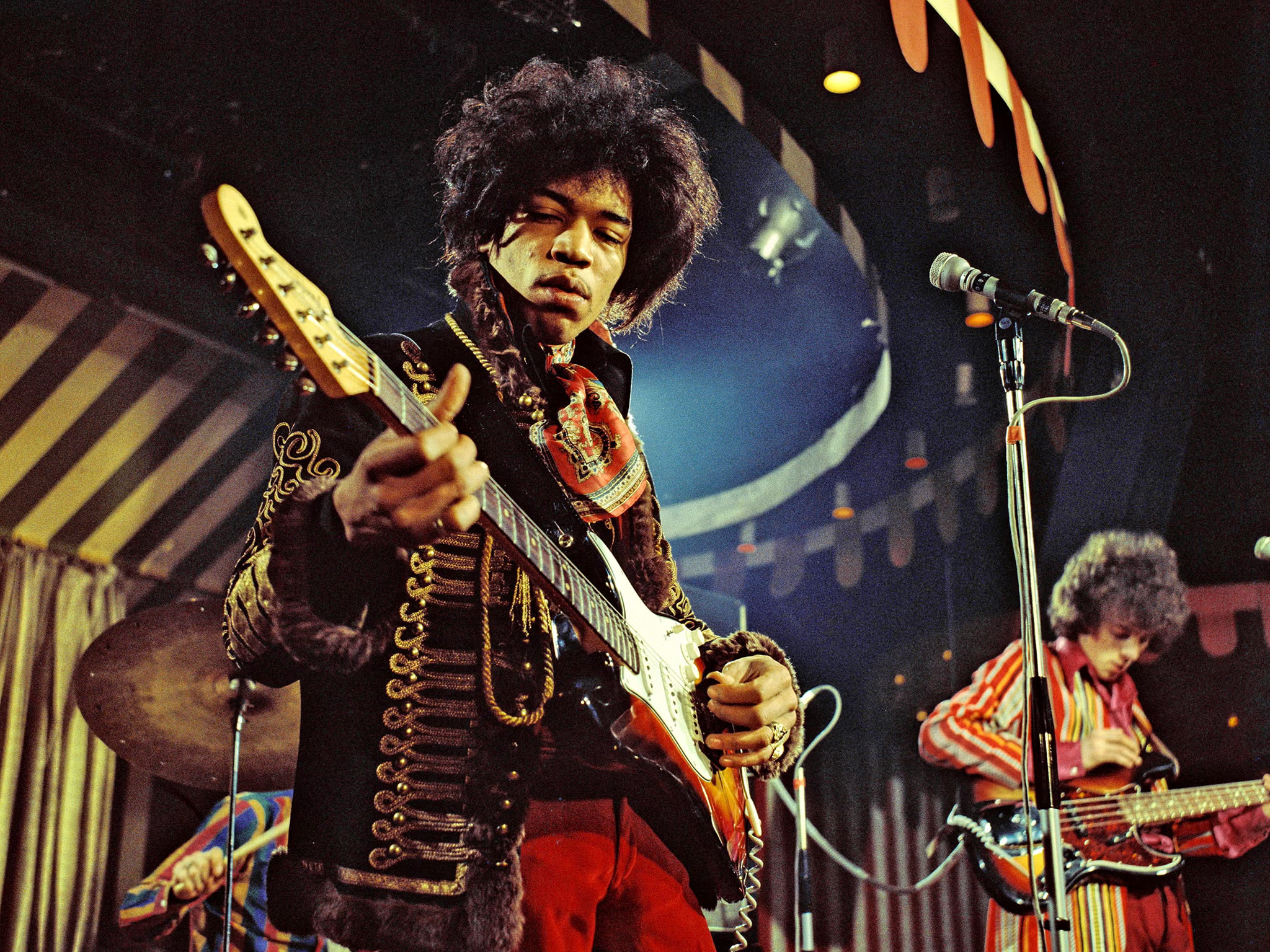
He followed this creative explosion later that same year with 'Axis: Bold as Love' (1967), a record that showcased a more sensitive, lyrical side to his playing on tracks like 'Little Wing' and made pioneering use of stereo panning and phasing effects. His 1960s output culminated in the sprawling double-album masterpiece 'Electric Ladyland' (1968), where Hendrix took full control as producer. Recorded during marathon, drug-fueled studio sessions that featured guest musicians like Steve Winwood and Jack Casady, the album was a revolutionary sonic tapestry that pushed into deep psychedelia, ambient soul, and avant-garde soundscapes. The record featured the definitive, heavily overdubbed cover of Bob Dylan's 'All Along the Watchtower' alongside the lengthy, improvisational blues-rock jam 'Voodoo Child (Slight Return)'.
By the turn of the decade, the immense pressure of global stardom, combined with constant touring and heavy drug consumption, began to take a severe toll. Following the dissolution of the original Experience lineup, Hendrix sought out a deeper connection to his R&B roots, forming the all-Black trio Band of Gypsys alongside bassist Billy Cox and drummer Buddy Miles. This lineup resulted in a powerful, funk-driven live album recorded on New Year's Day in 1970, featuring the anti-war masterpiece 'Machine Gun'. He also spent massive amounts of energy and money constructing his own state-of-the-art recording facility, Electric Lady Studios, in New York, seeking an environment where he could create without commercial deadlines. Tragically, this new chapter was cut short just as it was beginning. In September 1970, while staying in London, Hendrix passed away from drug-related asphyxiation at the young age of twenty-seven. Though his mainstream career lasted just four brief, volcanic years, he permanently altered the DNA of popular music, transforming the electric guitar into a limitless, expressive paintbrush and setting an untouchable standard for generations of rock musicians to come
Woodstock was not the only monumental music event of the era. The Monterey Pop Festival in 1967 became a landmark for introducing new acts like Janis Joplin and Otis Redding to wider audiences. These festivals became more than concerts; they were gatherings that defined cultural moments, blending music with protest, experimentation, and artistic innovation.
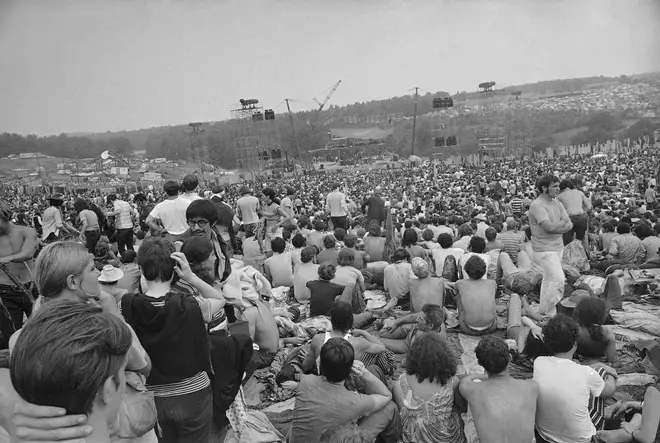
A year after Woodstock, the UK would see the biggest musical gathering ever. Held at Afton Down between August 26 and August 30, 1970, the legendary Isle of Wight Festival drew an estimated 600,000 to 700,000 people, vastly outnumbering the island’s population of around 100,000 and surpassing even Woodstock’s attendance. The event featured iconic performances by Jimi Hendrix (his final UK concert and one of his last ever, as he died just two weeks later), The Who, The Doors, and Joni Mitchell. The festival’s logistical challenges were immense, with chaotic crowd control, food shortages, and overwhelmed local infrastructure. This led to the passage of an Act of Parliament, which banned large gatherings on the island without a special license. The 1970 Isle of Wight Festival stands as one of history’s greatest musical gatherings, remembered for both its musical brilliance and its lasting impact on festival culture and regulation.
However, there was a British band that carved its own path, distinct from The Beatles and The Rolling Stones. They didn’t follow the psychedelic trend, nor did they embrace the heavy rock ethos of The Who or Led Zeppelin. Instead, they had a treasure trove of extraordinary songs, and their substance of choice? Well, it was strawberry jam.
The Kinks were a pivotal force in the music scene, celebrating their British roots in a way that set them apart and inspired many others to do the same (keep reading, and you’ll understand). Their album 'The Kinks Are the Village Green Preservation Society' is a timeless masterpiece, vastly different from most of the albums of that era. Though it was initially overlooked, history has been kind to The Kinks. Their influence reverberates through decades of British music, a testament to their enduring legacy.
Emerging from the British Invasion, their early hits, 'You Really Got Me' and 'All Day and All of the Night', are often regarded as proto-punk for their heavy riffs and primal energy, inspiring generations of rock and punk bands. These songs captured the raw spirit of youth, with Dave Davies’ distorted guitar tone paving the way for the hard rock and punk explosions to come.
By the mid-60s, The Kinks had transcended their raucous beginnings, with Ray Davies, the band’s chief songwriter, delving into more complex themes. Songs like 'A Well Respected Man' and 'Dedicated Follower of Fashion' offered a sharp critique of British society. Meanwhile, 'Sunny Afternoon' and 'Waterloo Sunset' unveiled a more introspective and melodic side. The latter, often hailed as one of the greatest songs of all time, is a tender, nostalgic portrayal of urban life in London, with its glistening melody and evocative lyrics capturing the serene beauty of everyday moments
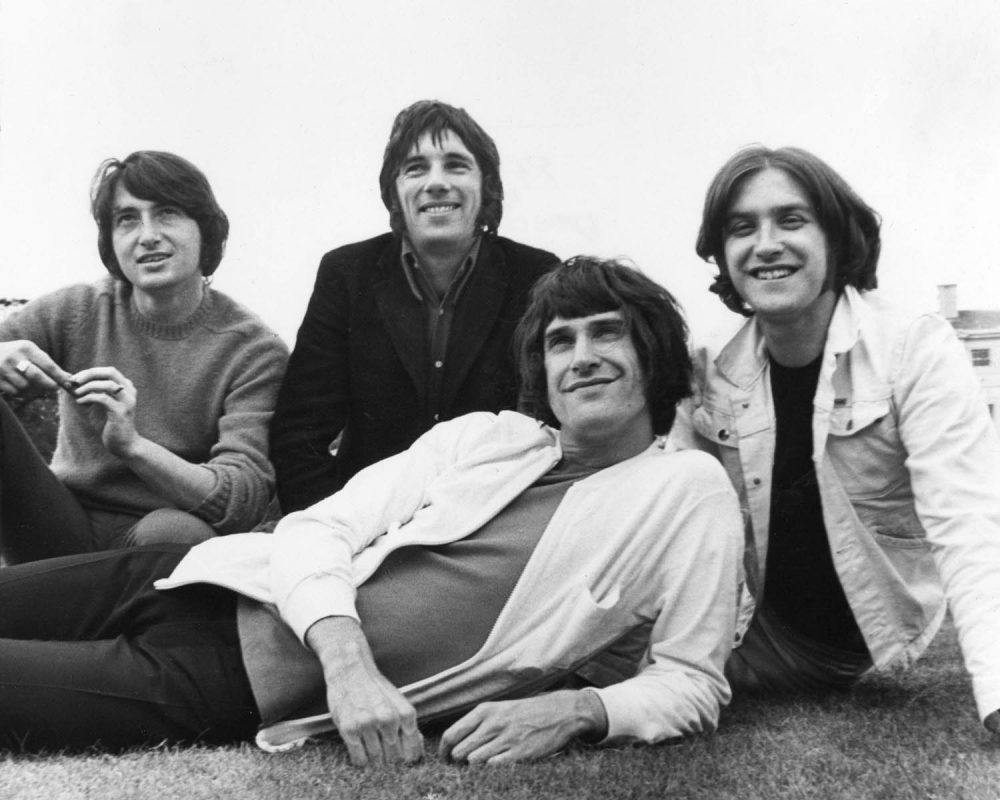
Their 1967 album 'Something Else by The Kinks' marked a turning point, blending baroque pop with sharp lyrical storytelling. It included gems like 'David Watts' and 'Death of a Clown', reflecting the band’s growing artistic ambition and willingness to experiment beyond the standard pop formula. This album saw the band delving into themes of class, aspiration, and the complexities of everyday British life, offering a subtle yet profound commentary on society.
But it was 1968’s 'The Kinks Are the Village Green Preservation Society' that fully crystallised their vision, a concept album steeped in nostalgia for a disappearing England. With tracks like 'Do You Remember Walter?' and 'Picture Book', the album explores the bittersweet passage of time, memory, and resistance to modernity's relentless pace. Its richly textured soundscapes and thoughtful lyrics make it an intricate exploration of identity, tradition, and change, cementing the band as innovators in the concept album format and as chroniclers of a uniquely British experience.
While their peers were exploring psychedelia or cranking up the volume, The Kinks took a different route. Rather than following prevailing trends, they turned inward, creating deeply British vignettes that captured the humour, melancholy, and contradictions of postwar England. Their songs painted vivid portraits of ordinary people, suburban rituals, and the changing social fabric, resonating with listeners who yearned for authenticity in an age of rapid transformation. The band’s understated approach, eschewing flamboyant fashion and psychedelic excess, set them apart as authentic originals. Their idiosyncratic, poetic, and quietly revolutionary style would go on to inspire a generation of artists, from Blur to Arctic Monkeys, and continues to influence musicians who value sharp storytelling and cultural reflection over spectacle.
It wasn't all psychedelic masterpieces, mass gatherings of the people and protests, though. Two British bands were about to change music forever.
Led Zeppelin was officially forged in late 1968 out of the ashes of the original Yardbirds lineup, quickly rising to become the definitive architects of heavy rock. The formidable quartet, consisting of Jimmy Page, Robert Plant, John Paul Jones, and John Bonham, rapidly became one of the most influential rock bands of their era. Their music masterfully fused traditional American blues, blistering hard rock, acoustic folk, and even Eastern modal influences to create a sonic signature that was both intensely powerful and dynamically nuanced.
Each band member contributed singular, irreplaceable talents to this massive sound. John Bonham delivered a thunderous, heavily syncopated style of drumming that served as the band's engine, while Jimmy Page provided inventive, multi-layered guitar work and visionary production techniques. John Paul Jones anchored the arrangements with his versatile multi-instrumental musicianship on bass and keyboards, which complemented the soaring, primal vocals of front man Robert Plant
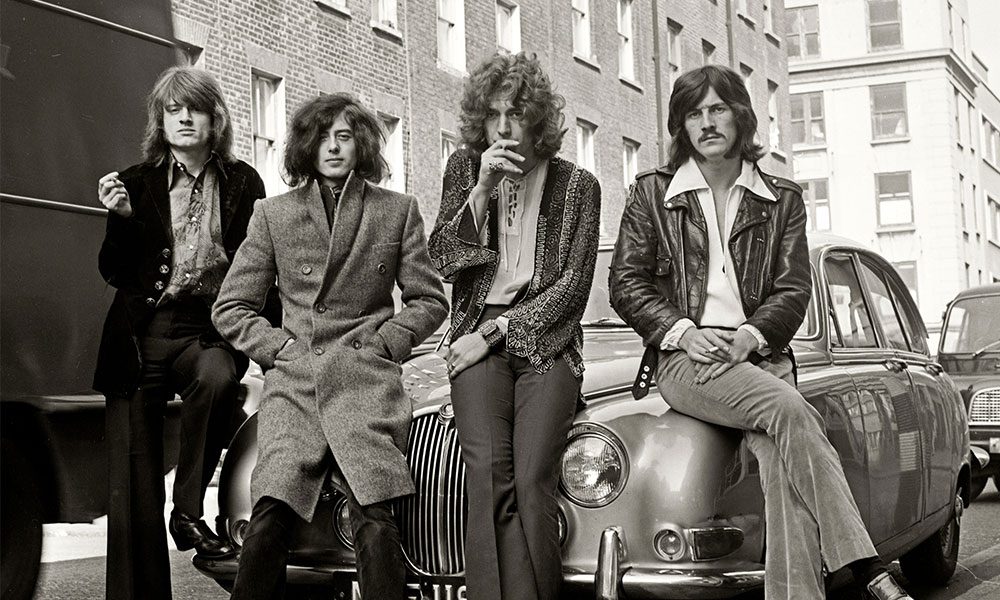
Breakout tracks like 'Dazed and Confused', 'Communication Breakdown', and the iconic, slide-heavy riff in 'Whole Lotta Love' showcased their unmatched ability to push sonic boundaries and weaponise the recording studio itself. Their early studio albums, 'Led Zeppelin' (1969) and 'Led Zeppelin II' (1969), set the stage for a bold new direction in popular music by successfully blending raw heaviness with immense musical sophistication. Although the band would reach their absolute commercial and creative peak during the stadium-rock era of the 1970s, this foundational groundwork was firmly established in the late 1960s, inspiring countless future artists and permanently changing the landscape of rock music
At the same time, Black Sabbath were emerging from the industrial heartland of Birmingham and laying the absolute foundations for a entirely new genre: heavy metal. Formed in 1968 out of the bleak, post-war landscape of the English Midlands, the band consisted of Ozzy Osbourne, Tony Iommi, Geezer Butler, and Bill Ward. Their groundbreaking self-titled debut album, 'Black Sabbath', and their follow-up masterpiece, 'Paranoid', were both released in 1970 but were written, rehearsed, and forged in the late 1960s
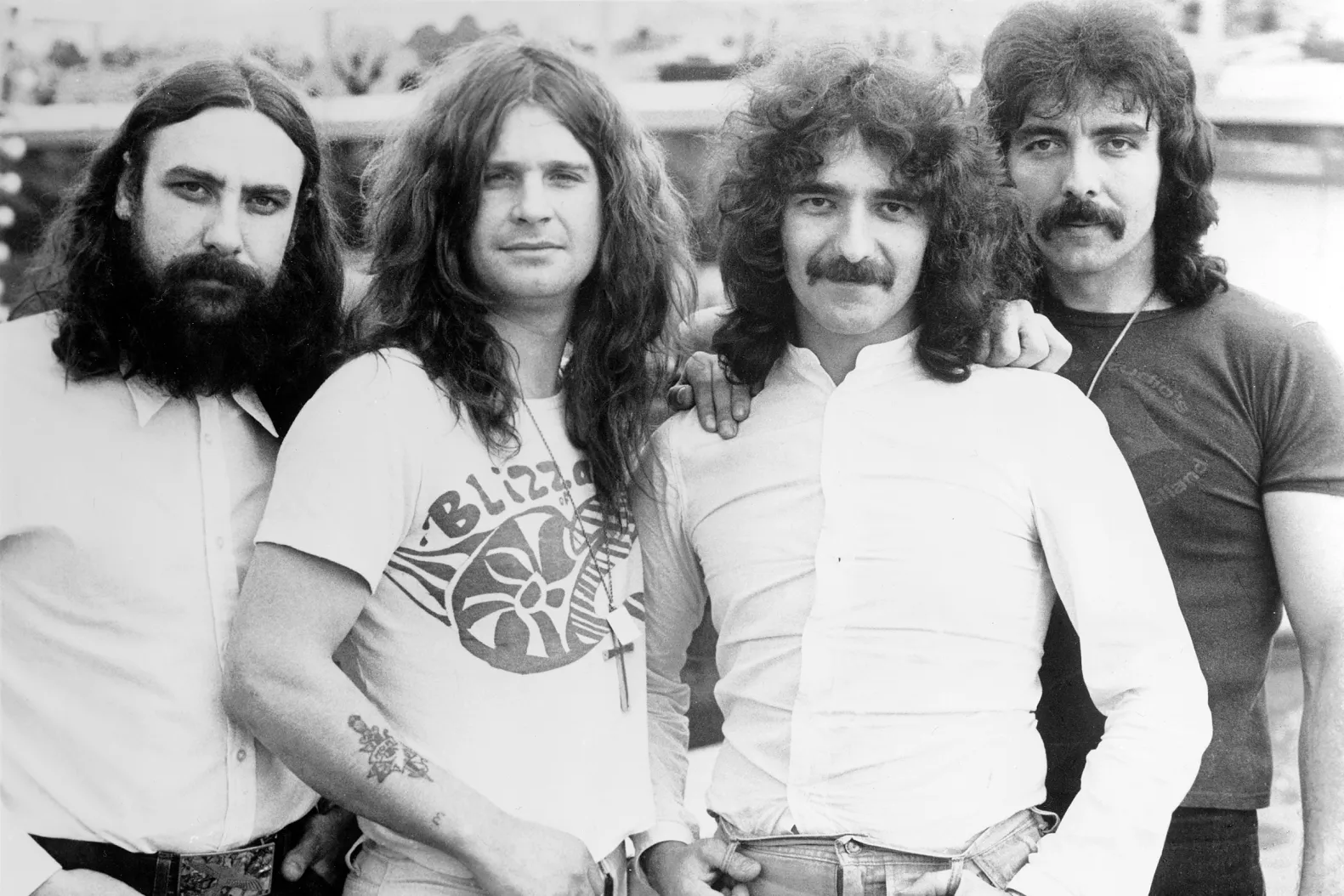
The band drew heavily on American blues and hard rock, but they deliberately stripped away the optimistic, utopian imagery of the flower-power movement to introduce a darker, more ominous tone that set them apart from their contemporaries. Witnessing crowds line up around the block to watch horror movies, the band famously decided that if people would pay money to be scared by cinema, they should create music that evoked that exact same sense of dread and suspense.
Tony Iommi became the primary architect of this sonic darkness, adopting a unique technique where he down-tuned his Gibson SG guitar to slacken the strings. He did this partly to accommodate a factory accident that had severed the tips of his fingers, a physical limitation that accidentally yielded a thick, sludgy, and menacing guitar tone. Paired with Ozzy Osbourne’s haunting, siren-like vocals and Bill Ward’s jazz-inflected, swinging drum style, the music possessed a massive rhythmic weight. Geezer Butler anchored the band by playing heavy basslines that locked in perfectly with Iommi's guitar, while also writing dark, introspective lyrics that explored themes of war, paranoia, the occult, mental illness, and social unrest.
Songs like 'Black Sabbath', which made pioneering use of the ominous musical interval known as the tritone or the devil's chord, alongside the driving riffs of 'N.I.B.' and the frantic anxiety of 'Paranoid', became the definitive blueprints for the entire heavy metal genre. Their early work was not just influential; it was entirely revolutionary, giving rise to an aggressive underground musical movement that would shape rock for decades to come. Together, Led Zeppelin and Black Sabbath redefined the possibilities of amplification and artistic expression at the end of the 1960s, leaving a towering legacy that continues to resonate today
Across the pond, America would give us. Simon & Garfunkel, The Doors, The Supremes, The Velvet Underground, Jefferson Aeroplane, and The Beach Boys.
Simon & Garfunkel, the voice of introspection in the 1960s, crafted songs that not only balanced folk simplicity with lyrical depth but also left an indelible mark on the American music scene. Their music, led by the haunting harmonies of Paul Simon and Art Garfunkel, often reflected the uncertainties and introspections of a rapidly changing world. They began the decade as traditional acoustic folk purists, debuting with 'Wednesday Morning, 3 A.M.' (1964), an album that initially failed commercially and prompted Paul Simon to retreat to the English folk scene.
However, their trajectory changed forever when producer Tom Wilson took the album's acoustic track, 'The Sound of Silence', and secretly overdubbed electric guitars, bass, and drums. This unauthorised remix transformed the song into a massive folk-rock hit, forcing the duo to reunite and rush-record 'Sounds of Silence' (1966) and the baroque-tinged 'Parsley, Sage, Rosemary and Thyme' (1966), which established them as major cultural forces.
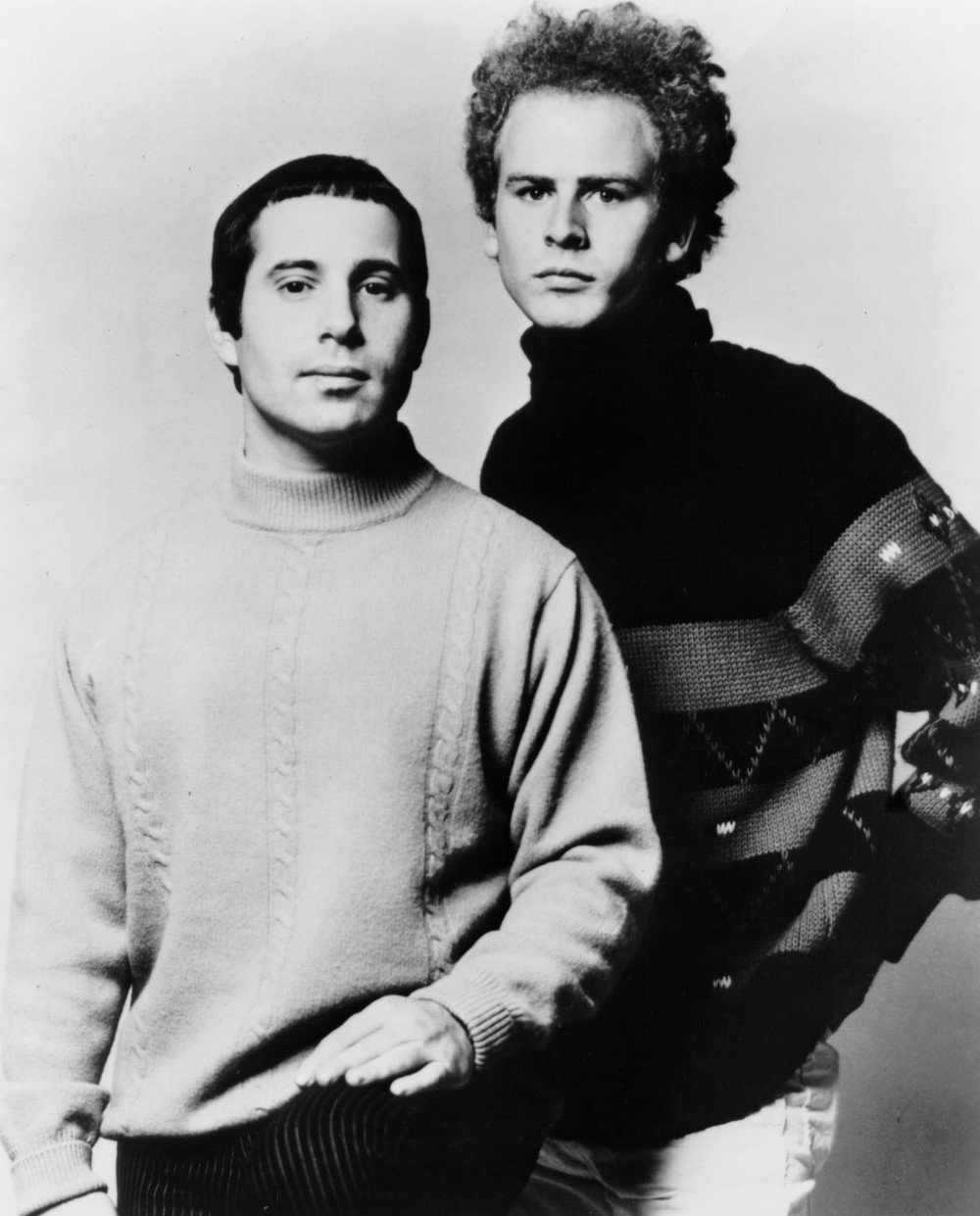
Their rapid ascent caught the attention of director Mike Nichols, who featured their music prominently in the era-defining film 'The Graduate' (1967). This cinematic partnership brought together Simon's lyrical sophistication and Garfunkel's angelic vocals, spawning the chart-topping single 'Mrs. Robinson' and introducing their intellectual folk style to a massive international audience.
They fully capitalised on this momentum with 'Bookends' (1968), a loose concept album that encapsulated themes of ageing, memory, and societal disillusionment. On this record, tracks like 'America' and 'A Hazy Shade of Winter' offered deeply poetic snapshots of existential searching and youth drifting through a fractured landscape.
Their creative peak came with 'Bridge Over Troubled Water', recorded during a period of escalating, bitter personal friction and creative differences between the lifelong childhood friends. Released in 1970, the album became their magnum opus, a masterful blend of gospel, classical, and pop influences that formed a deeply emotional statement of comfort and resilience.
Songs like 'The Boxer', with its thunderous, orchestrated snare-drum crashes, and the percussion-heavy 'Cecilia' revealed both vulnerability and rhythmic experimentation, cementing their status not just as folk icons but as trailblazers of genre-blending songwriting. Despite the album achieving historic commercial success and sweeping the Grammy Awards, the duo's strained relationship permanently fractured during the sessions. They split up immediately after its release, leaving the elegant title track as a poignant, soaring monument to the massive possibilities of the singer-songwriter era.
American counterculture found its darkest, most poetic voice in Los Angeles with The Doors. Fronted by the mercurial and charismatic Jim Morrison, the quartet crafted a theatrical, jazz-infused psychedelic sound that contrasted sharply with the sunny pop of the era. Their self-titled debut, 'The Doors' (1967), immediately established them as major forces, driven by the hypnotic organ work of Ray Manzarek and the timeless, flamenco-tinged guitar riffs of Robby Krieger on 'Light My Fire'. They quickly followed this with 'Strange Days' (1967), an album steeped in late-sixties paranoia that made pioneering use of the Moog synthesiser. John Densmore’s crisp, jazz-accented drumming provided the perfect erratic heartbeat for Morrison’s baritone vocals and provocative, Oedipal poetry, culminating in epic, cinematic tracks like 'The End' and 'When the Music's Over'.
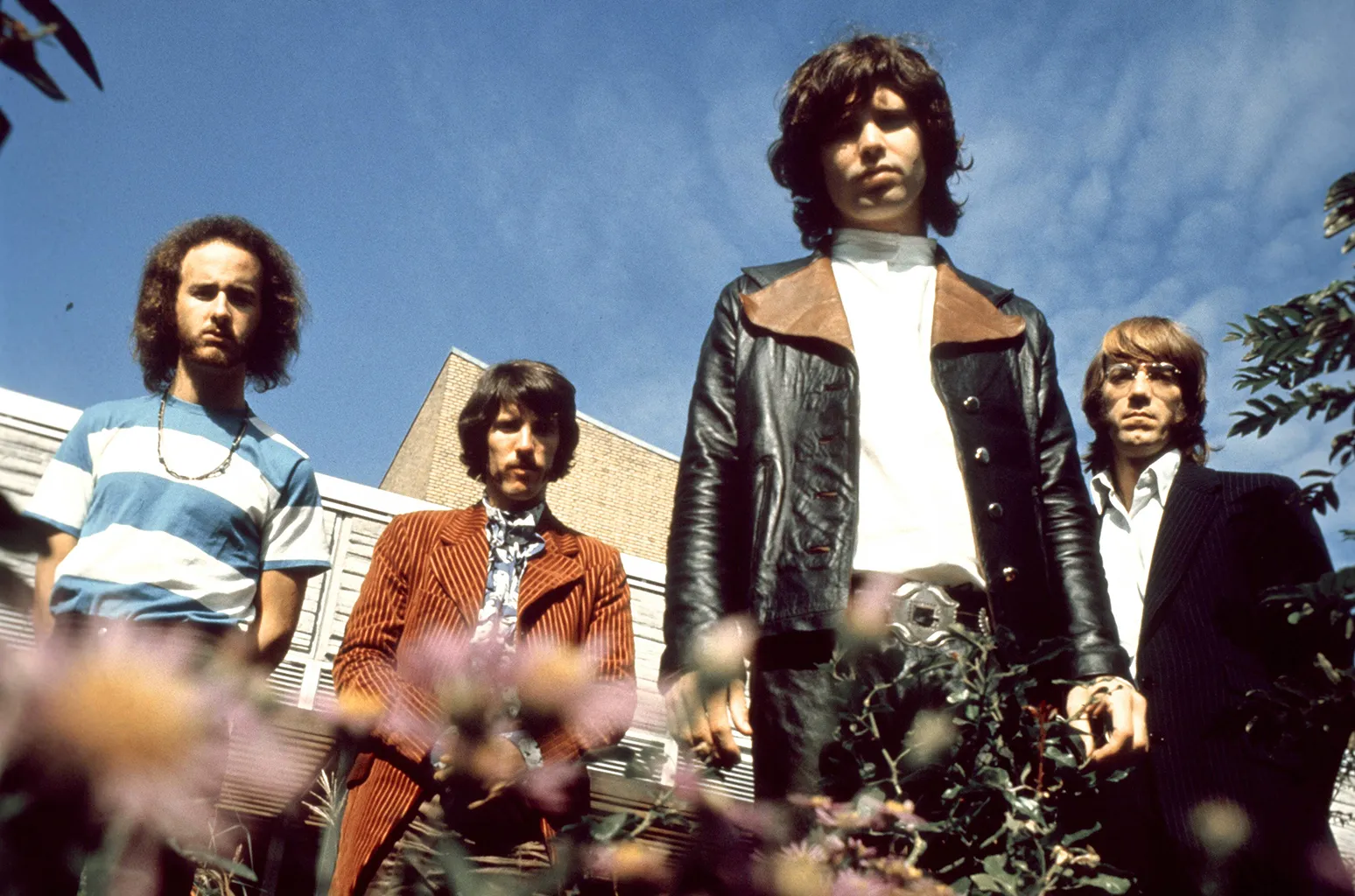
As the decade progressed, the band continued to push artistic boundaries while spiralling through Morrison's chaotic, unpredictable personal life. Albums like 'Waiting for the Sun' (1968) and the horn-heavy 'The Soft Parade' (1969) saw them experimenting with baroque pop and orchestral arrangements, yielding hits like 'Hello, I Love You' and 'Touch Me'. However, they truly reclaimed their gritty, rhythm-and-blues roots with 'Morrison Hotel' (1970) before delivering their studio masterpiece, 'L.A. Woman' (1971). Recorded in a makeshift rehearsal space, 'L.A. Woman' serves as a swampy, blues-drenched love letter and farewell to Los Angeles. The title track, 'L.A. Woman', captures a driving, cinematic sense of urban decay, while the haunting, rain-swept atmosphere of 'Riders on the Storm' acts as a poignant, eerie swan song, released just weeks before Morrison’s tragic death in Paris.
The Supremes were Motown's crown jewel, blending soulful vocals with impeccable pop melodies and an unmistakable sense of style. Diana Ross, Mary Wilson, and Florence Ballard dominated the charts with hits like 'Where Did Our Love Go', 'Baby Love', and 'Stop! In the Name of Love', consistently topping the Billboard Hot 100 and becoming international stars. They were one of the first African-American acts to achieve mainstream success, breaking barriers in a racially divided America and appearing on national television shows at a time when such representation was rare.
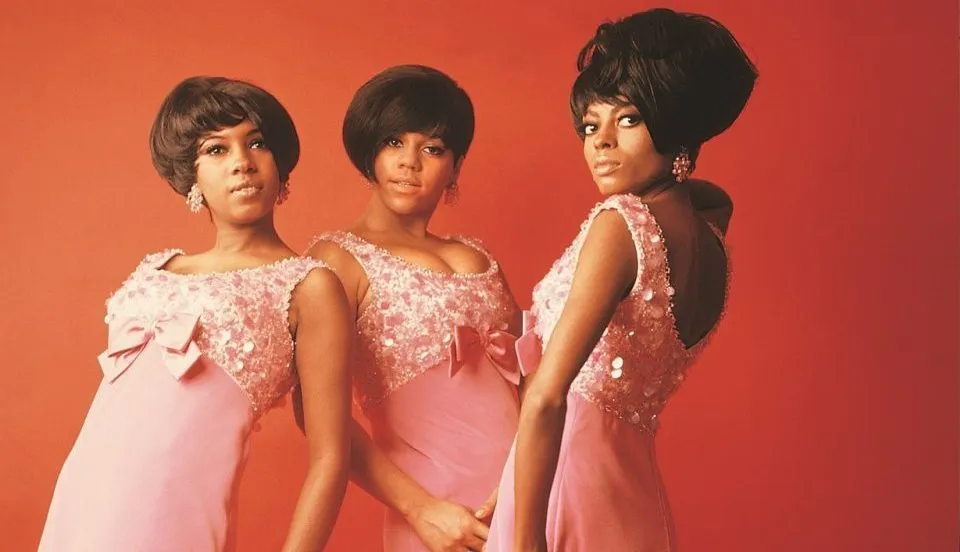
The Supremes were Motown's crown jewel, blending soulful vocals with impeccable pop melodies and an unmistakable sense of style. Diana Ross, Mary Wilson, and Florence Ballard dominated the charts with hits like 'Where Did Our Love Go', 'Baby Love', and 'Stop! In the Name of Love', consistently topping the Billboard Hot 100 and becoming international stars. They were one of the first African-American acts to achieve mainstream success, breaking barriers in a racially divided America and appearing on national television shows at a time when such representation was rare.
Their glamour, poise, and polished choreography helped define Motown's crossover appeal, setting new standards for stage presentation and influencing generations of female vocal groups. The Supremes' success paved the way for broader acceptance of Black artists in mainstream pop, and their legacy can be seen in the work of later icons like Destiny's Child, En Vogue, and Beyoncé. Beyond their musical achievements, The Supremes played an important role in the civil rights era, becoming symbols of Black excellence and inspiration during a pivotal period of social change.
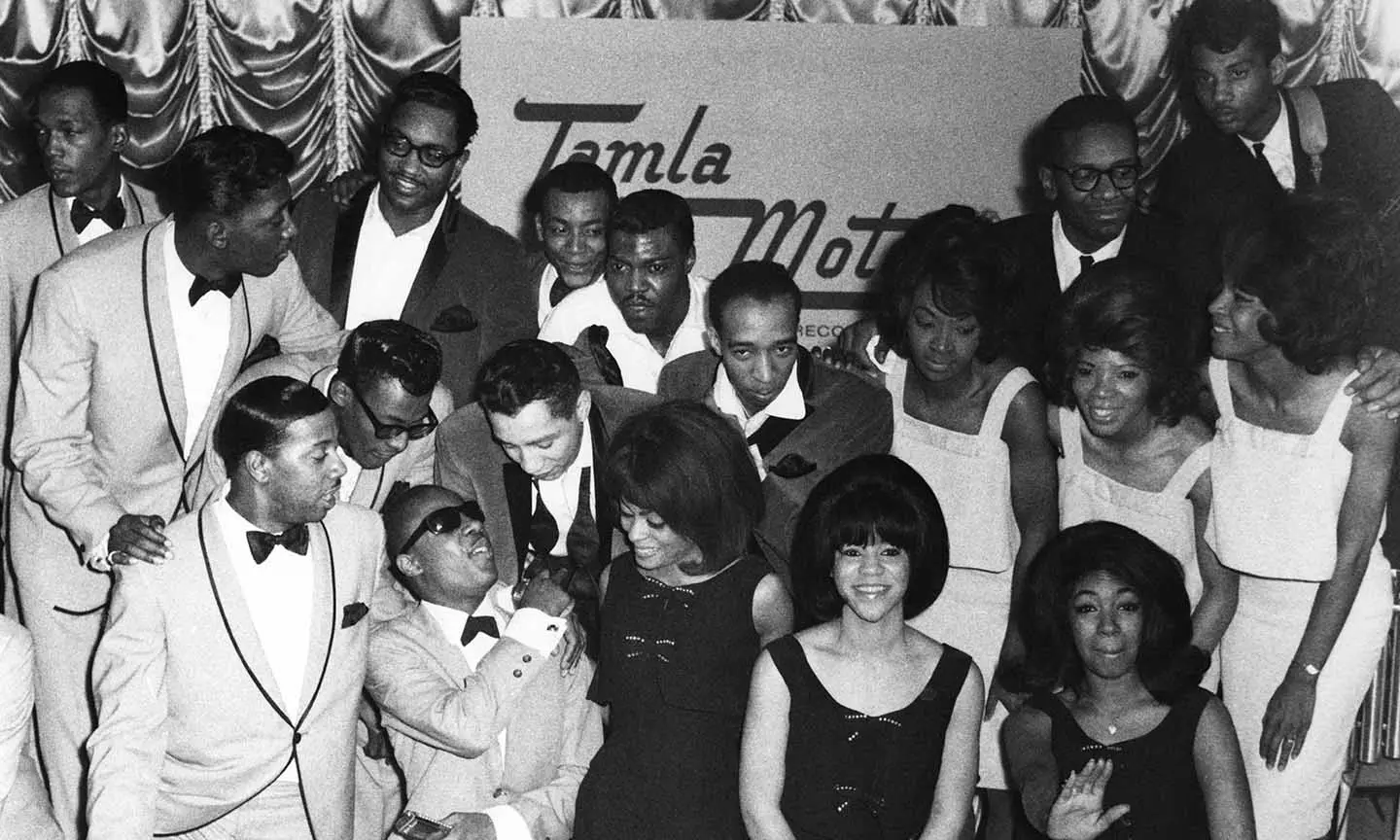
Motown was much more than just The Supremes. The label’s roster also included The Temptations, Marvin Gaye, Stevie Wonder, Smokey Robinson & The Miracles, The Four Tops, and Martha and the Vandellas, each contributing signature sounds and unforgettable hits. These artists, together with Motown’s in-house band The Funk Brothers, created the instantly recognisable Motown Sound, a blend of soulful vocals, catchy melodies, driving basslines, handclaps, and sophisticated arrangements. Motown founder Berry Gordy ran the label like an assembly line, focusing not only on crafting hits but also on artist development, choreography, and crossover success.
Motown’s music became the soundtrack for a generation, breaking racial barriers and uniting diverse audiences during the civil rights movement. Hits like 'My Girl,' 'I Heard It Through the Grapevine,' and 'Dancing in the Street' not only topped charts in the U.S. and abroad but also inspired social change, giving a powerful voice to Black artists in mainstream American households. As Motown’s influence spread internationally, it inspired musicians worldwide, including the UK’s Northern Soul scene. The label’s classic tracks have been sampled by countless hip-hop and R&B artists, and Hitsville U.S.A. in Detroit stands today as both a museum and a monument to Motown’s enduring legacy. Motown not only revolutionised pop music, but also left a lasting imprint on global culture, blending artistry with ambition and paving the way for future generations of performers.
The Velvet Underground, a stark contrast to mainstream '60s music, was a beacon of avant-garde art-rock. Led by Lou Reed and guided by the artistic vision of Andy Warhol, their debut album, 'The Velvet Underground & Nico', was a revelation. It fearlessly delved into taboo subjects like drug use, sexuality, and alienation. Songs like 'Heroin' and 'Venus in Furs' were raw and experimental, boldly challenging the norms of rock music.
Although they were not commercially successful at the time, the band’s uncompromising approach and willingness to explore the darker corners of urban life had a seismic influence on generations of musicians, from David Bowie to R.E.M. and beyond. The Velvet Underground's gritty sound and unflinching subject matter laid the groundwork for punk, alternative, and indie rock, proving that music could be a vehicle for artistic honesty and social provocation. Their collaborations with Warhol also helped bridge the worlds of rock, visual art, and avant-garde cinema, making them a foundational force in the development of multimedia art and underground culture in New York City.
Jefferson Airplane emerged as pioneers of the psychedelic rock movement, crafting a unique sound that became the definitive anthem of the counterculture revolution. Their breakout hits, such as 'White Rabbit' and 'Somebody to Love', not only captured the explosive spirit of the 1967 'Summer of Love' but also showcased their potent blend of surreal lyricism and electrifying performances. Grace Slick’s powerful, commanding vocals and the band’s fearless embrace of musical experimentation were instrumental in shaping the historic San Francisco music scene centred in the Haight-Ashbury district.
Their sophomore album, 'Surrealistic Pillow' (1967), stands as a defining masterwork of the era, blending their original folk-rock roots with mind-expanding psychedelic soundscapes. They quickly pushed this sonic experimentation even further with the chaotic, politically charged layers of 'After Bathing at Baxter's' (1967) and the heavy, revolutionary counterculture anthems found on 'Crown of Creation' (1968) and their landmark live-recorded album 'Bless Its Pointed Little Head' (1969).
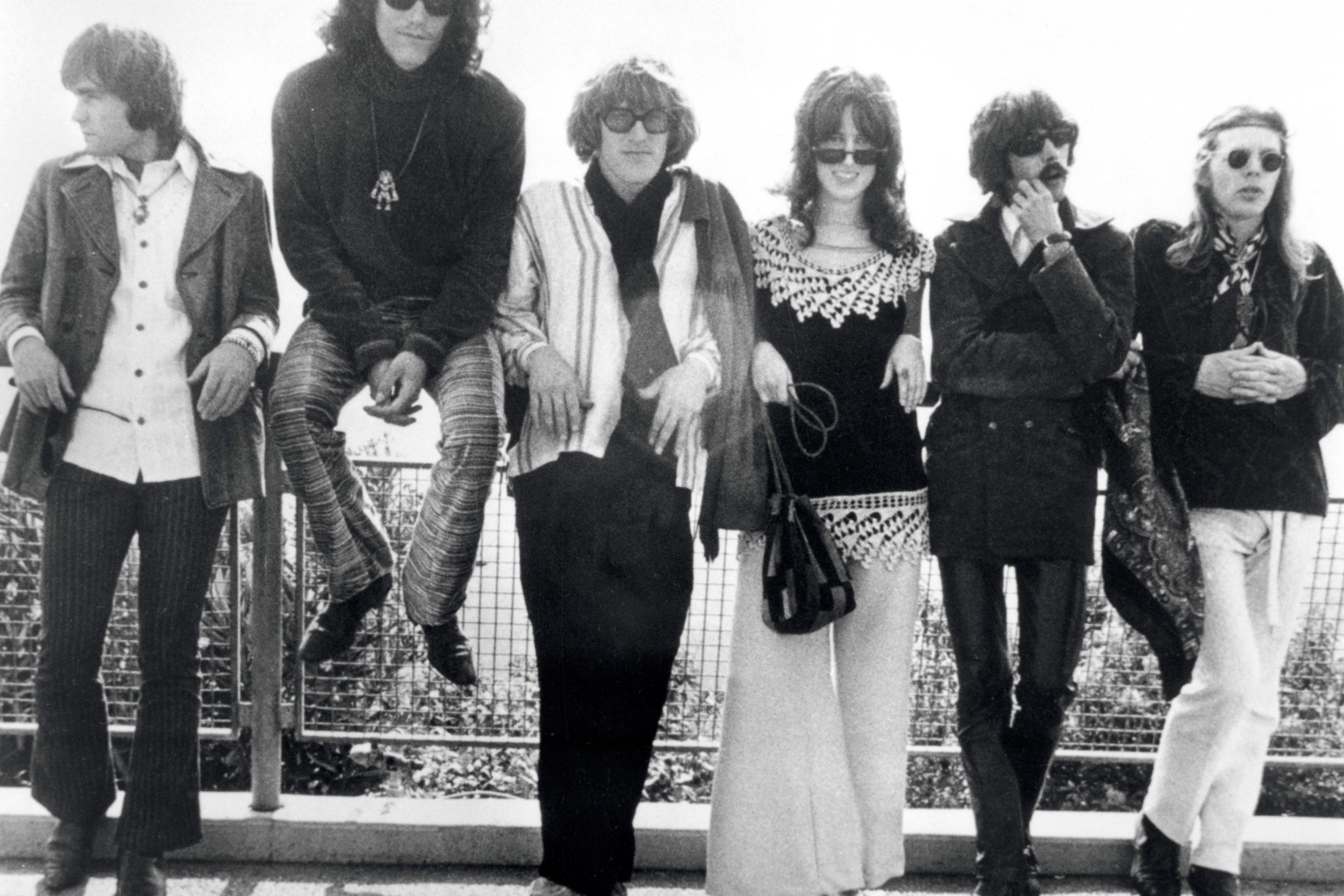
The band's sonic power relied on a dense, fiercely collaborative instrumental lineup. Marty Balin's soulful harmonies perfectly countered Slick's piercing lead vocals, while Jorma Kaukonen’s blues-drenched, weeping lead guitar riffs soared over the top. Providing a massive, complex foundation underneath was the intricate, jazz-fluid bass playing of Jack Casady and the relentless, driving rhythm of drummer Spencer Dryden.
Live on stage, this combination created a volatile, improvisational wall of sound that routinely pushed their songs into uncharted jam-band territory. Jefferson Airplane's monumental sets at major 1960s music festivals, including their sun-drenched morning performance at the Monterey Pop Festival and their historic, dawn-breaking wake-up call to the massive crowd at Woodstock, further solidified their enduring influence. By the time they closed out the decade with the raw, rebellious political fury of 'Volunteers' (1969), they had fully cemented themselves as the true sonic architects of the American counterculture
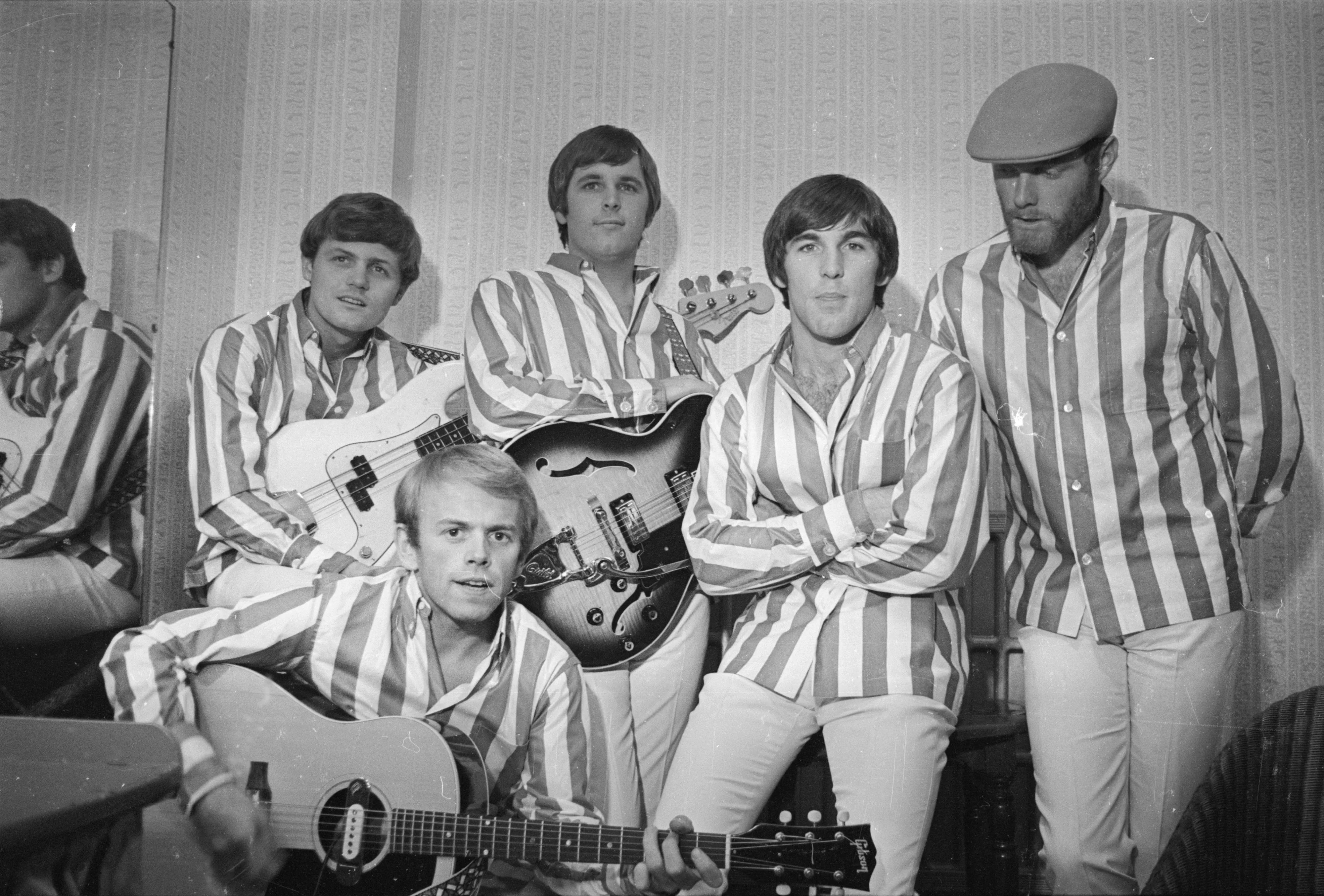
The Beach Boys captured the absolute essence of 1960s California, with songs about surfing, hot rods, and youthful idealism. Led by the musical genius of Brian Wilson, the band’s sound relied on a tight, family-centred lineup featuring brothers Dennis and Carl Wilson, their cousin Mike Love, and high school friend Al Jardine, later joined by Bruce Johnston.
On stage, they delivered clean, sun-soaked vocal harmonies while wearing matching striped shirts, presenting a wholesome image that stood in stark contrast to the gritty, rebellious British invasion bands. Behind the scenes, their music evolved rapidly from fun, radio-friendly pop hits like 'Surfin’ USA' and 'I Get Around' to the groundbreaking sophistication of 'Pet Sounds'. Released in 1966, 'Pet Sounds' was a monumental turning point not only for the band but for the landscape of popular music itself, with lush harmonies, emotional vulnerability, and innovative production techniques, including layered instrumentation, unconventional sound effects, and modular recording. Wilson created an album that completely redefined what pop could be
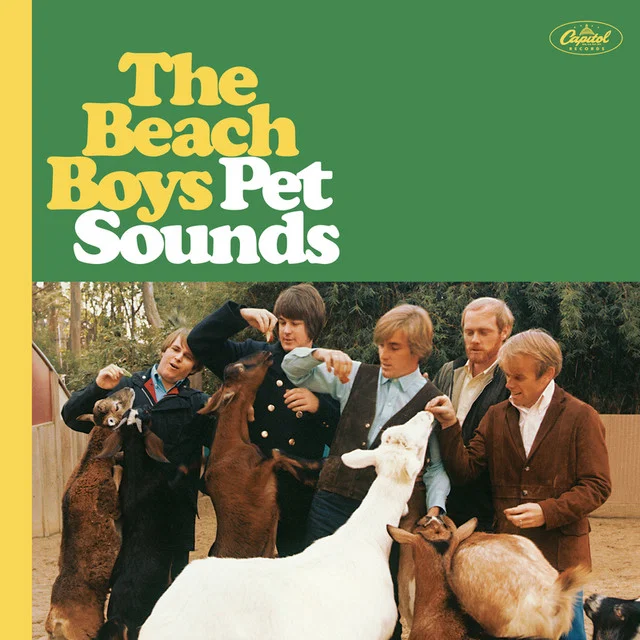
Songs like 'God Only Knows', 'Wouldn’t It Be Nice', and 'Caroline, No' explored themes of love, loss, and longing with a depth rarely heard in mainstream music at the time. The album’s introspective tone and sonic ambition had a profound impact on artists across the globe, most notably The Beatles. 'Pet Sounds' was a direct inspiration for 'Sgt. Pepper’s Lonely Hearts Club Band', a fact acknowledged by the Fab Four themselves. The single 'Good Vibrations', often considered a standalone masterpiece, was built on the innovations of 'Pet Sounds' and pushed the boundaries of what a three-minute pop song could achieve
With 'Pet Sounds', The Beach Boys transitioned from being America’s teenage soundtrack to pioneers of the studio-as-instrument era, laying the foundation for generations of artists to treat pop as a more serious, expressive art form.
Following this creative peak, Brian Wilson attempted to construct an even more ambitious, avant-garde masterpiece titled 'Smile', which was intended to be a teenage symphony to God. Wilson partnered with eccentric lyricist Van Dyke Parks to craft a deeply surrealistic, modular tapestry of American history and spirituality.
However, the sessions quickly devolved into chaos due to a combination of immense psychological pressure and logistical nightmares. Wilson's deteriorating mental health was severely exacerbated by heavy drug use, leading to bouts of intense paranoia. This included forcing musicians to wear fire helmets in the studio while recording the track 'The Elements: Fire', a session that Wilson later tried to destroy because he believed it caused real fires around Los Angeles.
Compounding this instability was fierce internal friction within the band. Mike Love and other members openly resisted the complex, non-commercial musical direction and mocked Parks’s dense, abstract lyrics, driving a wedge between the collaborators and forcing Parks to walk away from the project.
As Capitol Records grew increasingly impatient for a follow-up hit and the Beatles released 'Sgt. Pepper’s Lonely Hearts Club Band' in the summer of 1967, a defeated Wilson officially abandoned the project. The legendary tracks were abruptly shelved, locked away in studio vaults to become rock history's most famous unreleased album, leaving a collection of brilliant, fragmented masterpieces hidden from the public for decades.
In the wake of this devastating shelving, the band salvaged fragments of the sessions to release the stripped-down, lo-fi album 'Smiley Smile' (1967). Though devastated by the loss of 'Smile', the band entered a fascinating, highly collaborative late-1960s period where Carl and Dennis Wilson stepped up as writers and producers. This era yielded deeply soulful, underappreciated albums like 'Wild Honey' (1967), the warm and introspective 'Friends' (1968), and '20/20' (1969). These late-decade records traded their initial stadium-pop grandiosity for a raw, eccentric, and intimate indie-pop sound, proving that their artistry extended far beyond the surfboards and sunny beaches of their early years
Bob Dylan and Neil Young were two of the 1960s' most famous sons. Dylan, in particular, would be part of one of the most important musical moments of the 20th Century, such as his 1965 performance at the Newport Folk Festival, which marked a significant shift in his musical style and was a defining moment in music history.
The 1960s saw Bob Dylan rise as a transformative figure in music, his influence reverberating far beyond the Greenwich Village folk scene. He began his recording career with his self-titled debut, 'Bob Dylan' (1962), a stripped-down collection consisting mostly of traditional folk, gospel, and blues covers. This initial record highlighted his raw acoustic guitar work, piercing harmonica, and a distinctive, weathered vocal style that channels old-time Americana. Though it featured only two original compositions, the album established his presence in the New York coffeehouse circuit and hinted at the gritty authenticity that would define his artistry.
Blending poetic lyricism with the folk tradition, he rapidly transitioned into writing his own visionary material and became the definitive voice of a generation. His breakthrough sophomore release, 'The Freewheelin' Bob Dylan' (1963), catapulted him to international fame by introducing the timeless civil rights anthem 'Blowin' in the Wind' alongside the deeply apocalyptic imagery of 'A Hard Rain’s a-Gonna Fall'. These songs captured the absolute essence of the civil rights and anti-war movements, showcasing a sudden, unprecedented maturity in his songwriting that blended the topical urgency of journalism with the timeless weight of high literature.
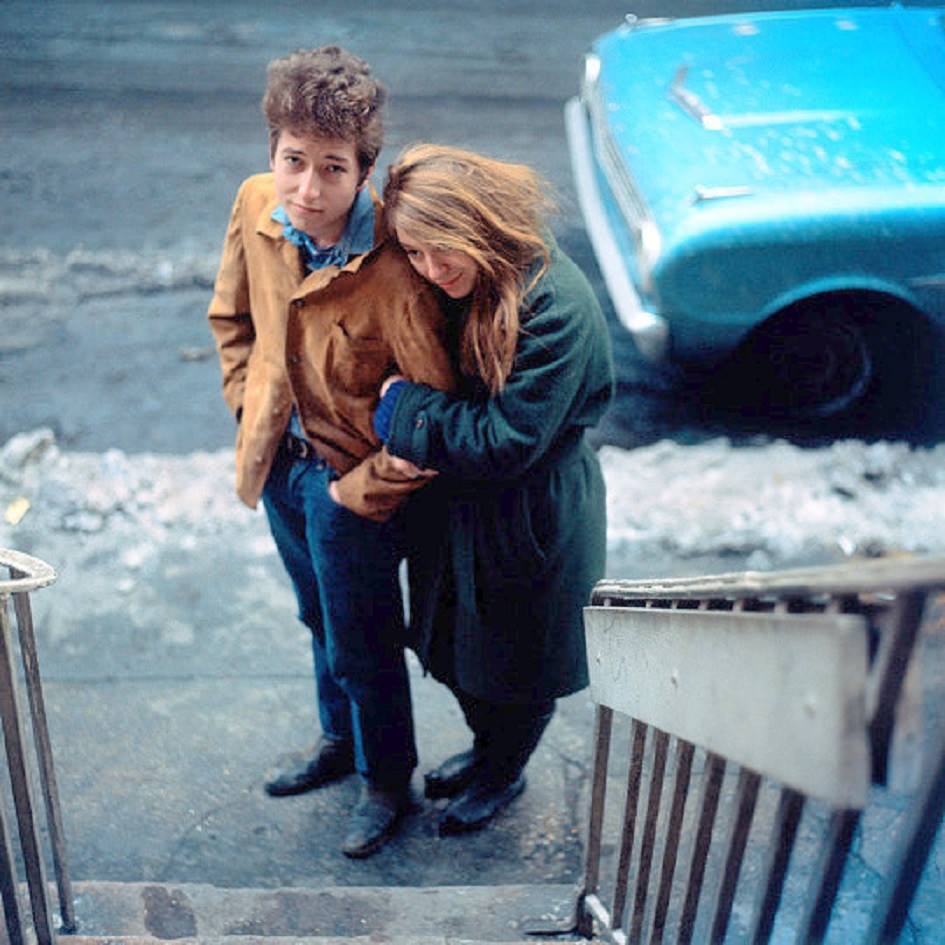
This socio-political focus peaked with his third album, 'The Times They Are a-Changin'' (1964), where the stark, uncompromising title track became a massive rallying cry for a generation seeking to redefine the world around them. Songs like 'With God on Our Side' and 'The Lonesome Death of Hattie Carroll' demonstrated the profound impact of his early music on society, cementing his status as a protest singer who could weaponise folk music against institutional injustice and racial violence.
However, resisting the suffocating labels placed upon him by the media and the folk community, he began to pivot sharply away from topical protest music toward highly personal, surrealist songwriting with 'Another Side of Bob Dylan' (1964). Tracks like 'Chimes of Freedom' and 'It Ain't Me, Babe' introduced a more abstract, symbolist poetic style that focused on internal emotions and individual liberty rather than collective political movements. This crucial transition set the stage for his imminent, revolutionary leap into electric rock music, proving that he refused to be confined by any single genre or cultural expectation.
Dylan’s impact wasn’t limited to folk music. In July 1965, he shocked the traditionalist audience by taking the stage with a loud, electric backing band at the Newport Folk Festival, a moment that has since become one of the most mythologised turning points in music history. Backed by members of the Paul Butterfield Blues Band and keyboardist Al Kooper, Dylan plugged in a Fender Stratocaster and launched into a blistering, distorted set. The reaction from the crowd was immediate and intense, with some fans feeling deeply betrayed and booing loudly over the amplified volume. At the same time, traditionalist purists decried the move as a commercial sell-out. Folk icon Pete Seeger was famously said to have wanted to cut the power cables with an axe because the distortion blurred the political clarity of the lyrics, a reflection of just how seismic the moment felt and the depth of the generational division it caused
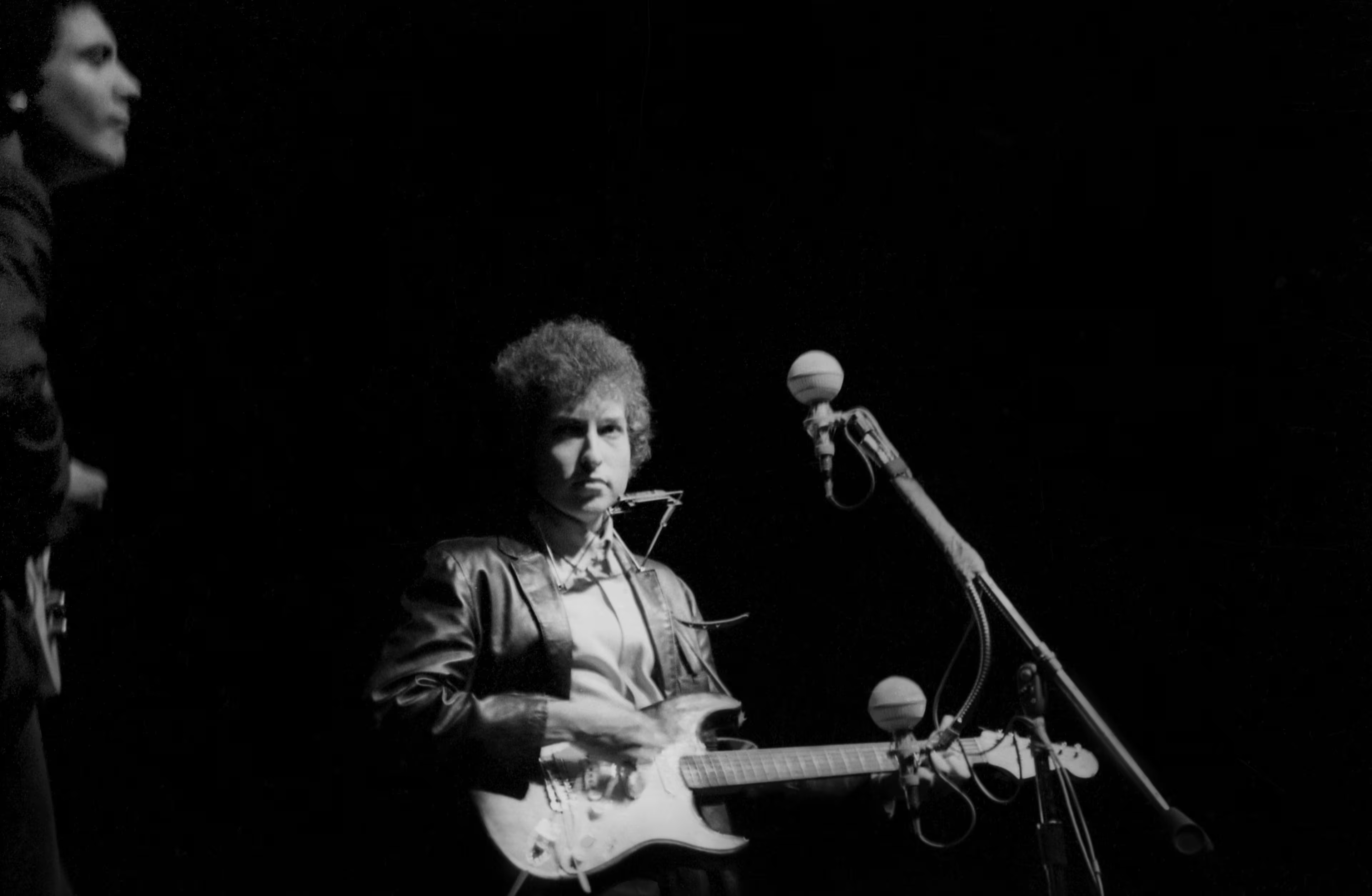
But Dylan wasn’t simply turning his back on his acoustic roots. He had already begun bridging the gap earlier that year with 'Bringing It All Back Home' (1965), a transitional album split between a loud electric side and a traditional acoustic side. This record introduced groundbreaking tracks like 'Subterranean Homesick Blues' and 'Maggie's Farm', which proved that rock music could handle complex, stream-of-consciousness poetry. This bold sonic direction was completely solidified later that summer on his masterpiece album 'Highway 61 Revisited' (1965), which featured the explosive single 'Like a Rolling Stone'. Backed by the stinging blues guitar lines of Mike Bloomfield and the spontaneous, soaring Hammond organ hook of Al Kooper, the track broke every established rule of radio formatting and songwriting with its snarling vocal delivery and unprecedented six-minute run-time. Yet, it became a massive commercial hit and fundamentally redefined the artistic possibilities of rock music.
He followed this success with the sprawling double album 'Blonde on Blonde' (1966), a landmark in lyrical complexity and sonic experimentation recorded primarily in Nashville with top-tier session musicians. Tracks like 'Visions of Johanna', 'Stuck Inside of Mobile with the Memphis Blues Again', and the epic, album-closing 'Sad Eyed Lady of the Lowlands' combined surreal, symbolist poetry with what Dylan famously described as a thin, wild mercury sound. Dylan’s electric era didn’t just evolve his own artistry; it shattered the boundary between folk and rock, ushering in an era where lyrics could be deeply poetic, songs could challenge societal norms, and popular music could finally carry the weight of serious art.
To support these revolutionary records, Dylan embarked on a legendary 1966 world tour backed by the Hawks, the Canadian rock group that would later be known simply as the Band. These concerts became battlegrounds, split into a quiet acoustic first half and a thunderous, electric second half. Night after night, hostile folk purists packed international theatres to boo, culminating in an infamous concert at Manchester's Free Trade Hall where an audience member screamed out " Judas " at Dylan before the band launched into a ferocious, retaliatory version of 'Like a Rolling Stone'.
This relentless creative frenzy and the intense pressure of global stardom came to a sudden, screeching halt in July 1966, when Dylan was injured in a mysterious motorcycle accident near his home in Woodstock, New York. The crash forced him into total seclusion, effectively ending his public electric era and allowing him to retreat into the quiet roots-rock and country experimentation that would define his late-sixties output. Ultimately, his initial decision to plug in wasn't just a stylistic choice; it was a fierce statement of personal independence and a signal that art must be a constant act of reinvention. In hindsight, Dylan's going electric was the natural evolution of folk ideals, and in doing so, he altered the trajectory of modern music itself.
During his period of total seclusion in Woodstock, Dylan began a casual, highly collaborative recording project in the basement of a house nicknamed Big Pink, playing alongside the Hawks. These informal sessions traded the blistering, wild mercury sound of his mid-sixties electric era for a warm, weathered, and deeply mysterious exploration of American roots music. Though these tracks were heavily bootlegged and not officially released at the time, they yielded stripped-down masterpieces like 'This Wheel's on Fire' and 'I Shall Be Released', establishing a template for the roots-rock movement that would sweep through the music industry at the turn of the decade.
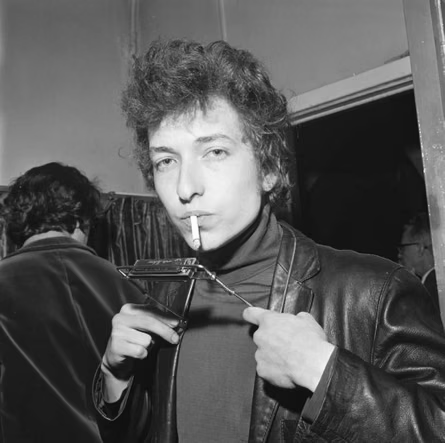
When Dylan finally emerged with a formal studio follow-up, he shocked the music world once again by releasing 'John Wesley Harding' (1967). Arriving at the absolute peak of the lush, drug-infused psychedelic rock era, the album was a stark, minimalist collection of acoustic-driven parables and folk-blues tales. Recorded with just a bass player and a drummer in Nashville, the record completely ignored the studio trickery of the time, relying instead on Dylan's haunting vocals and sparse instrumentation. The album featured 'All Along the Watchtower', a concise, apocalyptic track that was so lyrically compelling it inspired Jimi Hendrix to record his own definitive, electric reimagining of the song less than a year later.
Dylan plunged even deeper into the heart of traditional Americana with 'Nashville Skyline' (1969), a full-fledged country music album that completely shattered his image as a counterculture protest singer. He surprised listeners by dropping his signature harsh, nasal snarl in favour of a smooth, warm country croon, a vocal shift caused by his decision to stop smoking cigarettes before the sessions. The album opened with a beautiful duet version of 'Girl from the North Country' featuring country music titan Johnny Cash, who became a fierce public defender of Dylan's artistry within the conservative country establishment. Supported by hits like 'Lay Lady Lay', 'Nashville Skyline' proved that Dylan's commitment to artistic reinvention was absolute, showing that he was just as comfortable in the Grand Ole Opry as he was in a Greenwich Village coffeehouse.
Neil Young’s contributions to the 1960s were equally significant, though his journey began with the iconic folk-rock group Buffalo Springfield. Formed in Los Angeles alongside Stephen Stills and Richie Furay, the band released three albums, with Young playing a key role in crafting their unique blend of folk, rock, and country influences. His sonic imprint was clear on the paranoid, innovative production of 'Mr. Soul' and the dual-guitar interplay that defined the band's identity.
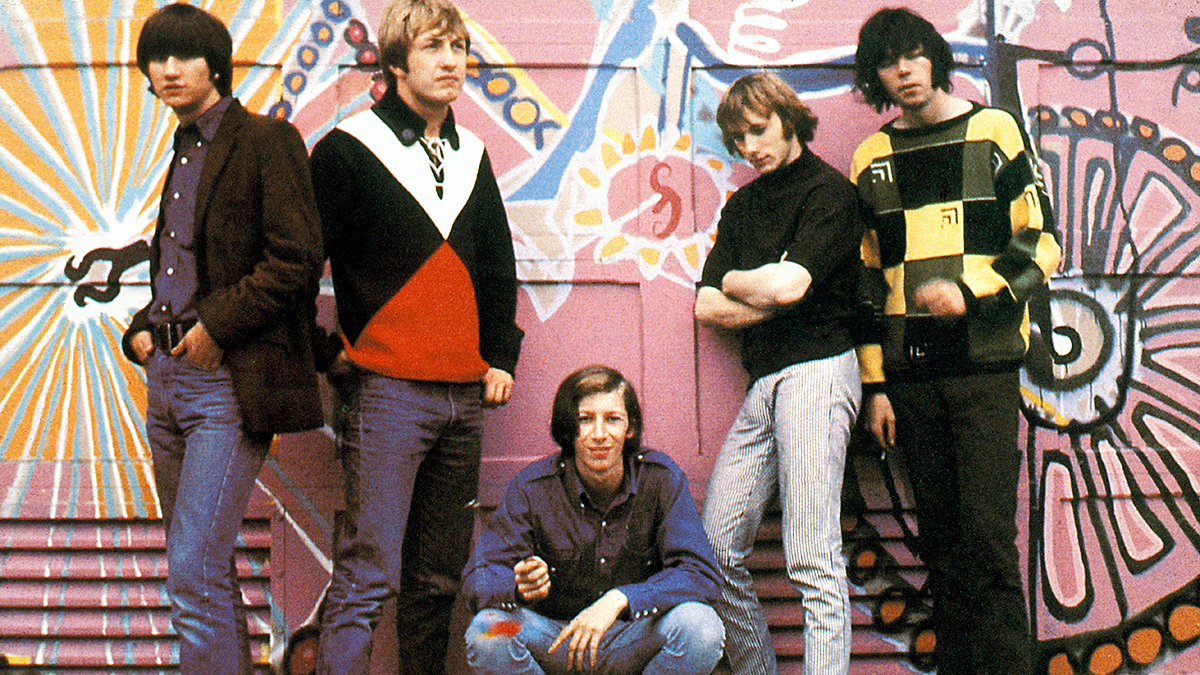
This cooperative guitar work became the backbone of their most famous track, 'For What It's Worth' (1966). While Stephen Stills wrote and sang the lead vocals for the song as a response to the Sunset Strip curfew riots, Young provided the track with its defining musical signature by playing the eerie, repeating high-harmonic guitar note that rings out through the intro and verses, adding a palpable layer of tension to the anti-war and counterculture anthem
Behind the scenes, the group was a hotbed of internal volatility and shifting lineups, which frequently saw Young abruptly quit and rejoin the band. Despite this friction, Young used the studio to experiment fiercely. Tracks like 'Expecting to Fly' and 'Broken Arrow' bypassed the traditional band setup entirely, instead showcasing Young’s introspective, avant-garde orchestral arrangements and experimental songwriting with help from producer Jack Nitzsche. These haunting, complex tracks hinted at the deeply personal and innovative work that would come to define his solo career
By the end of the decade, following the permanent collapse of Buffalo Springfield, Young began to carve out his independent identity with his self-titled debut album, 'Neil Young', in early 1969. While the record was an experimental, heavily produced folk-pop effort that suffered from an over-polished mix, it acted as a necessary creative palette cleanser. It set the stage for a dramatic musical pivot just a few months later, when Young sought a more primal, direct vehicle for his songs
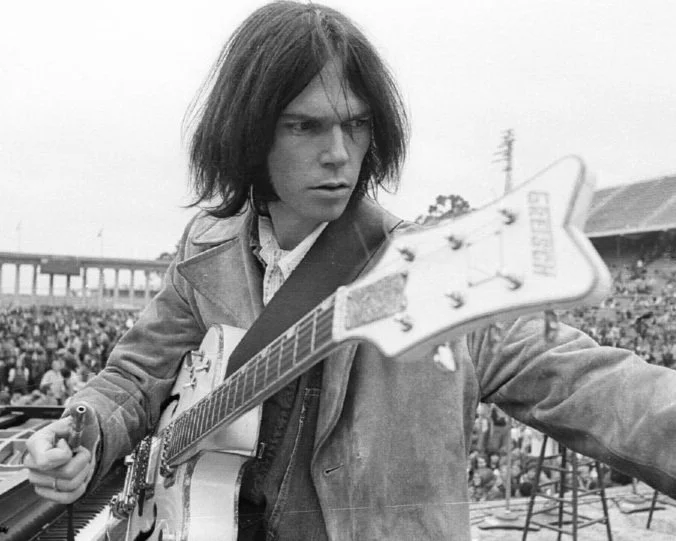
Neil Young's music would soon become a unique blend of tender acoustic ballads and adventurous, bruising sonic textures, setting him apart from every other artist of the era. This definitive breakthrough arrived with his second release, 'Everybody Knows This Is Nowhere' (1969), where he teamed up with the raw, beautifully undisciplined backing band Crazy Horse, featuring Danny Whitten on guitar, Billy Talbot on bass, and Ralph Molina on drums. Written in a single day while Young suffered from a high fever, electrifying tracks like 'Cinnamon Girl', 'Cowgirl in the Sand', and 'Down by the River' established him as a premier force in the burgeoning underground rock scene.
These songs were defined by their raw, extended guitar jams and emotive, cryptic lyricism that laid the groundwork for his storied career in the decades to come. The musical centrepiece of these tracks was the intense guitar interplay between Young and Whitten, where Whitten’s rock-solid rhythm playing provided the perfect launchpad for Young's erratic, jagged solos. He achieved this signature, heavy sound by running his beloved 1953 Gibson Les Paul guitar, nicknamed Old Black, through a highly customised Fender Deluxe amplifier, creating a unique brand of melodic, jagged, and feedback-laden distortion that practically anticipated the grunge rock movement decades later.
Young would carry this momentum into the 1970s, alternating seamlessly between fragile acoustic folk and thunderous rock. He quickly released some of his finest work, beginning with the brilliant, melancholy piano and guitar arrangements of 'After the Gold Rush' (1970), an album that addressed environmental decay and broken relationships on tracks like 'Southern Man' and 'Don't Let It Bring You Down'. This creative hot streak led directly into 'Harvest' (1972), a massive commercial success recorded in a barn on his Northern California ranch. The album featured his only number-one hit single, the country-rock ballad 'Heart of Gold', alongside the sweeping orchestral arrangements of 'A Man Needs a Maid' and the gritty anti-heroin warning of 'The Needle and the Damage Done'.
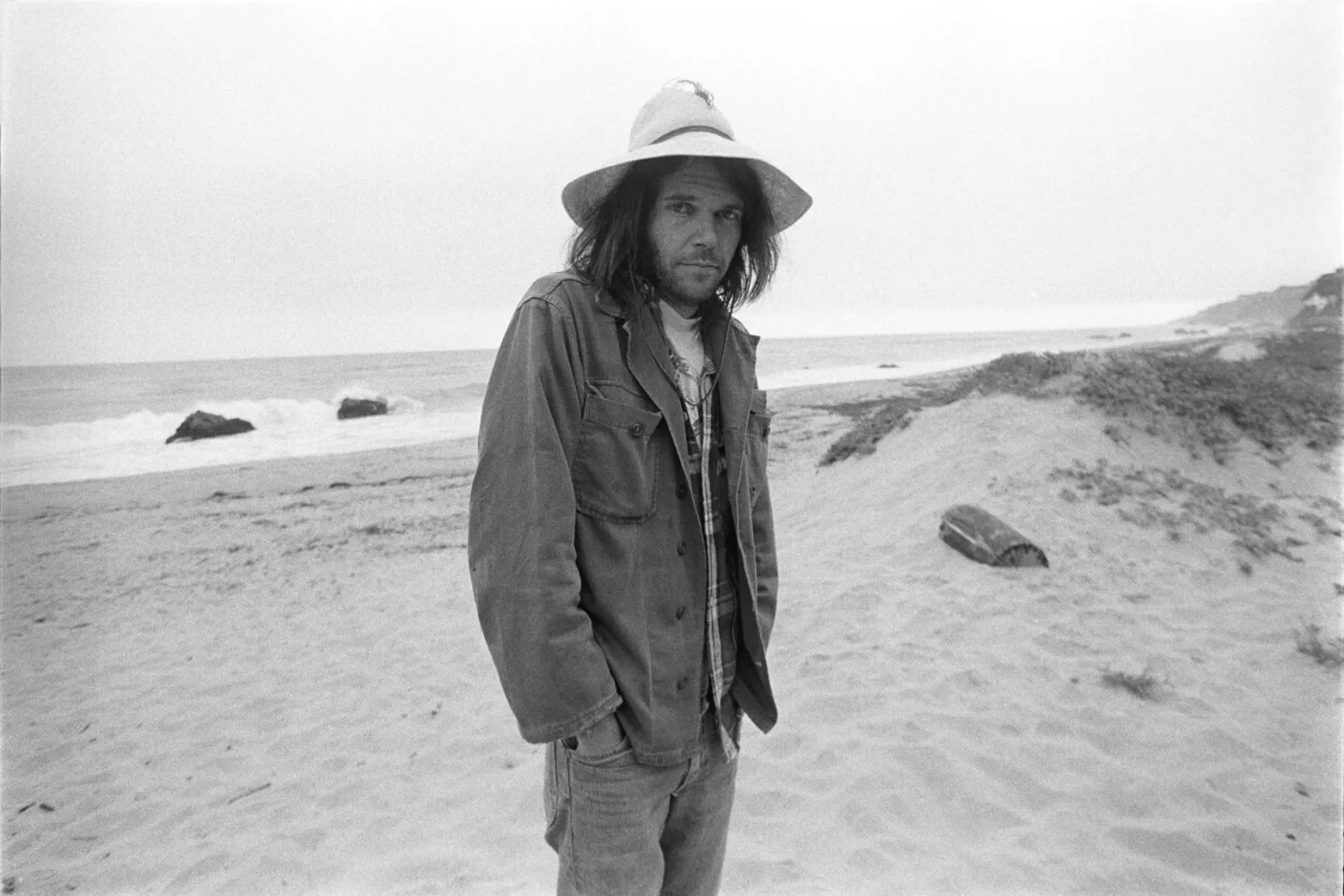
Following the tragic drug-related overdoses of Danny Whitten and roadie Bruce Berry, Young recoiled from mainstream stardom and retreated into a period of deep emotional turmoil. He channelled his grief and cynicism into a trilogy of dark, unflinching, and deliberately unpolished albums known to fans as the Ditch Trilogy. This raw artistic purge began with the chaotic live album 'Time Fades Away' (1973) and the booze-fueled nocturnal grief of 'Tonight's the Night', which was recorded in 1973 but delayed due to its harrowing intensity. This historic run culminated in the release of the bleak, haunting masterpiece 'On the Beach' (1974), a record that combined bluesy desolation with sharp critiques of capitalist culture, proving that the uncompromising independent spirit he forged in the late 1960s would continue to guide his art, regardless of fame or commercial expectations.
In summary, the 1960s were a decade of transformation, driven by a generation's unwavering determination to break away from the past and forge a new future filled with hope. This era, marked by rapid change, left behind a wealth of incredible records and boldly turned away from the ways of old.
As The Who so aptly put it, 'The Kids Are Alright', a sentiment that encapsulates the spirit of the 1960s and its determination to forge a new future.