Top 10 James Songs
James, formed in Manchester and initially signed to Factory Records, never followed obvious paths to success. Few bands have had a journey quite like theirs: from a scout hut in Withington, where Tim Booth was recruited as a dancer before anyone realised he could sing, to becoming one of the most cherished and celebrated bands ever to emerge from a city that has produced more than its fair share of legends.
Their story begins in 1982 in Whalley Range, Manchester. After catching the attention of Factory Records boss Tony Wilson at the Haçienda, they released their debut EP, ‘Jimone’, in 1983. It was Morrissey, already a devoted fan, who helped give them their first major break: personally endorsing the band and inviting them to support the Smiths on the ‘Meat Is Murder’ tour in 1985. The Smiths even covered James’s own ‘What’s the World’ during that tour, a remarkable endorsement for any young band. Their early albums ‘Stutter’ (1986) and ‘Strip-mine’ (1988) earned critical respect but modest sales, and the band spent much of the late 1980s building a fierce live reputation rather than chart success; at one point, sales of their T-shirts vastly outstripped their record sales.
By the late 1980s, James were at the heart of Manchester’s extraordinary musical moment. Both the Stone Roses and the Happy Mondays had previously supported James on tour before going on to spearhead the Madchester movement, a fact that speaks volumes about how central James were to that scene, even if history has sometimes overlooked them in favour of their former support acts. When ‘Gold Mother’ arrived in 1990, it went to No. 2 in the UK, and the re-recorded ‘Sit Down’ the following year, with its irresistible baggy beat and the opening line “those of you who have suffered”, became one of the defining anthems of a generation, reaching No. 2 on the UK singles chart. That it was kept off the top spot, first by Chesney Hawkes and then by Cher, remains one of pop music’s great injustices.
The early 1990s were James at their commercial and creative peak. ‘Seven’ (1992) consolidated their arena-rock status, while ‘Laid’ (1993), produced by the legendary Brian Eno, is widely regarded as their masterpiece: a beautifully restless album that broke them in America on the strength of its bawdy, soaring title track. The Eno sessions also yielded the experimental companion piece ‘Wah Wah’ (1994). Further albums ‘Whiplash’ (1997) and ‘Millionaires’ (1999) followed before interpersonal tensions led to a split in 2001, with Tim Booth departing to pursue other projects.
The 2007 reunion proved that James were far from finished. ‘Hey Ma’ (2008) announced a creative rebirth, and the band have continued to release ambitious, vital music ever since, including ‘All the Colours of You’ (2021), which reached No. 3 in the UK, and ‘Be Opened by the Wonderful’ (2023), a double album on which they reinterpreted their catalogue with an orchestra and choir. Their legacy is one of remarkable longevity and quiet influence: a band that outlived acid house, Britpop, and grunge, and kept evolving through them all. That journey reached a new peak with ‘Yummy’ (2024), which gave them their first-ever UK No. 1 album, 42 years into their career, and proof, if any were needed, that some bands only get better with time.
So there you have it: a brief history of one of Britain's most enduring bands. But history only tells part of the story; the real measure of any band is in their songs. James has never been short of those, and narrowing their catalogue down to just ten is no easy task. Here, then, is my personal top ten.
10. Nothing But Love
The lead single from the 2016 album ‘Girl at the End of the World’, ‘Nothing But Love’ is a euphoric, full-hearted celebration of love in its most elemental form: an anthem which has soundtracked weddings and emotional montages ever since. The song was a long time in the making; the band had previewed an early version live at Scarborough Open Air Theatre in 2015, but Tim Booth later admitted that the lyric wasn’t there yet, saying: “We knew the song would work, but it didn’t work then.” Even within the band, there was debate about the song’s direction; Booth and bassist Jim Glennie were convinced from the start that it was the big song on the record, while others were less sure it had single potential. The finished version is something else entirely.
What makes ‘Nothing But Love’ so compelling is what it is actually about. It is not a straightforward love song. Booth has explained that the lyric captures a love that is overwhelming and potentially destabilising: “Oh shit, I’m in love with this person... It’s a love that threatens your life, in a certain kind of way.” The imagery of “earthquake, avalanche, volcano” is not decorative; it is Booth’s way of conveying that this kind of love is not easy or gentle, but something that erupts and upends everything in its path. It is, as he put it, “not an easy-going kind of love.”
Musically, the song carries that weight beautifully. Brian Eno, the band’s long-time collaborator, was brought in when the band felt they had reached a creative dead end with the track. Booth recalled phoning Eno directly, and Eno’s contribution, an unmistakable synthesiser arpeggio, gave the song the lift it needed. Former member Adrian Oxaal added mandolin and cello, lending the track a rich, layered warmth that few bands could pull off. The layers of vocals build to something genuinely communal and uplifting, and it is no surprise that the song became a highlight of the band’s 2023 orchestral tour, taking on an even greater scale when performed with a full orchestra and choir.
The song also lent its name to the band’s definitive career retrospective, ‘Nothing But Love: The Definitive Best Of’, released in 2025, a choice that speaks to how central the track has become to the James story. As a reminder that James could write tender, heartfelt pop as well as they could write anthems, it remains one of the finest moments from their post-reunion era, and proof that, even four decades in, they were still capable of writing songs that felt genuinely new.
9. Ring the Bells
‘Ring the Bells’ is the second track on the 1992 album ‘Seven’, and one of the most quietly powerful songs in the James catalogue. Written by Tim Booth, Larry Gott and Jim Glennie, it had actually been in the band’s live set long before it was ever recorded; it was first aired on the World Cup tour of 1990 and became a fixture in their setlists from that point on, appearing in the ‘Come Home’ live video. When it came to choosing the follow-up single to ‘Sit Down’, ‘Ring the Bells’ was the obvious choice, but the band and label went with the less immediate ‘Sound’ instead, a decision that perhaps denied the song the wider recognition it deserved.
A demo version of the track, entitled ‘Ring Those Bells’, dates all the way back to January 1990 and was later included on the 2012 box set ‘The Gathering Sound’, offering a fascinating glimpse at the song in its earliest form.
At its heart, ‘Ring the Bells’ is a song about waking people up: a rallying call to those sleepwalking through life, delivered with the kind of urgent sincerity that James do better than almost anyone. Booth has said the song is about “breaking free from patriarchal Jehovah” and “finger pointing the God of shame”; it is, in other words, a song about liberation from authority, from the constraints of religion and expectation, and from the passivity of a crowd that has stopped questioning. The opening lines, “Ring, ring the bells, wake the town, everyone is sleeping,” set that tone immediately: this is not a gentle nudge but a shout, an insistence that the world wake up to what is happening around it. As the song builds, the lyric shifts from frustration to something more expansive and personal; the lines “when you let me fall, grew my own wings, now I’m as tall as the sky” speak to resilience and self-discovery, the idea that being let down or abandoned can paradoxically become the thing that sets you free.
Musically, the song is a perfect example of what made James so distinct from their contemporaries: it builds from a deceptively simple guitar riff into something genuinely anthemic, with Andy Diagram’s trumpet adding colour and lift, and Booth’s vocals rising with the song’s emotional momentum. The production, handled in part by the band alongside Youth, gives it a live, breathing quality that suits the material perfectly. The track reached number 37 in the UK Singles Chart upon its release in March 1992, though its chart position tells only a fraction of its story; it has remained a beloved live staple ever since, and one of those songs that means far more to the people who know it than the numbers suggest. It has also remained a band favourite in acoustic form, appearing on the ‘Unhinged’ bonus CD included with their 1998 best of collection.
Perhaps the most striking testament to the song’s real-world power is a story Tim Booth has told on a number of occasions: a group of young people in an American religious cult used ‘Ring the Bells’ as their anthem and their inspiration to break free from their parents. Given what the song is actually about, that is not entirely surprising; it is a song built for exactly that kind of catharsis.
The fact that it could reach people in that situation, and mean that much, says everything about what James at their best are capable of. The song was later released in a live acoustic form on the 1994 Greenpeace compilation ‘Alternative NRG’, and that version even found its way into an episode of The X-Files: a quietly surreal footnote to a remarkable song.
8. Tomorrow
‘Tomorrow’ has an unusual history even by James’s standards. It began life not as a crafted song but as an improvisation: born in the second studio that James had set up at Real World Studios during the ‘Laid’ sessions in 1993, where Brian Eno would select pieces of the band’s improvised jams and mix them on the spot, doing only one take to preserve the spirit of the moment. That raw version appeared on the 1994 experimental album ‘Wah Wah’, the sprawling companion piece to ‘Laid’, and it had been a regular feature of James’s live sets even in that early form. Three years later, having survived a period of serious internal upheaval, a crippling tax bill, and a lineup change, the band resurrected it, rerecorded it with a more anthemic, conventional sound, and released it as the second single from the 1997 album ‘Whiplash’.
It reached number 12 in the UK Singles Chart, and it remains one of the most purely uplifting songs in the James catalogue: a soaring, wide-open anthem co-written with Eno, built around Booth’s extraordinary falsetto and a sense of forward momentum that feels almost physical. One contemporary reviewer described it as “a huge anthemic stadium sparkler... the perfect vehicle for Tim Booth’s Broadway show-stopping tendencies”, and it is hard to argue with that. Clash included it on their list of the top 10 best James songs: "Put simply, it is the song U2 wish they had written".
Aching-yet-optimistic acoustic guitars precede a song of hope, “gotta keep faith that your path will change, gotta keep faith that your luck will change tomorrow,” which could go on forever if only the band would let it. The Sunday Times noted that on ‘Whiplash’ the band “sound much less angst-ridden than they used to; Booth’s declamatory vocal style is here propelled forward by frenetic drums and acoustic guitars that positively glisten in the mix”, and nowhere is that more true than on ‘Tomorrow’. It is a song that seems to grow with each listen, and which takes on a different quality depending on when and where you hear it; intimate and personal at low volume, vast and communal at full blast in a field.
Watching Tim Booth let loose and dance without inhibitions when the song is played live is a sight to behold; the way he inhabits a song physically is unlike almost any other frontman, and ‘Tomorrow’ brings out the best of it. There is something about the song’s relentless forward motion, its refusal to give in to despair, that seems to unlock something in both Booth and the crowd. It is not a complicated song, and that is precisely the point: sometimes the most powerful thing a band can do is strip everything back to a simple, repeated act of faith.
The song gained extra significance when performed on a sodden Friday morning at Glastonbury 2016, the day after the EU referendum result. It was Saul Davies, unusually, who took to the mic to speak before the song: “This is dedicated to all the brilliant, beautiful people in the country who voted to Remain. It’s with incredible sadness that we stand up here today, privileged to be in front of you, but unified in our sadness that our country has turned on people. Fuck them.”
A much-needed sliver of hope to a despondent crowd on a desperate morning; the kind of moment that only live music can provide, and the kind of moment that only James seems to find themselves at the centre of.
What makes ‘Tomorrow’ feel especially significant to me personally is the way it connects James to the next generation of Manchester music. The Courteeners, who have long been open about their love of James, have for years incorporated a snippet of ‘Tomorrow’ into the live version of their own song ‘What Took You So Long?’, from their debut album ‘St Jude’ (2008). It is a tribute that speaks to just how deep the James influence runs in Manchester, and it made for a genuinely special moment on 15th June 2019 at Heaton Park, when James supported the Courteeners in front of 50,000 people: my first time seeing James live. Having watched James play their set, and then heard Liam Fray weave ‘Tomorrow’ into the Courteeners’ closing song in front of that enormous crowd, felt like a passing of the torch between two generations of Manchester bands, and a reminder of just how long James’s shadow reaches.
7. Just Like Fred Astaire
‘Just Like Fred Astaire’ is the second track on the 1999 album ‘Millionaires’, and one of the most purely joyful songs James have ever recorded. Produced by Brian Eno and Steve Osborne, it is an unashamedly romantic, sweeping piece of orchestral rock: a love song so giddy and wide-eyed that it almost dares you to resist it. One contemporary reviewer called it “a completely over the top love song” that “is so beautiful it should be put under a glass globe and Mr Sheened by angels,” and that is not far off the mark.
The lyric is a masterclass in Booth’s particular brand of romantic poetry: absurd, tender, and completely sincere all at once. The narrator visits a doctor with symptoms of lovesickness, “palpitations, my mind’s diseased, even my vision is impaired, I’m losing my hair,” before arriving at the chorus: “when I hold her in my arms, I feel like Fred Astaire.” The Fred Astaire comparison is not just a throwaway image; it is carefully chosen. Astaire was synonymous with effortless elegance, grace under pressure, and the ability to make something impossibly difficult look natural and light.
That is precisely what the song is about: the way love can make the ordinary feel extraordinary, make the clumsy feel graceful, make the anxious feel free. The lyric also goes beyond simple romance; later verses touch on crossing racial divides and bridging gaps “that weren’t really there,” giving the song a quietly political dimension that sits comfortably alongside its giddiness. It is a lyric that captures the dizzy, disorienting euphoria of falling in love better than almost anything else in the James catalogue, and the song’s swooping melody carries that feeling all the way through.
The song even came with its own behind-the-scenes drama: the band had originally approached the estate of Fred Astaire seeking permission to use footage of the Hollywood legend in the video, only to be threatened with legal action if they released the song under its original title. The artwork for the single, which had planned to feature Fred Astaire and Ginger Rogers, was similarly blocked by the estate, and a romantic older couple was used instead. The video was filmed at the then-derelict West Pier in Brighton. The single was seen internally as potentially the biggest on ‘Millionaires’; Saul Davies described it as having “an enormous amount of crossover potential as a crossover tune to a public we haven’t really had before.” In the event, releasing it only a week before the album worked against it; by the time the band appeared on Top of the Pops, ‘Millionaires’ was already in the shops, and the single peaked at number 17, perhaps lower than it deserved.
It is also worth noting the context in which ‘Just Like Fred Astaire’ arrived. ‘Millionaires’ was the last James album before the band’s split in 2001, and there is something bittersweet about the fact that one of their most optimistic, life-affirming songs came at the end of their first chapter. Tim Booth himself acknowledged at the time that the band’s renewed energy had come alongside unresolved tensions: “The optimism of the last year did give the band a real lift, but there were a lot of problems and conflicts at the same time which hadn’t been resolved. Those tensions are all there in the songs as well.” That duality, joy and strain existing side by side, gives ‘Millionaires’ as a whole, and ‘Just Like Fred Astaire’ in particular, a quality that goes beyond simple celebration. The album reached number two in the UK and was certified gold, and one live reviewer at the time wrote that ‘Just Like Fred Astaire’ was “one of those jaw-droppingly eerie ballads, like Joy Division’s ‘Love Will Tear Us Apart’ or U2’s ‘One’, that give a band genuine gravitas.”
High praise, and entirely deserved. The song has endured so well in the years since, remaining a staple of James’s live set. It tapped into something genuinely universal: the feeling, however fleeting, that love can make you lighter than air.
6. Come Home
‘Come Home’ has one of the more complicated histories in the James catalogue, and understanding that history makes the song even more remarkable. It was first released as a single in November 1989 on Rough Trade Records, received little attention, and led directly to James parting ways with the label. That it would go on to become one of their most enduring songs is a testament to the way James’s best material has always found its audience eventually, even if it had to take the long way round.
The song was written by Tim Booth out of genuine personal anguish. He wrote it about walking away from his partner and son not knowing if he’d done the right thing; the mother of his first child was also James’s manager and would send the band on tour for months at a time, and Booth felt, as he later put it, “so bad about being away from my son in particular” and “a lot of guilt and shame.” That raw emotional honesty is audible in every note of the song: it is not a polished, comfortable piece of writing but something genuinely conflicted, a song that aches with the tension between duty to the band and duty to the people you love. It is also, in its own way, a song about the pull of home itself: that irreducible need to return to the people and places that make you who you are.
The Madchester scene was exploding around the band as they recorded ‘Gold Mother’, and watching the Happy Mondays use a drum machine convinced James to experiment with the sound themselves, directly influencing ‘Come Home’. The track was written in the studio rather than developed over time, giving it an immediacy and urgency that sets it apart from more carefully constructed James songs. It was initially intended as the lead single from ‘Gold Mother’ and was distributed to club DJs as a white-label promo by Rough Trade without revealing James as the artist, in order to combat the band’s reputation as “wimpy, vegan, celibate Buddhists.” The tactic worked in the clubs; it was the mainstream that took longer to catch on.
When Fontana re-released the song in June 1990 in a version remixed by Flood, everything changed. The re-release came at the end of the band’s triumphant World Cup tour and Glastonbury performance, and the timing was perfect: James were suddenly the hottest band in Manchester, and ‘Come Home’ had a production sheen to match the moment. The Flood mix strips back some of the original’s rougher edges and replaces them with a propulsive, danceable energy that plants the song firmly in the Madchester era without losing any of its emotional core.
The 12” formats of the re-release also featured a remix by Andy Weatherall, the man who had just created Primal Scream’s era-defining ‘Loaded’, and whose involvement was a mark of exactly how plugged into that moment James had become. The song featured on the influential 1990 Madchester compilation album ‘Happy Daze’, cementing its place in that scene’s history. The single reached number 32 in the UK, and the artwork, with “come” on the front and “home” on the back, became one of the most recognisable James images of the era.
Live, ‘Come Home’ is one of those songs that seems to expand to fill whatever space it is played in. The chorus, with Booth’s voice rising and the crowd invariably joining in, has the quality of a collective exhale: everyone, for a moment, feeling the same thing. It is a song about longing and guilt and love and belonging, and it works on all of those levels simultaneously. That it began as a deeply personal piece of writing and became something so widely shared is, in many ways, the James story in miniature.
5. She's a Star
‘She’s a Star’ is the lead single from the 1997 album ‘Whiplash’, and in many ways, it is the song that brought James back. After the internal upheaval, financial difficulties, and prolonged absence that followed the ‘Laid’ and ‘Wah Wah’ era, the band returned in February 1997, needing to prove they were still relevant. ‘She’s a Star’ did exactly that: A-listed by Radio 1 and released on 10 February 1997, it reached number nine in the UK Singles Chart, becoming the band’s first top-ten single since 1991 and their third overall. It was certified silver by the BPI in December 2020 for sales and streams exceeding 200,000 units, and as of now remains their last UK top-ten single, a fact that says more about the fickleness of the charts than it does about the quality of everything that followed.
The single came in a three-CD slipcase format, a format the band had employed across the ‘Whiplash’ campaign, with one disc of new B-sides, one of live and session tracks, and one of remixes. Controversially, the record company ditched vinyl and cassette entirely, a decision that drew criticism from some quarters but reflected the label’s confidence that the song would sell on CD alone. They were right.
The song was written by Tim Booth, Jim Glennie, and Larry Gott, and it is, in Booth’s own words, about “a woman coming out into her power.” It was his first attempt at writing from a woman’s perspective, shifting away from his usual pronouns to centre the lyric on female experience, and the result is one of his most generous and outward-looking pieces of writing. The lyric traces a woman moving through self-doubt and insecurity towards a recognition of her own worth: the repeated chorus declaration, “she’s a star,” is not triumphant so much as quietly insistent, a reminder rather than a revelation. The opening verses are unflinching about the texture of that insecurity, the frozen face, the packed bags, the shadow that keeps her small, before the song opens out into something warmer and more affirming. It is a song that earns its uplift, and that is why it works.
Lyrically, the song sits in a tradition of James writing that is outward-looking rather than confessional: Booth observing the world and the people in it rather than excavating his own interior. It shares that quality with ‘Come Home’, which was also written from a position of empathy and guilt rather than self-interest, but where ‘Come Home’ is shot through with anxiety, ‘She’s a Star’ is almost entirely generous in its impulse. The woman at the centre of the lyric is not a passive figure waiting to be rescued; she is someone who already contains what she needs, and the song’s job is simply to tell her so. That is a harder thing to write convincingly than it sounds, and the fact that it never tips into condescension or sentimentality is a mark of how carefully it is constructed. The band promoted it heavily in the week before release, with live performances on Channel 4’s TFI Friday and The Bob Mills Show, and the response confirmed what Radio 1 had already sensed: this was a song that connected.
Musically, ‘She’s a Star’ represents the sound of James consciously modernising without losing themselves. The ‘Whiplash’ sessions had begun at Westside Studios with Brian Eno in March 1995, drawing on ideas developed during sound-check jams on the previous American tour, and the album’s blend of the band’s signature rock sound with electronic textures is at its most accessible on this track. Stephen Hague, brought in to add what was described as a “pop Midas touch” to the album’s production, helped give the song a sheen that suited radio without stripping out its emotional core. The video featured a then-unknown Keeley Hawes, years before she became one of Britain’s most celebrated television actresses, and it is one of those videos that now functions as an accidental time capsule of mid-nineties British pop.
The song’s afterlife has been remarkable. In November 2025, it was chosen as the soundtrack to the Waitrose Christmas advertising campaign, a four-minute romantic comedy short titled ‘The Perfect Gift’, starring Keira Knightley and Joe Wilkinson and directed by Molly Manners. The advert used both the original 1997 recording and the orchestral version recorded for the 2023 ‘Be Opened by the Wonderful’ tour, and it became one of the most talked-about pieces of advertising that Christmas, widely described as the best Christmas advert of 2025.
The music supervisor who placed the track described it as “a proper British 90s classic, with the perfect tone and sentiment for the story.” That a song written nearly thirty years earlier could feel so perfectly suited to a new context is a testament to how well it was constructed: ‘She’s a Star’ is one of those songs that seems to know exactly what it is, and never stops being right.
4. Runaground
‘Runaground’ is one of James’s most underrated songs, and one of the most quietly devastating things Tim Booth has ever written. Released in May 1998 as a single to accompany the band’s first compilation, ‘The Best Of’, it was one of two new tracks recorded specifically for that release, the other being ‘Destiny Calling’. Where ‘Destiny Calling’ is rousing and anthemic, ‘Runaground’ is its opposite: subdued, wistful, and achingly direct. It is a song about the particular kind of self-destruction that comes from always wanting more than you have, from leaving every door open, from being so afraid of getting stuck that you end up dropping everything worthwhile in the pursuit of things that turn out to be shadows.
One reviewer placed it alongside ‘Come Home’ and ‘Don’t Wait That Long’ as another of Booth’s flagellating stabs at his own unreliability, and that reading is hard to resist: there is a through-line in the James catalogue of Booth holding himself to account with a rigour he rarely applies to anyone else, and ‘Runaground’ sits squarely in that tradition.
The song was written collectively by the full band lineup at the time: Booth, Jim Glennie, David Baynton-Power, Saul Davies, and Mark Hunter. It is a track that sounds like a band completely at ease with itself, and perhaps that ease is what makes it so affecting. There is no grandstanding here, no stadium-sized gesture; just a soft arrangement built around gentle guitars, a lilting, almost sighing melody, and Saul Davies’s violin threading through the track like light coming under a door. One contemporary reviewer described it as sitting in “one of the reflective lulls between their big anthems,” and that is exactly right: it is the kind of song that James have always been capable of but which tends to get overlooked in favour of the more immediately arresting material.
The lyric has a directness that is unusual even for Booth. There is no metaphysical scaffolding, no egghead bluster; just an honest, unguarded account of a man who cannot stop himself from looking for something else, always leaving an open door, always thinking “why can’t I have more?” The couplet “You take for granted all the riches of the world / You may have oysters, but you’ll never find your pearls” is as precise a summary of that particular affliction as anything in the James catalogue: the idea that the restless pursuit of more is precisely what keeps the best things out of reach. The result is a song that feels like a confession, and a remarkably unsentimental one. It does not ask for sympathy; it simply states what it sees, with the kind of clarity that only comes when a writer has stopped trying to make themselves look good. That honesty is what gives the song its staying power: it is a song that a lot of people recognise themselves in, even if they would rather not.
The release was complicated by poor timing: the single was delayed by three weeks, and when it finally came out, Booth was in the middle of an acting stint in a production of ‘Saved’ at the Bolton Octagon, which severely limited the band’s ability to promote it.
A day off allowed a TFI Friday performance and a few interviews, but that was more or less the sum of it. The fact that the song was already available on the platinum-selling ‘The Best Of’ did not help its chart prospects, and it entered the top 40 at number 29 before dropping away the following week. It was a chart position that did not reflect the quality of the song, and Saul Davies’s reported prediction that it would be the band’s biggest single since ‘Sit Down’ turned out to be wishful thinking.z But chart positions are the wrong measure for a song like this. ‘Runaground’ is not a song that announces itself; it is a song that stays with you.
3. Destiny Calling
‘Destiny Calling’ is the one that makes you want to leap out of your seat. Released in August 1998, a week before the band’s first compilation ‘The Best Of’, it is the most immediate and exhilarating thing James recorded in the 1990s outside of ‘Sit Down’: a rousing, capo-up, full-throttle rush that sounds, as Saul Davies once cheerfully described it, like “’She’s a Star’ at twice the speed.” Davies wrote it that way after sitting down with a capo and turbocharging the melodic DNA of the previous single. The result is something that feels both instantly familiar and entirely new, a song that sounds like it has always existed.
The lyric is a sharp, gleeful dig at the culture of celebrity, consumption, and manufactured aspiration that was saturating the late 1990s. Q magazine’s John Aizlewood, reviewing the track, wrote that it “bristles with inspiration” and singled out the lines “Tell us when our time is up / Show us how to die well / Show us how to let it all go” as evidence of a band still writing with genuine depth beneath the pop surface. Under The Radar described it as “an excellent commentary on the decade’s preoccupation with youth, celebrity, and consumption set to a rousing, pop format,” and that is exactly right: it is a song that manages to be both a critique of the culture it was released into and an irresistible product of it. The Spice Girls and the Monkees both get name-checked in the lyric, which tells you something about the song’s targets and its sense of humour about them.
The video leaned into that satire with some relish. Shot in the format of a mock shopping channel, it featured Graham from ITV’s ‘Blind Date’ as presenter, the whole thing playing as a deadpan skewering of the era’s obsession with celebrity and commerce. It was one of the more inventive promotional videos of the band’s career, and it suited the song’s tone perfectly. The artwork for the single resurrected the daisy logo that had been a visual signature of the band in their early years, and a poster campaign asking “Is This Your Destiny Calling?” appeared across the country in the weeks before release.
The single went to number 17 in the UK, a respectable position, though it was somewhat overshadowed by what happened the following week. ‘The Best Of’ was released on 31 August 1998 and went to number one, denying the Titanic soundtrack the top spot during Oscars week: a pleasing piece of chart symmetry that felt entirely appropriate for a band who had always done things their own way. The album was later certified platinum, and ‘Destiny Calling’ was its calling card. For those who had followed James through the ‘Whiplash’ era and beyond, the song felt like a statement of intent: proof that the band could still write something that crackled with energy and wit.
The enhanced CD3 format of the single was particularly generous, containing a Brian Eno introduction and an eight-part interview with the band, a document of where James were at a pivotal moment in their career.
Live, ‘Destiny Calling’ became an instant fixture in the setlist, typically used as an opener or placed early in the set to detonate the room. On the 1998 Best Of arena tour, it was deployed to devastating effect at shows including the Manchester Apollo and the Doncaster Dome, and at the V Festival that summer. It is the kind of song that needs no warm-up: it arrives at full speed and takes the crowd with it from the first bar. The contrast with ‘Runaground’, its companion single, is instructive: where ‘Runaground’ asks the crowd to be still and listen, ‘Destiny Calling’ asks them to move, and they invariably oblige. Together, the two songs represent the full range of what James could do in 1998: one song that breaks your heart quietly, and one that detonates the room.
For me, ‘Destiny Calling’ sits at number three because it is the James song that most reliably produces that specific feeling of pure, uncomplicated joy. Not the bittersweet joy of ‘Sit Down’, not the wistful joy of ‘Ring the Bells’, but something more immediate and less complicated: the joy of a band playing at full tilt, of a lyric that is both smart and silly at once, of a capo and a tempo and a chorus that simply refuse to let you stand still. ‘Destiny Calling’ has since featured in The Clash’s top ten best James songs, and it is not hard to see why: it is one of those songs that captures a band at the exact moment when everything is working, when the wit, the energy, and the craft all arrive at the same time. Some songs you admire. Some songs you love. ‘Destiny Calling’ is one of those rare ones that does both simultaneously, every single time.
2. Sit Down
There is a version of this list on which ‘Sit Down’ is number one, and I would not argue with anyone who put it there. It is, by almost any measure, the James song: the one that has outlasted every era, the one that fills arenas thirty years after its release, the one that turns strangers into friends and makes rooms of thousands feel suddenly intimate. It is also, in its way, a miracle: a song written during a period of profound personal loneliness that became one of the most communal and uplifting anthems in British pop history. That transformation, from private pain to shared joy, is what makes ‘Sit Down’ so remarkable, and what gives it a depth that its chart success alone cannot explain.
The song was written in autumn 1988 by Tim Booth during what he has described as one of the lowest periods of his life: feeling desperately alone in his twenties, awake at four in the morning with no one to talk to. What saved him, he has said, were the books of novelist Doris Lessing and the music of Patti Smith, both of whom made him realise that his feelings of isolation were not unique, that there were others out there in the same darkness. The song was his way of saying thank you to both of them.
That origin story matters because it explains why the lyric works so differently from most anthems: it does not celebrate triumph or togetherness from a position of strength; it invites people in from a position of vulnerability. “Those who feel the breath of sadness, sit down next to me. Those who find themselves ridiculous, sit down next to me.” It is an invitation, not a rallying cry, and that distinction is everything.
The song was first released in June 1989 on Rough Trade Records, in an eight-and-a-half-minute original form, and stalled at number 77 on the UK chart. It was ranked number eight in John Peel’s Festive Fifty of 1989, a mark of its cult status, but the wider world had not yet caught on. There was an additional obstacle: the original music video was banned for two weeks by the Musicians' Union because Jim Glennie had taken the role of a drummer in the shoot when he did not play drums on the record, which the union judged to be displacing a professional musician. It was, as Rough Trade founder Geoff Travis later recalled, “immensely frustrating,” and it almost certainly cost the song the chart momentum it needed.
Over the next two years, as James became increasingly central to the Madchester scene, the song took on a life of its own in their live sets. It became a cult hit at the Haçienda, where crowds would sit down when it was played, a practice that spread to James gigs across the country. Jim Glennie has offered the most straightforward explanation for why it worked: “It’s a hard song to dance to, you’d look a bit of a twat. So sitting down takes the legs out of the equation.” The ritual became one of the defining images of James concerts and one of the most striking pieces of live theatre in British music at the time. The communal sitting down at the sold-out December 1990 G-Mex shows in Manchester, in front of 10,000 people each night, was by all accounts extraordinary: thousands dropping to the floor in unison, then rising together for the chorus, filmed for the ‘Come Home Live’ video. It was that moment, more than anything, that convinced the band to overcome their initial reluctance and re-release the song.
The live power of ‘Sit Down’ generated one of the most remarkable stories in James folklore. Shortly after the G-Mex shows, while on tour at the Liverpool Royal Court Theatre, Larry Gott’s guitar strings snapped in the middle of the song. Booth signalled the band to take it right down. And then the audience took over: they sang the song back to the band for ten minutes, unaccompanied, while Gott restrung his guitar. Gott cried. Booth cried. It is the kind of moment that cannot be manufactured or planned, and it speaks to something that was already happening between the song and its audience: a connection that had gone well beyond the usual relationship between a band and their fans.
The re-recorded version, produced by Gil Norton, the one-time Pixies producer, was released in March 1991 on Fontana Records. It was shorter, tighter, and had new lyrics, and it reached number two in the UK Singles Chart, spending three weeks there, kept off the top spot by Chesney Hawkes’ ‘The One and Only’. It was the twentieth best-selling single of 1991 in the UK, and it became one of the biggest songs of the year. In 2013, it placed fourth in a BBC Radio 2 and Official Charts Company poll to find the greatest track ever to miss out on number one: the poll itself was a testament to how deeply embedded the song has become in the national consciousness. The Apollo 440 remix, released in November 1998 to coincide with the band’s arena tour, reached number seven, making it the band’s highest-charting single since the original 1991 release.
Larry Gott, speaking to The Guardian in 2014, described what happens when the song is played live with a simplicity that says it all: “As soon as we launch into the opening bars, they start smiling. Then they turn to someone next to them or their girlfriend or boyfriend and hug them, and then they start singing every single word. As a musician, that’s incredibly humbling.” Booth, in the same period, has been careful to explain that the band treat the song with a certain frugality: “We play it when we can play it with passion, because for us the whole gig is more important than one song.” That restraint is itself a mark of respect: a refusal to let the song become a routine.
The song has since taken on new dimensions that its author could never have anticipated. In 2006, it was used in the BBC’s ‘Manchester Passion’, a live retelling of the Easter story set to Manchester music, in which Booth himself appeared as Judas Iscariot.
On 26 May 1999, after Manchester United completed their extraordinary comeback against Bayern Munich at the Nou Camp to win the Champions League and complete the Treble, ‘Sit Down’ was played over the stadium tannoy as the players celebrated on the pitch. United defender David May, who had not played in the final due to injury but was on the bench, led the singalong, urging everyone around him to follow the chorus. It was, as one United fan who was there put it, the moment that “captured the night perfectly”: a Manchester band’s song soundtracking one of Manchester football’s greatest ever nights.
Coldplay performed it at the One Love Manchester benefit concert in 2017, following the Arena bombing, in front of a crowd that needed exactly what the song had always offered: the simple comfort of not being alone. And during the Covid pandemic, Booth sang it to his dying father-in-law over FaceTime, at the man’s request, an experience he recalled to Classic Pop magazine with characteristic directness: “He could barely talk, this beautiful man, but he asked me to sing ‘Sit Down.’ So I sang ‘Sit Down.’ And it changed my relationship to that song.” Some songs are bigger than the people who wrote them. ‘Sit Down’ is one of those songs.
Honourable Mention: Laid
Laid’ could not not be on this list. It is the most famous James song in the world, the one that broke them in America, the one that appeared in a Hollywood film and became a shorthand for a certain kind of reckless, exhilarated, all-consuming desire. It is also, in some ways, the hardest James song to write about without it becoming a list of cultural footnotes: it has accumulated so many of those that the song itself can get a little lost beneath them. So let us start with the song.
‘Laid’ is the title track of the 1993 album produced by Brian Eno, and it is one of the most extraordinary things James ever recorded. It is explicitly, almost defiantly bawdy: a song about sex, obsession, and the particular madness of being completely consumed by another person. “This bed is on fire with passionate love,” Booth sings in the opening line, and the song barely pauses for breath from there. It is funny, carnal, and completely uninhibited, and it arrived on an album that was otherwise full of Eno’s more abstract, atmospheric experiments: a bolt of pure pop energy in the middle of something much stranger. That contrast is part of what made ‘Laid’ the album so compelling, and it is part of what made the title track stand out so sharply.
The song was produced during the Eno sessions at Real World Studios in 1992, the same sessions that gave birth to ‘Ring the Bells’, ‘Sometimes’ and much of the ‘Laid’ album. Eno’s working method during those sessions was deliberately unconventional: he encouraged the band to improvise freely, then shaped what emerged rather than directing it from the start. His production on ‘Laid’ is characteristically light-handed: the song sounds live and immediate, with Booth’s vocal right at the front and the band playing with a looseness that suits the lyric perfectly. The result sounds like it was recorded in a single, inspired afternoon, which, in spirit, it probably was. There is a rawness to it that more polished production would have destroyed, and Eno was wise enough to know that.
The American breakthrough came gradually. ‘Laid’ was licensed to Fontana’s US partner Mercury Records, and the band had to sell the rights to the song to Mercury to pay off debts, a decision that would have long-term consequences for how the song was used and who profited from it. The track was heavily rotated on American alternative radio, and James toured the US extensively behind the album, building the kind of grassroots following that eventually translated into genuine commercial success. The song reached the top five on the US Modern Rock chart, and the album sold far better in America than anything James had released before. The US touring during this period was relentless, and it took a real toll: the band were playing to audiences who had discovered them almost entirely through the album rather than through the live reputation that had sustained them in Britain for a decade. That disconnect, between the band James were in the UK and the band they were becoming in America, is one of the more fascinating tensions in their story, and ‘Laid’ sits at the centre of it.
The moment that sealed ‘Laid’s place in popular culture came in 1999, when it was used in the teen comedy film ‘American Pie’. The placement was perfectly judged: a song about reckless, uninhibited desire in a film about exactly that, and the combination introduced James to an entire generation of American teenagers who had never heard of them. The film’s success was enormous, and the song’s profile rose with it. It became, in the United States at least, essentially synonymous with a certain kind of adolescent abandon: the song you put on when you wanted to signal that the evening was about to get interesting. That is not exactly the context James had imagined, but it is hard to argue with the reach it gave them. It has since been covered, referenced, and used in film and television more times than can easily be counted, and it remains one of the most recognisable British rock songs of the 1990s in the United States, which is a remarkable thing for a band from Manchester that once sold more T-shirts than records.
The irony, of course, is that the song’s enormous American success came at a price. Having sold the rights to Mercury to pay off debts, James was not the primary beneficiary of the song’s commercial afterlife: the licensing fees and royalties from ‘American Pie’ and its sequels, from the countless covers and placements that followed, flowed largely elsewhere. It is one of those music industry stories that is both entirely unsurprising and genuinely painful, and it adds a layer of complexity to ‘Laid’.
1. Born of Frustration
'Born of Frustration’ is the opening track of ‘Seven’, released in 1992, and it was the album’s lead single, reaching number 13 on the UK Singles Chart. It was written by the full band lineup: Booth, Jim Glennie, Larry Gott, Saul Davies, Mark Hunter, Andy Diagram, and David Baynton-Power. That collective authorship is audible in the finished track: this is a band playing as a single organism, every part locked into every other part, and the result is one of the most cohesive and powerful things they ever put on record. The song had been previewed live as early as June 1991, when James performed it on Channel 4’s ‘Friday Night at the Dome’ alongside ‘Heavens’ and ‘Protect Me’, giving an early indication of the direction ‘Seven’ would take.
The lyric is more interior than the title suggests. It does not open with a rallying cry but with something more unsettled and personal: “All this frustration / I can’t meet all my desires / Strange conversation / Self control has just expired.” This is not a protest song in the conventional sense; it is a song about the gap between who you are and who you want to be, about the maddening distance between desire and reality. The frustration is not directed outward at politicians or systems but inward, at the self, at the illusions we construct and the webs we spin. “All an illusion / Only in my head you don’t exist / Who are you foolin’?” is Booth addressing himself as much as anyone else, and that self-directed quality gives the lyric a psychological depth that a simpler protest song would not have.
The chorus arrives with a shift in perspective: “Stop, stop talkin’ ‘bout who’s to blame / But all that counts is how to change.” It is a line that cuts through the noise of grievance and recrimination with something more useful: not an answer, but a direction. And then, in the final stretch, the song opens out into something stranger and more beautiful: “Who put brown owl eyes on a butterfly’s wings? / Who gave the leopard spots and taught the birds to sing?” These are not rhetorical questions designed to be answered; they are an expression of wonder, of the inexhaustible strangeness of the world, set against the song’s prevailing mood of frustration and confusion. The juxtaposition is deliberate, and it is devastating: a song that begins in restlessness and self-doubt arrives, finally, at awe. “Born of frustration / I’m living in the weeds / Where nothing is the way it seems / Where no one is who they need to be / Where nothing seems that real to me.” It is one of the most honest and precise descriptions of existential disorientation in the James catalogue, and it lands with the force of something that has been building for the entire song.
Musically, the song is James at their most focused and direct. Larry Gott’s guitar drives it forward without ever overplaying; David Baynton-Power’s drumming is propulsive and precise; and Booth’s vocal, by turns declamatory and intimate, sits perfectly in the mix. But it is Diagram’s trumpet that makes the song what it is. It weaves through the track in a way that no guitar could, adding a colour and a texture that lifts ‘Born of Frustration’ out of the category of straightforward rock song and into something harder to define. It is the sound of a band who were never content to do what was expected of them, and it is one of the most distinctive instrumental contributions on any James record. Diagram had joined the band in 1990, initially as a touring musician, and his integration into the songwriting process by the time of ‘Seven’ was complete: the trumpet on ‘Born of Frustration’ does not feel like an addition to the song but an essential part of its architecture.
The broader context of ‘Seven’ matters here. The album arrived at a moment when James were navigating a significant transition: the Madchester era was receding, the post-’Sit Down’ commercial momentum was real but fragile, and the band needed to prove that they were more than the sum of their recent hits. ‘Seven’ did exactly that: it was a more ambitious, more cohesive record than anything that had come before, and ‘Born of Frustration’ announced its intentions from the very first track. The album reached number two in the UK, and the single’s number 13 chart position, while not quite matching the heights of ‘Sit Down’, confirmed that James were operating at a level that their early years had only hinted at. The production, handled by Youth alongside the band, gave ‘Seven’ a cleaner, more expansive sound than ‘Gold Mother’, and ‘Born of Frustration’ benefited from that clarity: every element of the arrangement has room to breathe, including, crucially, the trumpet.
Live, ‘Born of Frustration’ has often been used as an opener, and it is easy to understand why: it arrives with such force and such clarity of purpose that it sets the terms for everything that follows. There is something about hearing it in a room full of people, that trumpet cutting through the noise, Booth moving through the lyric with the kind of physical intensity that makes even the most interior lines feel like public declarations, that transforms the song from a piece of private reckoning into something shared and communal. The “la la-la-la-la” sections, which on record function as a kind of release valve between the denser lyrical passages, become in a live setting something genuinely joyful: a crowd singing back something that sounds like wordless solidarity, a collective acknowledgement that the frustration is real and the wonder is real, and both of those things can be true at the same time. It is a song that asks you to feel something, and it does not give you much choice in the matter. It is also a song that has aged remarkably well: the frustration it articulates, the sense that nothing is quite what it seems and that this is not acceptable, has not dated in the slightest. If anything, it has become more resonant with time.
The reason it is number one is not complicated. It is the James song I return to most often, the one that still surprises me, the one that still sounds like a discovery even after years of listening. It has the trumpet, the lyric, the energy, and the band playing at the absolute top of their game. It has that moment, forty seconds in. And it has that word: frustration. A word that, in Booth’s mouth, in this context, with this band behind him, does not sound like defeat. It sounds like the beginning of something.
Every band has a song that contains them entirely: a single track that, if you played it to someone who had never heard of them, would tell that person everything they needed to know. For James, that song is ‘Born of Frustration’. It has the intelligence, the anger, the hope, the musicianship, and the refusal to be ordinary.
Final Thoughts
Any list like this is, at its heart, an argument with yourself. The songs that make it in are not necessarily the objectively best songs in the catalogue: they are the ones that have meant the most, at the right moments, in the right rooms, at the right times in your life. The songs that do not make it are not lesser songs; they are simply the ones that lost out in a competition that was never entirely fair.
There are songs that were very close to this list and deserve to be named. ‘Heads’, from the 2018 album ‘Living in Extraordinary Times’, is one of the most politically urgent things James have recorded in their later career: a snarling, righteous piece of writing about inequality and the corruption of the American dream that builds to something genuinely cathartic. It is a song that sounds like a band that has not made their peace with the world and has no intention of doing so, and in that sense, it belongs in a direct line with ‘Born of Frustration’. That it did not make the list says more about the strength of the competition than about the quality of the song.
‘Curse Curse’ and ‘All I’m Saying’, both from the 2014 album ‘La Petite Mort’, are two sides of the same remarkable record. ‘La Petite Mort’ was written in the shadow of the deaths of Booth’s mother and his closest friend, and both songs carry that weight in very different ways. ‘Curse Curse’, with its EDM-inflected backing and its bawdy, overheard scenario, is the album’s most immediate track: the song that critics compared to ‘Laid’ in its willingness to be explicit and funny about desire, and which announced that James were not about to retreat into solemnity in the face of grief. ‘All I’m Saying’ is its opposite: the album’s closing track, a song of such quiet devastation that it is almost impossible to listen to without thinking of someone you have lost. “I’m dreaming of you / You are free of all the pain / You kept from me” is Booth at his most unguarded, and the song ends with “I love you / See you next time,” which is either a farewell or a promise, and is probably both. That it did not make the list is a genuine regret.
The title track of ‘All the Colours of You’ (2021) deserves a mention as one of the most striking lead singles of the band’s later career: a song that arrived during the pandemic and managed to be simultaneously personal and political, intimate and enormous. Produced by Jacknife Lee, it announced a new sonic chapter for the band while remaining unmistakably James, and the album’s number three chart position was a reminder that the audience had not gone anywhere. The record was their tenth top-ten album, a statistic that still feels slightly surreal for a band that once sold more T-shirts than records.
Then there are the early hits that the list has not had room for. ‘How Was It for You?’, the 1990 single that gave James their first top-40 hit, is a song that still sounds fresh, strange, and alive. ‘Lose Control’, released later that year, has a propulsive, danceable energy that places it firmly in the Madchester moment without ever quite belonging to it. ‘Sound’, the single from ‘Seven’ that followed ‘Born of Frustration’ into the top ten, is one of the most underrated songs in the catalogue: a hypnotic, slowly building piece of music that rewards patience in a way that most chart singles do not. ‘Waltzing Along’, from ‘Whiplash’, is a song that has acquired a devoted following over the years, and rightly so: it is the kind of tender, slightly off-kilter love song that James do better than almost anyone.
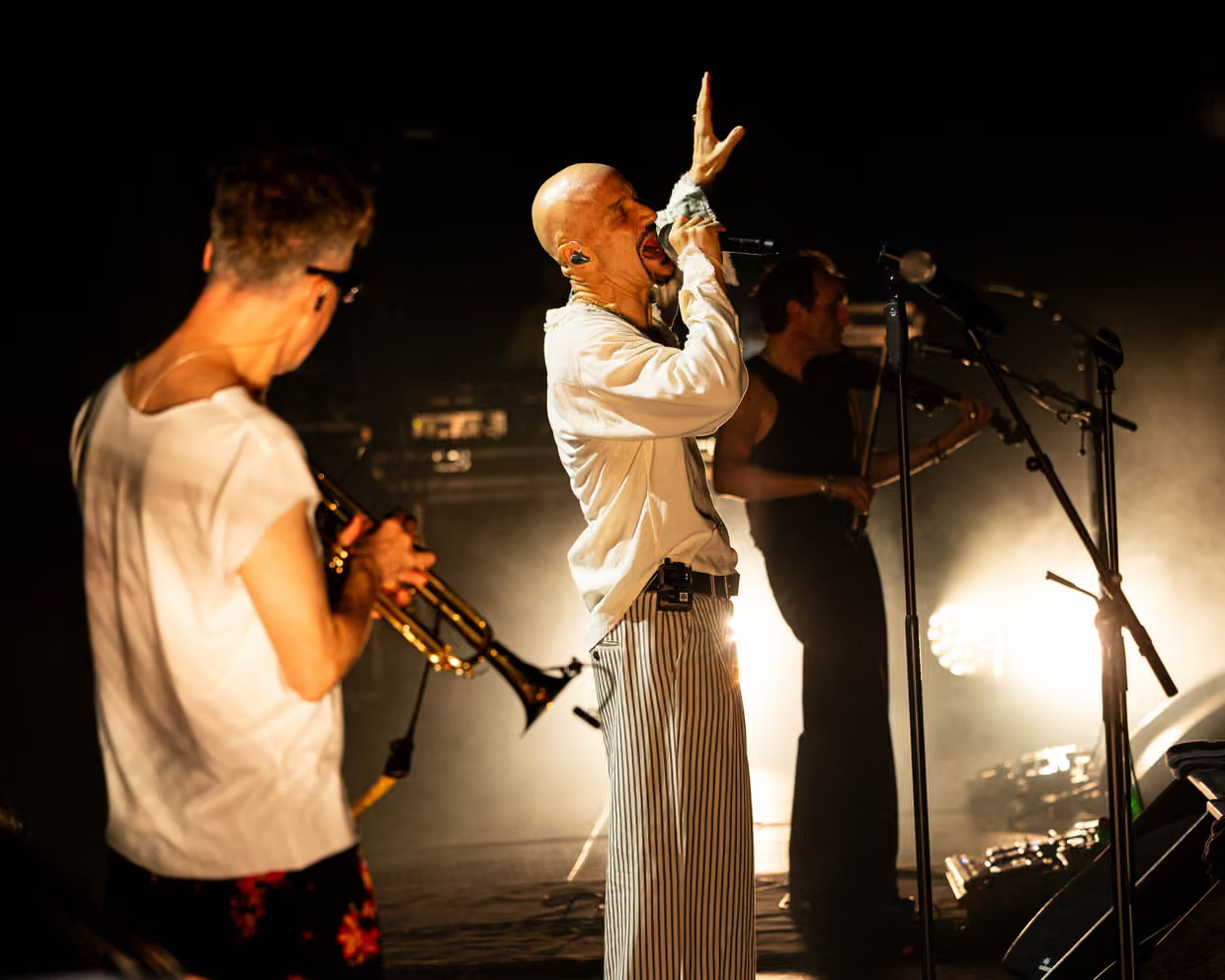
And ‘Getting Away With It (All Messed Up)’, from the 2001 album ‘Pleased to Meet You’, is the song that closed the band’s first chapter with a directness and a rawness that makes it feel, even now, like a genuine farewell: a song about the cost of excess and the difficulty of change, and one of Booth’s most honest pieces of writing.
All of these songs, and many more besides, are the reason that narrowing James down to ten is an act of sustained, pleasurable frustration. The catalogue is too large, too varied, and too consistently good for any single list to do it justice. This one has tried. But the best thing about a list like this is that it is never finished: there will always be another listen, another context, another moment when a song you thought you knew reveals something new. That is what James do. That is what they have always done. And as long as they keep making records, and as long as those records keep sounding like nothing else, that is what they will keep doing.