Top 10 Charli XCX Songs
Charli XCX, real name Charlotte Aitchison, has spent the past decade and a half cementing herself as one of the most fearless and forward-thinking artists in pop music. Born in Cambridge and raised between Hertfordshire and the London rave scene, she began writing songs as a teenager and was signed to Asylum Records at just 14 years old after posting music on MySpace. Her early mixtapes and cult-favourite debut album ‘True Romance’ (2013) built a devoted underground following, while co-writing smash hits like ‘I Love It’ with Icona Pop and ‘Fancy’ with Iggy Azalea established her as one of the most commercially potent songwriters of her generation. She has never been content to stay in one lane: from the polished bubblegum of ‘Sucker’ (2014) to the experimental PC Music-influenced sounds of ‘Pop 2’ (2017) and ‘Charli’ (2019), she has consistently pushed at the boundaries of what pop music can be.
But it was her 2024 sixth studio album ‘Brat’ that finally launched her into the pop stratosphere. Released on 7 June 2024 through Atlantic Records, the record channels the illegal London rave scene where Charli first cut her teeth, exploring themes of partying, womanhood, insecurity, and self-destruction behind a wall of abrasive synths and pounding club beats. Tracks like ‘Club Classics’, ‘Apple’, ‘Sympathy is a Knife’, ‘Talk Talk’, and ‘260’ filled out a record that felt genuinely unlike anything else in mainstream pop that year. Charli herself described it as her “most aggressive and confrontational record”, but also her most vulnerable.
The album’s features and remix campaign were just as much a part of the story as the record itself. A deluxe edition, ‘Brat and It’s the Same, but There’s Three More Songs So It’s Not’, followed just days after the original release. Then came a string of high-profile remixes: ‘Talk Talk’ was reimagined with Troye Sivan, and ‘Guess’ received a landmark remix featuring Billie Eilish, her first-ever guest appearance on another artist’s song. The full remix album, titled ‘Brat and It’s Completely Different but Also Still Brat’, arrived in October 2024, featuring contributions from 20 guest artists. Charli explained the thinking behind it, writing: “I think songs are endless and have the possibility to be continuously broken down, reworked, changed, morphed, mutilated into something completely unrecognisable.”
The cultural impact of ‘Brat’ stretched far beyond music. On TikTok, the record was inescapable: dances, edits, and memes dominated feeds all summer, with the ‘Apple’ dance created by Kelley Heyer becoming one of the biggest viral trends of 2024, taken up by celebrities, athletes, and even Olympic competitors. Then came perhaps the most surreal chapter in the album’s story. On 21 July 2024, the same day President Joe Biden withdrew from the US presidential race, Charli posted two words on X that sent the internet into meltdown: “Kamala IS brat”. The Harris campaign embraced it fully, renaming their X account “Kamala HQ” and redesigning their banner in the album’s now-iconic acid green. ‘Brat’ edits of Harris went viral across TikTok and Instagram, with users pairing clips of the candidate with Charli’s music, and analysts suggested the moment helped generate genuine enthusiasm among younger voters. Collins Dictionary later named “brat” its 2024 Word of the Year, defining it as “a confident, independent, and hedonistic attitude”.
Brat’ became a full-blown cultural phenomenon: it peaked at number one in the UK, Australia, Ireland, and New Zealand, reached number three on the Billboard 200; Charli’s highest ever US chart position; earned nine Grammy nominations and won three, and was named the highest-rated album of 2024 by Metacritic. PopMatters called it “a miracle and an instant classic”, and it was shortlisted for the Mercury Prize. The record was described by critics as her most aggressive, confrontational, and yet vulnerable work to date; a fearless self-portrait that announced Charli XCX as one of the defining voices of her era. Several of its tracks feature in my top 10 below, but more on those in a moment.
In her personal life, Charli is married to George Daniel, drummer, producer, and creative force behind The 1975, who also contributed production to ‘Brat’. The pair wed in July 2025 at Hackney Town Hall in London, followed by a second ceremony in Sicily in September of the same year. Their relationship has been one of music’s great creative partnerships, with Daniel producing some of Charli’s most beloved tracks.
On the live front, the ‘Brat’ era produced one of the most relentless and celebrated runs of shows in recent pop history. Even before the album dropped, Charli announced two distinct strands of live activity: ‘Brat Live’, which brought full performances of the then-upcoming record to cities including Barcelona, New York, Chicago, and Los Angeles, and ‘Partygirl’, a series of warehouse rave sets replicating her iconic Boiler Room energy, with dates in Brooklyn, London, Mexico City, São Paulo, and Ibiza.
Then came the ‘Sweat’ tour, a co-headlining North American arena run with Troye Sivan that began in September 2024 in Detroit and concluded in Seattle in October 2024. The shows were widely praised as some of the most joyful and anarchic arena performances in years, with a string of headline-grabbing surprise guests: Lorde and Addison Rae joined the pair at Madison Square Garden in New York, while Kesha made a surprise appearance at the Kia Forum in Los Angeles.
The full ‘Brat’ arena tour followed, kicking off at Manchester’s Co-op Live on 27 November 2024; her biggest ever UK headline shows. The four-date UK run took in Manchester, London’s O2 Arena, Birmingham’s Resorts World Arena, and Glasgow’s OVO Hydro, with Shygirl as support on all dates. The production was deliberately stripped back; no elaborate staging, no backup dancers; relying instead on extraordinary lighting, visuals, and Charli’s own ferocious stage presence to turn arenas into full-scale raves. Reviews were rapturous. The London show at the O2 was particularly special; Charli brought out Caroline Polachek for ‘Everything Is Romantic’ and ‘Welcome to My Island’, and then, in what became the moment of the night, Robyn and Yung Lean joined her onstage for ‘360’ and a stunning rendition of ‘Dancing on My Own’. The crowd, dressed head-to-toe in slime green, lost their minds.
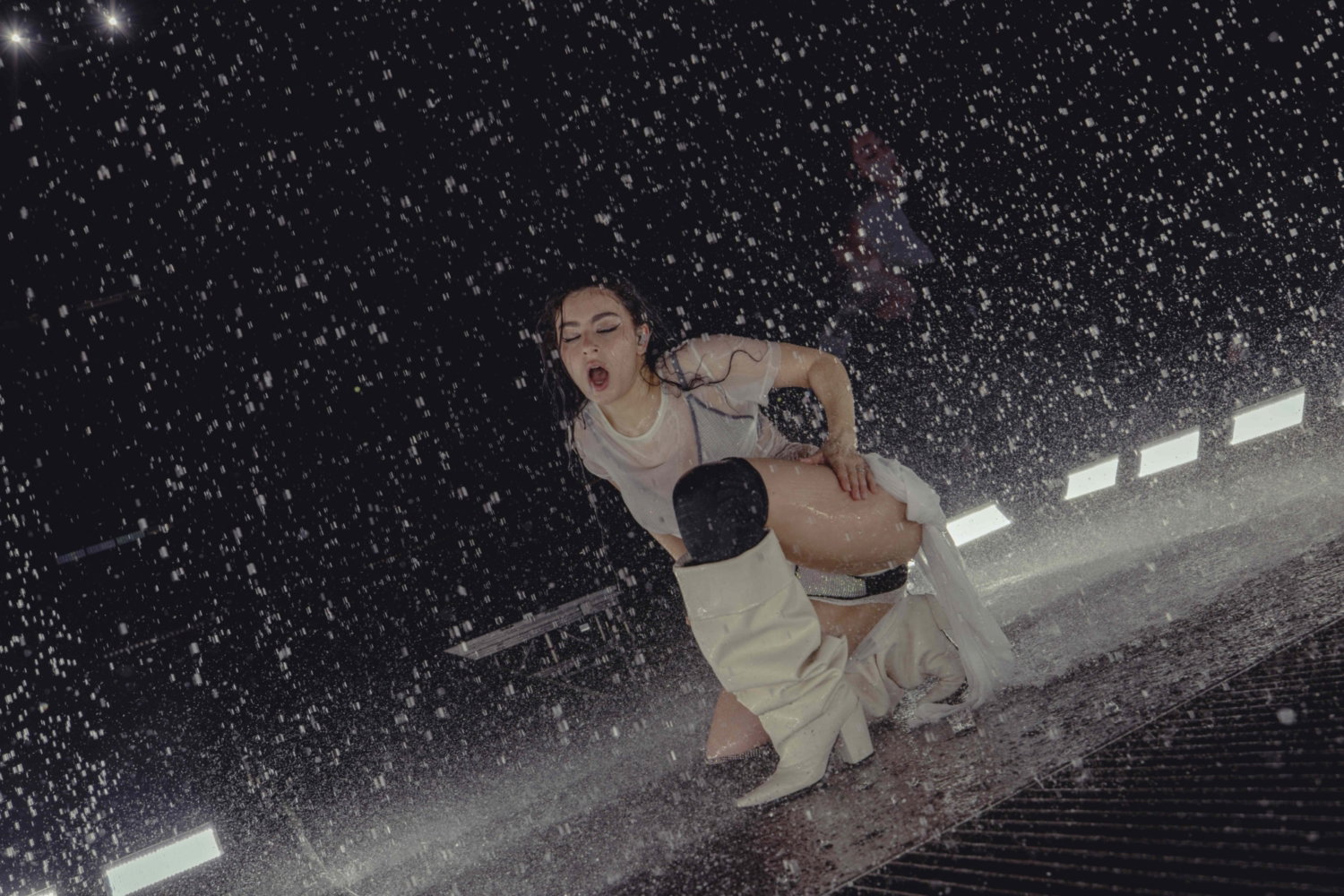
The tour was later expanded into 2025, spanning 36 shows across Asia, Europe, North America, and Oceania, and concluding in Gwacheon, South Korea in August 2025. British producer Finn Keane, who produced the majority of ‘Brat’, served as support for the US leg. The guest appearances continued throughout: Bb Trickz joined Charli at Brooklyn’s Barclays Centre for ‘Club Classics’, and the ‘Apple’ dance became a beloved touring ritual, with Charli selecting a different special guest each night to perform the now-iconic routine. Over the course of the tour, everyone from Amelia Dimoldenberg to Chappell Roan, Clairo, and Gracie Abrams stepped up to the challenge.
Before the US dates, Charli made one of the most talked-about festival appearances of 2025 at Coachella in April, turning the California desert into a full-on rave. The set was a stunning reunion of the ‘Brat’ era’s biggest collaborators in a single night: Troye Sivan joined her for ‘Talk Talk’, Lorde appeared for ‘Girl, So Confusing’, and Billie Eilish brought the house down for ‘Guess’. The performance was widely described as a potential farewell to the ‘Brat’ era; though Charli herself seemed reluctant to let it go, closing the set with a message on the screens declaring she never wants ‘Brat Summer’ to end.
She also headlined Primavera Sound in Barcelona in June 2025 alongside Chappell Roan and Sabrina Carpenter; a lineup Charli herself dubbed the “holy trinity” of that year’s pop moment, before arriving at what many felt was the emotional peak of the entire cycle.
On Saturday 28 June 2025, Charli headlined the Other Stage at Glastonbury in front of over 60,000 fans, with organisers having upped the stage’s capacity specifically to avoid overcrowding. Dressed in a black leather two-piece and an Alexander McQueen scarf, she opened with the thunderous energy of ‘Brat’ and barely paused for breath across the entire set. There were no special guests; just Charli, a wall of white lights, and a crowd that knew every word. The ‘Apple’ dance moment went to Gracie Abrams, who delivered the routine with fierce precision in a baby-pink cardigan. When the cameras panned out during ‘Von Dutch’, the audience held up their phones and created a sea of light stretching as far back as the eye could see. Charli paused only briefly to address the crowd: “I am known to have a heart of stone,” she said. “But this moment means so much to me. Thank you, Glastonbury.” The set was broadcast live on BBC iPlayer and sparked fierce debate online afterwards; some viewers criticised her use of autotune and minimalist production. Charli, characteristically, was unbothered; responding on X: “the best art is divisive and confrontational.” She has another landmark show on the horizon: Charli is set to headline Reading and Leeds Festival in August 2026, her only scheduled UK festival appearances of the year, as part of the first all-British and Irish headline lineup at the festivals in 25 years.
With all of that in mind, here are my top 10 Charli XCX songs.
10. 365
‘365’ is the perfect closer to ‘Brat’; and the fact that it sits at number ten on this list says everything about the quality of what comes above it, not any lack of brilliance in the song itself. Where ‘360’ opens the album with a blast of self-assured swagger, ‘365’ closes it by looping everything back to the beginning; literally. The song samples ‘360’, and the two track numbers even share the same first two digits; a deliberate, elegant piece of album architecture that turns ‘Brat’ into something closer to a circular, never-ending rave than a conventional record. It is the musical equivalent of a snake eating its own tail; you finish the album and find yourself right back at the start, which, given that the whole record is about the relentless, exhausting, exhilarating pursuit of a good time, is exactly the right place to end up.
Charli herself described each beat switch in ‘365’ as moving into a new room of the club, and you can feel that in the music; it shifts and mutates, pulling you deeper and deeper until you have no idea how long you have been in there or how many rooms you have passed through. That structural restlessness is part of what makes it such a thrilling listen. It never settles. It never lets you settle. Just when you think you have found your footing, the floor moves again. This is not a song you put on in the background. It demands your full attention and your full body.
Lyrically, the song is unabashedly hedonistic; a full-throated celebration of being a party girl 365 days a year. The title says it all. The recurring hook, “bumpin’ that”, operates as a double entendre; simultaneously a reference to dancing to a beat and something rather more illicit. The lyrics are littered with the language of a night that has gone very deep very fast: “should we do a little key, should we have a little line”, “french manicure, wipe out the residue”. It is hedonism rendered in sharp, funny, unflinching detail. And yet there is something almost poignant about it too; the idea of a party girl who never stops, who cannot stop, who has built her entire identity around the pursuit of the next moment. There is a restlessness underneath the euphoria that makes the song feel more complex than its surface might suggest.
The production, handled by Charli alongside A.G. Cook and Cirkut, the same team behind some of the album’s most explosive moments, is some of the most abrasive and thrilling on the record. All pounding beats and sharp, synthetic edges, it hits like a freight train and does not let up. It debuted live at the legendary Brooklyn Boiler Room event that kicked off the ‘Brat’ campaign in February 2024; one of the most hyped live events of the year, which broke the record for the most RSVPs in Boiler Room history. Hearing it in that context, a sweaty, chaotic warehouse full of people who had been waiting months for it, must have been something extraordinary.
The remix version, featuring Shygirl, who also opened the UK arena tour, takes things into even darker techno territory, sampling ‘Frequency’ by British duo Altern-8 and pushing the track somewhere that sounds like it belongs in a Berlin basement at 6 am. Shygirl’s contribution is perfectly judged; her delivery is cool, commanding, and utterly at home in the track’s abrasive sonic world. It is one of the standout moments on the remix album, and that is saying something given the competition. The fact that all of this is sitting at number ten tells you everything you need to know about what a staggering run of songs is still to come.
9. 360
If ‘365’ is the perfect ending, then ‘360’ is the perfect beginning. Released in May 2024 as the fourth single from ‘Brat’, it announced the era with a level of confidence that felt almost confrontational. From the very first second, that sharp, synthetic opening that lodges itself in your brain like a ringtone you cannot shift; you know this is something different. Produced by Charli’s longtime collaborator A.G. Cook alongside Canadian producer Cirkut, the song is a hyperpop, electropop, electroclash banger with minimalist synth-led production and Charli's rap-singing in a deadpan, slightly pitch-raised tone that sounds like she absolutely could not care less what you think of her. Which, of course, is entirely the point. A.G. Cook has said the song came together “really quickly” because Charli had such a clear vision for it from the start, and that clarity of purpose is audible in every second. There is no fat on it, no filler, no moment where it loses its nerve. It is lean, precise, and absolutely lethal.
Lyrically, ‘360’ is an anthem of self-assured cool; a celebration of being the reference, the blueprint, the “it girl” before “it girl” was even the phrase. Charli name-drops her friends Julia Fox and Gabbriette, shouts out A.G. Cook, and declares herself “666 with a princess streak", a line that perfectly encapsulates the ‘Brat’ aesthetic in five words. The song opens with “I went my own way and I made it / I’m your favourite reference, baby”; a statement of intent that doubles as a mission statement for the entire record. Charli herself described the song as being “about being the reference”; a celebration of the women in her orbit who are doing things entirely on their own terms, and of herself as someone who has spent over a decade being the blueprint for a sound and an attitude that the mainstream is only now catching up with.
What makes ‘360’ so interesting, though, is what lies beneath the bravado. Critics noted that the boastfulness could also be read as a kind of armour; the confidence a mask for the insecurities that unravel across the rest of the album. The Line of Best Fit observed that the lyrics “sound less like re-affirmations of greatness and more like attempts to convince herself of it”, and there is something in that reading that makes the song feel richer and more human than a straightforward flexing anthem. The album opens with a song that is, at its core, about the gap between the person you project to the world and the person you actually are when the music stops. ‘360’ sets that tension up perfectly; all surface brilliance and crackling energy, with something more complicated humming underneath.
The music video, directed by Aidan Zamiri and described by Charli as her “best music video ever”, is a gloriously chaotic love letter to internet culture; starring an ensemble cast of online it-girls, models, and actresses, including Julia Fox, Gabbriette, Rachel Sennott, and Chloë Sevigny, on a mission to find the next hot internet girl. The opening two minutes take place around a large dinner table, the group plotting to “fulfil the prophecy” of finding a new hot internet girl before their kind ceases to exist forever. It is funny, absurd, and completely self-aware; a satire of the very culture it is celebrating. Charli said of making it: “We were just being so silly on set. It was silly vibes, it was silly times.” That looseness and joy come through in every frame. The video racked up over 20 million views on YouTube and earned a Grammy nomination for Best Music Video, a well-deserved one. It is one of the best pop music videos in years; the kind that rewards repeat viewing and spawns a thousand screenshots.
Then came the remix. Released just weeks after the original, the ‘360’ remix featuring Robyn and Yung Lean is one of those moments where a great song becomes something even greater. Charli and Robyn go way back; they met on a festival tour in Australia and bonded at an afterparty, and their history together gives the remix a warmth and a chemistry that you cannot manufacture. Robyn’s presence on the track is a statement in itself; she is one of the great architects of emotionally intelligent dance-pop, and her endorsement of Charli’s vision felt like a passing of the torch from one era to another. Yung Lean, meanwhile, brings something stranger and more oblique to the mix; his contribution is minimal but perfectly placed, adding a layer of cool that the track wears effortlessly.
The remix was later performed live at Charli’s London O2 show, with Robyn and Yung Lean both joining her onstage; one of the great surprise guest moments of the entire ‘Brat’ tour, and a moment that felt genuinely historic. The song was also nominated for Record of the Year at the Grammys, a nomination that felt both completely deserved and also slightly surreal, given that this is a track that sounds like it was made for a warehouse at 3 am rather than a ceremony in Los Angeles. But that is the magic of ‘360’; it operates in both worlds simultaneously, and it is brilliant in both. Pitchfork called it Charli’s “best pure pop tune in ages”; the New York Times called it “wryly funny, deliriously catchy, and endlessly quotable”; and Paste named it “an all-timer in her catalogue already”. It is all of those things and more. It is the sound of an artist who has finally, fully, arrived.
8. Boom Clap
There is a beautiful irony in the origin story of ‘Boom Clap’. The song was written during sessions for Charli’s debut album ‘True Romance’ alongside Swedish producer Patrik Berger, the same man who would later help write ‘I Love It’. It did not make the final cut for that record and was subsequently offered to Hilary Duff for her then-upcoming album. Duff’s team passed. Charli’s response to this, as she told MTV UK, was characteristically self-deprecating: “My number one project as a songwriter is to write for Hilary Duff. They came back and were like, ‘This isn’t cool enough for Hilary.’ I was like, crushed.” Instead, the song found its way onto the soundtrack of ‘The Fault in Our Stars’; the 2014 Josh Boone-directed film adaptation of John Green’s bestselling novel about two teenagers with cancer who fall in love. And the rest, as they say, is history.
The song became Charli’s first solo top-ten hit, peaking at number eight on the US Billboard Hot 100, topping the Mainstream Top 40, and reaching number six in the UK. It sold more than three million copies in the United States alone and topped the charts in multiple territories. It was, quite simply, the moment the mainstream world woke up to what Charli XCX was capable of as a lead artist in her own right. She had already proven herself as a songwriter and featured artist; ‘I Love It’ and ‘Fancy’ had made sure of that. But ‘Boom Clap’ was the first time her name was at the top of the bill, and she delivered.
Musically, it is a radio-ready electropop and synth-pop gem, built around a dramatic, pulsing beat and one of the most instinctively satisfying choruses of the decade. Charli has described the inspiration behind it as coming from French yé-yé pop and acts like the Flying Lizards and Bow Wow Wow; artists known for their dumb, hooky, shouty choruses. She has said the chorus of ‘Boom Clap’ is deliberately, gloriously dumb, and she is right, in the best possible way. It is the kind of chorus that sounds like it was always going to exist, like it was just waiting for someone to write it. Lyrically, it is a song about the intoxicating, slightly terrifying feeling of falling for someone completely; “the sound of my heart” as the chorus announces with total conviction. Charli told Billboard: “The song itself is very euphoric and enthusiastic about romance... It’s about wanting to fall in love, but there’s this hint of sadness in that, which I like.”
Pitchfork named it the 37th best song of 2014. Spin called it her “most unforgettable chorus yet”. It was performed at the MTV VMAs, the MTV EMAs, the American Music Awards, and Saturday Night Live. It launched a career.
What is easy to forget, looking back from the vantage point of the ‘Brat’ era, is just how significant a moment ‘Boom Clap’ was in Charli’s story. Before it, she was known in the right circles; beloved by critics and a passionate underground fanbase, respected in the industry as a songwriter.
After it, she was a genuine pop star; her name above the title, her voice on the radio, her face on the television. It was the song that opened the door to the mainstream, and it did so entirely on her own terms. She did not chase a trend or compromise her sound; she just wrote a perfect pop song and let it do the work.
There is also something quietly poetic about its origin. A song written for herself, offered to someone else, rejected, and then reclaimed; and in the process of reclaiming it, turned into the biggest moment of her career to that point. Hilary Duff’s team said it was not cool enough. The Billboard Hot 100 disagreed. Charli has since reflected that without ‘Boom Clap’, she would not have had access to the writing rooms that shaped the rest of her career; it was the key that unlocked everything that followed. And despite everything that has come since, the cult mixtapes, the experimental reinventions, the global phenomenon of ‘Brat’, it remains one of the most purely joyful pop songs she has ever made. Sometimes dumb is exactly right.
7. Unlock It (Lock It)
If ‘Boom Clap’ was the song that opened the door to the mainstream, then ‘Unlock It (Lock It)’ is the song that proves Charli was always going to end up somewhere far more interesting than the mainstream anyway. Released in December 2017 as a track on her ‘Pop 2’ mixtape, one of the most forward-thinking and underappreciated bodies of work in recent pop history, it is a song that sounds like nothing else before or since. And yet, somehow, it is also one of the most immediately infectious things she has ever made.
The origin story is pure Charli. She came up with the central hook, that endlessly repeating, hypnotic “lock it, lock it, lock-lock it, lock it, lock it, unlock it” while driving to a show in New Jersey during her support slot on Halsey’s Hopeless Fountain Kingdom Tour. It lodged itself in her brain, and she could not shake it. That is exactly what it does to the listener, too.
The hook is deceptively simple; just a few words, repeated with slight variations, over and over, and yet it is one of the most satisfying and addictive things in her entire catalogue. Charli has said she kept singing it over and over all day, and you believe her entirely.
Produced by A.G. Cook and Life Sim, the track samples Cook’s earlier PC Music single ‘Beautiful’ and employs production techniques that were genuinely years ahead of their time; pitched-up vocals, glitchy electronic effects, and layered, sparkling synth lines that blur the line between hyperpop, R&B, and pure euphoric pop. The chorus features a spoken word section in which the phrase “unlock it” is repeated 18 times; a choice that should be maddening and is instead completely irresistible. Pitchfork described it as “art-pop at its finest, just shy of parody but hyper-aware of contemporary trends”; which is about as good a description of the ‘Pop 2’ era Charli as you will find anywhere.
The features are perfectly chosen. Kim Petras, who Charli met at a SOPHIE concert, long before either of them had reached anything close to their current profile, brings a candy-coloured sweetness to her verse that contrasts beautifully with the track’s more abrasive edges. Jay Park, who Charli had worked with in Seoul and whose verse she specifically requested after he appeared in her ‘Boys’ music video, adds a completely different energy; cooler, more laid-back, cutting right through the song’s sugar rush with something more grounded. Together, the three of them make the track feel genuinely international; a collision of sounds and sensibilities that could only have happened in the specific, glorious chaos of that particular creative moment.
The song did not chart significantly on release. It was, at the time, too strange and too ahead of the curve for mainstream radio. But Charli’s fanbase, her angels,; knew immediately that it was something special, and they were right. In 2021, years after its release, a mashup with Tinashe’s ‘Superlove’ went viral on TikTok, soundtracking millions of videos and introducing an entirely new generation to ‘Pop 2’. The song was so transformed by the moment that Charli officially renamed it ‘Unlock It (Lock It)’ on streaming platforms in recognition of the TikTok version’s cultural footprint. It has remained a fixture in her live sets ever since; a moment of pure, communal joy that reminds you why she has always been one step ahead of everyone else. The world eventually catches up to Charli XCX. It just sometimes takes a few years.
6. Party 4 U
There are songs that arrive, and there are songs that accumulate. ‘Party 4u’ is the latter; a track that spent three years circling Charli’s discography, appearing in fragments and live whispers, before finally finding its moment in 2020 and then, astonishingly, finding it all over again in 2025. The origin story is one of the most quietly romantic in her entire catalogue. Charli and A.G. Cook first performed it publicly on 26 May 2017 at the Nylon Japan 13th anniversary party in Tokyo; a joint set, a new song, a room full of people who had no idea what they were hearing. Footage got out, as footage always does, and the song became a fan obsession almost immediately.
As Charli told Apple Music: “For myself and A.G., this song has so much life and story. We had played it live in Tokyo, and somehow it got out and became a fan favourite. Every time we get together to make an album or a mixtape, it’s always considered, but it has never felt right before now.”
It was considered for ‘Pop 2’ in 2017 and passed over. It lingered. It was requested, over and over, at shows and in fan forums and on social media. And Charli, characteristically, let the mythology breathe. “It kept on being requested and requested,” she said, “which made me hesitant to put it out because I like the mythology around certain songs. It’s fun. It gives these songs more life; maybe even more than if I’d actually released them officially.” When the COVID-19 lockdown arrived in 2020, the song suddenly made complete sense. Charli and Cook resurrected it for ‘How I’m Feeling Now’, her quarantine-crafted fourth album, finishing what they had started three years earlier. Cook crafted a sweeping outro so affecting that Charli reportedly wept upon hearing it. The final version of the song, as she described it, is “euphoric and sad at the same time”; and that is exactly what it is.
Produced by A.G. Cook alone, making it one of the only tracks on ‘How I’m Feeling Now’ not co-produced with SOPHIE or BJ Burton, the production is gauzy and delicate, refusing to climax in the way most pop songs do. It opens with hushed, echoing synths and an intimate, Auto-Tuned vocal, like a whisper in a darkened room. Around the one-minute mark, the track shifts: a deeper bassline emerges, the rhythm quickens, and Charli transitions from melancholy crooning to something more urgent and rhythmically driven.
Then comes the outro, the song’s most extraordinary moment, where her voice begins to loop and glitch, repeating “party on, party on you, party on you” over minimal beats and rapidly pulsing synths, until the track dissolves into crowd noise.
That crowd noise is real: it was recorded at the end of her 2019 Brixton Academy show. The song literally contains three years of her life: a 2017 recording, a 2019 crowd, and a 2020 vocal tracked alone at home. As she put it: “The song has literally grown. It’s gone on a journey.”
Lyrically, ‘Party 4u’ is devastatingly specific. The opening verse sets the scene with almost childlike sincerity: “1000 pink balloons, DJ with your favourite tunes, birthday cake in August, but you were born 19th of June.” The party is arranged with obsessive, tender precision for someone who never arrives. The narrator is surrounded by everything she has built for them and utterly alone inside it. Charli described the song as being about “throwing a party for someone who doesn’t come; the yearning to see someone but they’re not there”; and in April 2025, when the song went viral on TikTok and fans began debating the meaning of that glitching, looping outro, she explained it herself: “this is actually the moment you realize that that one person isn’t ever coming to your party so you stand in the middle of the room, tears briefly fill your eyes but then you wipe them away, pretend you’re ok and proceed to get unbelievably fckd up.” It is one of the most nakedly honest things she has ever said about her own music.
There is one more detail worth noting about the final version of ‘Party 4u’ that speaks to how carefully Charli thought about its place in the record. She has said that the song was originally intended to close ‘How I’m Feeling Now’, but she ultimately decided against it because it felt “too traditional”; the crowd noise outro sounded too much like “an emotional goodbye”. So instead it sits at track nine, and the album ends on ‘Anthems’; a choice that keeps the record from ever fully resolving, from ever letting you go. The decision is very Charli: even when she has the perfect ending, she refuses to use it.
Critics loved it from the start, even when the wider world had not yet caught up. New Statesman’s Elliot Hoste called it “the emotional heart” of ‘How I’m Feeling Now’. Atwood Magazine praised Charli “at her most restrained, and somehow, her most cutting, sonically.” Paste ranked it the fourth-best track in her entire discography as of 2023. And then came 2025. In February of that year, the song’s second verse went viral on TikTok; users posted videos of themselves lip-syncing, sharing heartbreak edits, and debating the meaning of the outro with the intensity of an English literature seminar. US on-demand streams more than doubled from January to February. Atlantic released it as a proper single to US radio in May 2025, five years after its album release, and a music video, directed by Mitch Ryan and based on Charli’s own concept, arrived on the fifth anniversary of ‘How I’m Feeling Now’. In it, she wanders barefoot through the aftermath of a party no one came to, walks out into an open desert, and sets a billboard of herself on fire. It is not just about love lost; it is about burning down the expectations that come with it. The song that waited five years to be released and then five more to be truly heard finally got everything it deserved.
5. Track 10
If you want to understand what made ‘Pop 2’ such a landmark record, and why those of us who were there at the time still talk about it with the reverence usually reserved for albums that shifted the entire direction of pop music, then ‘Track 10’ is the place to start. It is the final song on the mixtape, the last thing you hear, and it is devastating. Not devastating in the way that a ballad is devastating; it does not reach for grandeur or catharsis. It is devastating in the way that something small and perfectly observed can be: a feeling caught with such precision that it stops you in your tracks.
The song has a complicated and fascinating history. It began life as an early demo called ‘Blame It on Your Love’, originally recorded with producers Stargate in January 2017; the Norwegian production duo behind some of the biggest pop records of the 2000s. It was considered for a scrapped third album concept before being shelved, and was then reworked and remixed by A.G. Cook, Life Sim, and Lil Data into what became ‘Track 10’, making it the only song on the mixtape not written from scratch for the project. Interestingly, the original version was at one point also planned as the opener of ‘Pop 2’ before that idea was dropped, meaning the same song was considered for both the beginning and the end of the record before finally landing where it belongs, as the last thing you hear.
The released version samples two other pieces of music: ‘I.D.L’, a 2015 PC Music track by producer Life Sim, and ‘Tears’, another song from ‘Pop 2’ itself. The result is a song that feels like it is consuming its own surroundings; built from borrowed fragments, looped and layered into something new. The original demo was later reworked again in a completely different direction, given a feature from Lizzo, and released as a single in May 2019 under its original title ‘Blame It on Your Love’; debuting on BBC Radio 1 as Annie Mac’s Hottest Record in the World. That version is brighter, more commercial, more radio-friendly. ‘Track 10’ is something else entirely.
Produced by A.G. Cook, Life Sim, and Lil Data; with the intro effects reportedly created by Lil Data using code built around Charli’s own voice; and with additional writing credits going to Noonie Bao and Sasha Alex Sloan, the production is raw, emotional, and synth-filled; a slow, shimmering piece of electropop that strips everything back to its most essential elements. Charli’s vocal sits exposed in the mix, Auto-Tuned but intimate, and the arrangement around her is spare and aching. The lyrics deal with the frustrating, self-defeating cycle of running away from someone who gets too close; of knowing exactly what you are doing and being unable to stop. “Every time you get too close, I run, I run away,” she sings; “and every time you say the words, I don’t know what to say.” The chorus is a confession: “I blame it on your love, every time I fuck it up.” It is a song about deflection; about the way we assign responsibility to the people we push away rather than face what is actually going on inside us.
Clash named it one of the 17 best songs in Charli’s entire catalogue in 2022, writing that it “helped solidify her image of ‘Charli 2.0’, on the heels of her ‘Vroom Vroom’ EP.” Pitchfork placed it at number 92 on its list of the 100 Best Songs of 2018, and at number 85 on its list of the 200 Best Songs of the 2010s; extraordinary placements for a track that was released as the closing cut of a free mixtape with essentially no promotional campaign behind it.
It is a song that rewards those who find it. And the fact that it closes ‘Pop 2’, an album full of maximalist, abrasive, forward-thinking pop, with something this quiet and this honest, is one of the most quietly radical choices Charli has ever made. After all that noise, all that chaos, she ends it here: alone with a feeling she cannot quite name, blaming it on love.
4. I Love It
I know it’s not her song, and she only features on it. But in the words of Charli herself, “I don’t care.” This song belongs to Charli, and boy, does she own it. Even after all the success of ‘Brat’, this song was the closer to her biggest shows, including Glastonbury in 2025. It has now crossed one billion streams on Spotify, the first song in both Charli’s and Icona Pop’s catalogues to reach that milestone. That number tells you everything about the song’s staying power. It is not a nostalgia play, not a one-summer wonder. It is a song that people have been returning to, over and over, for more than a decade, and they show no signs of stopping.
The origin story of ‘I Love It’ is almost as good as the song itself. Charli has described writing it in around half an hour during a session in Sweden with producer Patrik Berger, the same man who co-wrote Robyn’s ‘Dancing on My Own’ and who would later help shape ‘Boom Clap’. Berger sent her two beats; she quickly wrote a song to each of them. One became ‘I Love It’. The other became her own single, ‘You’re the One’. Charli has said she knew almost immediately that she would not end up releasing it herself; it did not fit the sound she was developing for ‘True Romance’, and she could not picture a music video for it. “I knew straight away that it wasn’t right for me as an artist,” she told Rolling Stone.
So when Berger played it to Swedish duo Icona Pop during a recording session, and they immediately felt it as their own, the song found its rightful home. Icona Pop member Aino Jawo said the line “you’re from the 70s, but I’m a 90s bitch” reminded her of an older man from her past; the song mirrored her own experiences so closely it felt like she had written it herself. The band brought in producer Style of Eye to roughen it up, telling him, “We want the punkiness. We want the ‘f*ck it’ feeling.” Icona Pop’s Caroline Hjelt later described Charli’s original demo as “more cute, in a way; really cool and cocky,; which, if anything, makes you wish that version existed somewhere. They kept Charli’s original vocal in the track and built around it; which is why, even though it is technically an Icona Pop song, her presence is felt in every second.
The result is one of the great pop songs of the 2010s; a breakup anthem of such furious, joyful indignation that it is almost impossible not to feel invincible when it comes on. At just two minutes and thirty-six seconds, it is ruthlessly efficient; verse, chorus, verse, chorus, bridge, chorus, and then another verse-chorus run, each section arriving fast and furious before the next one hits.
The lyrics describe the end of a relationship with gleeful, cathartic abandon: crashing a car into a bridge and watching it burn, throwing someone’s things down the stairs, and simply not caring. Critics compared the breakup narrative to Kelly Clarkson’s ‘Since U Been Gone’; and there is something in that comparison, a similar furious liberation, though ‘I Love It’ is rawer and more anarchic, less polished heartbreak and more scorched-earth jubilation. Charli’s vocal contribution, which screams, euphoric chorus, is the centrepiece of the whole thing. She does not have many lines, but she owns every single one of them.
The song hit number one in the UK; its ascent to the top was helped in part by a Samsung mobile phone advertisement that placed it in front of millions of people who had never heard of Icona Pop. It reached number seven on the US Billboard Hot 100 and spent two weeks at the top of the Hot Dance/Electronic Songs chart. It was certified five times platinum in the United States. Pitchfork called it “delectable, empowering, infinitely repeatable” and labelled it Best New Music. Rolling Stone placed it at number 35 on their year-end list. It became one of the defining anthems of the summer of 2013. Its path to ubiquity was not a straight line, though; it first gained traction in the US as the opening theme for the MTV reality series ‘Snooki & JWoww’, and then received the kind of cultural rocket boost that money cannot buy when it featured in an episode of Lena Dunham’s HBO show ‘Girls’; specifically, a scene in which Hannah dances in slow motion at a Brooklyn club. After that appearance, digital downloads surged, and the song entered the Billboard Hot 100 within ten days.
What makes its continued presence in Charli’s live shows so significant is what it says about her relationship with her own history. She could easily have left it behind; it is, after all, technically someone else’s song. But she has never done that. It has remained a fixture in her setlists throughout her career; a reminder of where she came from and that she was always this good, even when the world had not quite caught up yet. The fact that she closed Glastonbury 2025 with it, in front of 60,000 people, at the peak of the biggest moment of her career, is her way of saying: this is where it started. And it started with a banger.
3. Girl So Confusing (feat. Lorde)
There are songs that capture a feeling, and there are songs that capture a moment in culture so precisely that they become inseparable from it. ‘Girl, So Confusing’ did both. On the original ‘Brat’ album, it is already one of the record’s most quietly arresting tracks; a song about the specific, uncomfortable confusion of female friendship and rivalry, about not knowing whether someone likes you or hates you, about the way women are conditioned to see each other as competition rather than allies. Charli sings about a fellow female artist, unnamed on the original, though the lyric “people say we’re alike, they say we’ve got the same hair” immediately sent every set of ears in the room in one direction.
Fans had long speculated about a tension between Charli and Lorde; two artists of similar vintage, similar aesthetic, and similar hair, who had been compared and contrasted in the music press since the early 2010s. Charli later confirmed in a Rolling Stone interview that she had been “super jealous” of Lorde’s success with ‘Royals’ in 2013: “She had big hair; I had big hair. She wore black lipstick; I once wore black lipstick. You create these parallels and think, ‘Well, that could have been me.’” Lorde, for her part, had withdrawn from those friendships during a period of serious body image struggles and disordered eating; retreating into herself without Charli ever fully understanding why.
The original song is devastating enough on its own terms. Produced by A.G. Cook with the same abrasive, pounding club sound that defines ‘Brat’, it sits in an interesting place on the record; slightly more vulnerable, slightly more uncertain than the swagger of ‘360’ or the hedonism of ‘365’. The chorus, “girl, it’s so confusing sometimes to be a girl”, is deceptively simple; a line that sounds almost throwaway until you sit with it and realise how much it is carrying. It is not just about Charli and Lorde. It is about every woman who has ever looked at another woman and felt a complicated mixture of admiration, envy, and fear; who has not known whether to reach out or pull back; who has read hostility into ambivalence and ambivalence into hostility. Pitchfork recognised it as a Best New Track upon its release.
But then came the remix. Upon hearing ‘Girl, So Confusing’, Lorde reached out to Charli; Charli had apparently sent her a voice note first, opening the door. Lorde offered to write a verse that would allow them to settle things publicly, transparently, on the record. The result, ‘The Girl, So Confusing Version with Lorde’, is one of the most remarkable pieces of pop music of the decade. Lorde’s verse is extraordinary in its honesty; she reveals that she was “trapped in a self-hatred” and that Charli’s life “seemed so awesome” from the outside, that she “never thought for a second” her own voice was in Charli’s head.
She addresses the body image struggles that had sent her spiralling, the way she had looked at Charli’s confidence and felt only her own inadequacy. The outro, in which both women sing “I ride for you” to each other, is the kind of moment that makes the hairs on your arms stand up. Lorde called working with Charli “such a huge honour”, adding: “I love that we truly did work it out on the remix. There’s something very brat about that, something very meta and modern. Only Charli could make that happen.”
The internet, predictably, went absolutely berserk. The song became the defining cultural event of the summer of 2024; not just a pop moment but a conversation about female friendship, about the way the music industry pits women against each other, about what it means to choose vulnerability over venom. The Forty-Five described it as “a genuine reset in the way music’s top tier addresses how crippling the outside noise and the internal insecurity can be.” Where a lesser artist might have responded to speculation about a feud with a denial or a carefully managed photo opportunity, Charli and Lorde responded with four minutes of raw, honest music that made the gossip feel embarrassingly small by comparison.
They performed it together at Coachella 2025; Lorde appeared from the wings to sing her verse to a crowd that had been waiting for exactly this moment, and as the song ended, Charli told the desert, “Lorde Summer 2025.” It was a passing of the torch, a declaration of solidarity, and a moment of genuine joy. Pop history, made in the California heat.
2. Von Dutch
It was released on 29 February 2024, a leap day, fittingly, for a song that felt slightly outside normal time. ‘Von Dutch’ arrived as the lead single from ‘Brat’ with very little warning and absolutely no apology, and within about thirty seconds, it was clear that something had shifted. This was not the polished, commercial Charli of ‘Crash’. This was not even the experimental, cult-beloved Charli of ‘Pop 2’. This was something rawer and more confrontational; a song that felt like it had been made for a sweaty basement at 2 am and somehow ended up as the opening salvo of one of the biggest pop albums of the decade. Charli had been saying for years that she wanted to make a pure club record; “I was born to make dance music,” she posted on X the day of the release. “I came from the clubs. XCX6 is the album I’ve always wanted to make.” ‘Von Dutch’ was the proof.
The song was written and produced by Charli alongside Finn Keane, known professionally as Easyfun, a longtime collaborator who had worked on several tracks from ‘Pop 2’ and who had also co-written and produced ‘Speed Drive’, Charli’s euphoric contribution to the ‘Barbie’ movie soundtrack. Keane told NME the session was “quite chill”; “probably about four hours, to give you a sense of how quickly Charli can work.” The track samples ‘Yeah Yeah’ by British electro house duo Bodyrox featuring Luciana, a 2006 club anthem that reached number two on the UK Singles Chart and topped the UK Dance chart, and in doing so plants ‘Von Dutch’ firmly in the lineage of early-to-mid 2000s British rave and bloghouse music. The production is all winding, aggressive synths and pounding beats; gritty and freewheeling, nodding to mid-2000s club culture while remaining unmistakably contemporary. Resident Advisor called it “a supercharged blast of dance pop, club and electroclash.”
The title is a reference to the Von Dutch clothing brand, the Y2K-era fashion label whose trucker hats became one of the defining status symbols of early 2000s celebrity culture, worn by everyone from Britney Spears to Justin Timberlake to Paris Hilton. The brand was named after Kenny Howard, an American artist who went by the nickname Von Dutch, a cult figure who became a fashion phenomenon after his death. Charli told The Face the song is a throwback to her teens, when she was on MySpace and “first began thinking my taste was cool.” The brand is the perfect metaphor for what the song is actually about: something that was once a cult object, became mainstream, is still cool in the right circles, and never stopped popping even when the world moved on. “Von Dutch, cult classic, but I still pop”; she sings it like a statement of fact, which it is.
Lyrically, ‘Von Dutch’ is an exercise in unapologetic, almost gleeful narcissism; a song about being the object of obsession and leaning into it completely. “It’s okay to just admit that you’re jealous of me,” she opens, and from there it only gets more brazen. The repeated declaration “I’m your number one” builds and builds until it becomes almost hypnotic; less a boast than a mantra, less a flex than a kind of ecstatic self-affirmation. The Face’s Shaad D’Souza called it “a perfect introduction to her acidic, freewheeling new mode; the song plays like bravura tweets fired off after a glass of champagne.” Pitchfork gave it Best New Track, with Anna Gaca describing it as “made of helium and hydraulics, with its heart in the club and its ass on a Harley; another chapter in the singer-producer’s gleeful participatory parody of celebrity culture.”
Charli first performed the song at her legendary Brooklyn Boiler Room set on 22 February 2024; an event that broke the record for the most RSVPs in Boiler Room history and which felt, even at the time, like the beginning of something enormous. The music video, shot by fashion photographer and director Torso at Charles de Gaulle Airport in Paris; including on the tarmac of the Musée de l’air et de l’espace at Le Bourget, on the wing of an actual Boeing 747 and an Airbus A380; is a paparazzo’s-eye-view chase through an airport terminal that ends with Charli falling off a plane and lying on a luggage conveyor belt staring directly into the camera. It is completely deranged and completely brilliant. It was nominated for Best Cinematography at the MTV Video Music Awards. A remix featuring Addison Rae and A.G. Cook followed in March 2024, with Rae and Charli trading verses; the pair later performed it together at Madison Square Garden during the Sweat tour, and again at Coachella 2025.
The song won the Grammy for Best Dance Pop Recording at the 67th Annual Grammy Awards in February 2025, which Charli accepted by performing it and ‘Guess’ at the ceremony in a set that turned the Crypto.com Arena into a pulsating club, complete with a hail of undergarments. She later admitted the songs were “not at all appropriate” for the Grammys. She was right. It was the best thing at the show. It was also used as the official theme song for WWE’s Royal Rumble in January 2025; a placement that speaks to the song’s sheer, blunt, physical force. ‘Von Dutch’ is not a song that asks for your attention. It takes it. It has been doing so since that leap day in February 2024, and it shows absolutely no sign of stopping.
Honourable Mention: Apple
Apple’ is the odd one out on ‘Brat’; and that is precisely why it belongs here. While the rest of the record is all abrasive synths, pounding club beats, and confrontational swagger, ‘Apple’ arrives at track eleven like a sudden change in weather: melodic, warm, and unexpectedly tender. Charli herself was nervous about it. “Obviously, that track is a little bit sonically different from the rest of the songs on the record,” she said, “and at first, I was nervous about that. But then it kind of felt, actually, that that is sort of the epitome of brat in a way: to kind of throw something unbelievably unexpected just right in your face and, you know, let it thrive.” She was right. It thrived.
The song was written by Charli alongside George Daniel, Noonie Bao, and Linus Wiklund, and co-produced by Charli, A.G. Cook, Daniel, and Lotus IV, marking only her second official co-production credit. It is a song about her parents; specifically, about the complicated, tender, sometimes suffocating weight of the relationship between a child and the people who made them. The apple of the title operates as a layered metaphor: the apple does not fall far from the tree, the apple is rotten to the core, the apple splits down the middle, revealing something both familiar and frightening. Charli confirmed in a podcast interview with Las Culturistas that the song is directly about her relationship with her mum and dad, and knowing her background adds considerable depth to that reading.
Her mother, Shameera, is of Gujarati Indian descent and was born in Uganda; her family was forced to flee the country in 1972 when Idi Amin expelled the Indian population. That history of displacement, trauma, and survival is woven into the fabric of who Charli is, and ‘Apple’, with its repeated question “I wanna know where you go when you’re feeling alone”, reaches toward that inheritance with remarkable delicacy. It is a song about intergenerational trauma rendered in three-and-a-half minutes of electropop, and it pulls it off completely.
Pitchfork’s Meaghan Garvey found the fruit allegory “curious”, but wrote that she had never had a Charli lyric “bounce around” her head in “the way that lines from ‘Apple’ have”; which is exactly the right response to a song that sneaks up on you. NPR included it on their list of the Best Songs of 2024. The song peaked at number eight in the UK, the album’s highest-charting single at the time, and reached number four on the US Billboard Hot Dance/Electronic Songs chart.
But the song’s cultural life was defined by something that happened almost immediately after the album dropped: the dance. New York-based actor and content creator Kelley Heyer invented a multi-step choreographed routine to the song’s second verse, uploaded it to TikTok on a whim, and watched it detonate. Within days, it was everywhere.
Charli herself filmed herself performing Heyer’s routine alongside Troye Sivan and photographer Terrence O’Connor in a video posted on 28 June 2024; the footage of the three of them doing it together, slightly chaotically, with evident delight, became one of the defining images of the ‘Brat’ summer. Celebrities, athletes, and Olympic competitors all joined in. The dance became a fixture of the ‘Brat’ arena tour, with Charli selecting a different special guest each night to perform it with her; Amelia Dimoldenberg, Chappell Roan, Clairo, and Gracie Abrams among those who stepped up. At Glastonbury 2025, it was Gracie Abrams who took the honours, delivering the routine with fierce precision in a baby-pink cardigan to 60,000 people on the Other Stage.
Heyer, for her part, described watching her choreography go viral as “amazing and at times overwhelming”; and when Charli performed it, Heyer said she was “starstruck”. “It makes me so happy,” she said. “It’s so cool how everyone has elevated my dance into something so much bigger.” That is ‘Apple’ in a sentence, really: a song that started as a slightly unexpected addition to a club record, became a vehicle for one of the most joyful viral moments of 2024, and ended up as a touring ritual that connected Charli to her fans in the most immediate, physical, joyful way possible. It earned a Grammy nomination for Best Pop Solo Performance, her first ever in that category.
A remix featuring The Japanese House arrived on the ‘Brat and It’s Completely Different but Also Still Brat’ album in October 2024, adding a spectral, melancholy layer to the track that suits its themes perfectly. ‘Apple’ is the song that proves ‘Brat’ is not just a club record. It is a record about being a person, and sometimes being a person means standing in the kitchen looking at your parents and thinking: I am so much like you, and I have absolutely no idea what to do with that.
1. Sympathy is a Knife
Arguably Charli’s most confrontational song, ‘Sympathy Is a Knife’ is a raw, claustrophobic meditation on insecurity, jealousy, and the paranoia that festers when you feel threatened by another woman’s proximity to your world. The production is among the most abrasive on the record; all grinding, industrial synths and relentless forward momentum; and Charli’s vocal sits exposed at the centre of it, unguarded and slightly unhinged in the best possible way.
From the moment ‘Brat’ dropped, fans were convinced they knew exactly who the song was about. The key lyric is hard to ignore: “Don’t wanna see her backstage at my boyfriend’s show / Fingers crossed behind my back, I hope they break up quick.” The reference to “George”, almost certainly George Daniel, Charli’s now-husband and drummer for The 1975, placed the song in a very specific context. Taylor Swift had a short-lived but intensely public relationship with The 1975’s frontman Matty Healy in 2023; Charli and George had been together since 2022. The overlap was obvious, and the internet ran with it.
The theory gained further traction from the song’s broader themes. Charli sings about a woman who “taps my insecurities”; someone whose success and visibility make her feel small, spiral, and doubt herself. Fans pointed to the history between the two artists: Charli had opened for Swift on both her '1989' and 'Reputation' World Tours, and in a 2019 Pitchfork interview had made an ill-received comment about performing to Swift’s younger audiences, for which she later apologised. The combination of professional history, personal proximity, and pointed lyrics made the Taylor theory feel, to many, airtight.
Charli, however, denied it. In an interview with Vulture, she was characteristically direct: “People are gonna think what they want to think. That song is about me and my feelings and my anxiety and the way my brain creates narratives and stories in my head when I feel insecure.” Swift, for her part, sent a glowing statement to New York Magazine, praising Charli’s writing as “surreal and inventive, always.” When fans at a Charli show in São Paulo began chanting anti-Taylor slogans, Charli shut it down immediately on Instagram: “It is the opposite of what I want and it disturbs me that anyone would think there is room for this in this community. I will not tolerate it.”
The saga took a further twist in October 2025 when Taylor Swift released her album ‘The Life of a Showgirl’, which featured a track called ‘Actually Romantic’. Many fans and critics interpreted the song as a direct response to ‘Sympathy Is a Knife’; its lyrics appeared to reference the Matty Healy connection, Charli’s social world, and the whole tangled dynamic the earlier song had set in motion. Whether intentional or not, the two songs now exist in conversation with each other; a dialogue conducted in metaphor and plausible deniability, which is, of course, exactly how the best pop feuds always work.
What makes ‘Sympathy Is a Knife’ so compelling, regardless of who or what it is about, is how honestly it portrays the uglier emotions that female artists are rarely permitted to express publicly: the envy, the fear, the irrational spiral. Like ‘Girl, So Confusing’, it reflects most critically on the person singing it. Charli is not the wronged party here; she is the one consumed by her own paranoia, and she knows it. That self-awareness is what elevates the song above gossip and into something genuinely affecting.
Final Thoughts
Charli XCX has spent over a decade doing things the hard way. Signed as a teenager, beloved by critics before the mainstream knew her name, she spent years being the best-kept secret in pop; the songwriter behind other people’s hits, the cult artist whose mixtapes circulated among the people who would eventually shape what music sounded like. She was never the biggest name in the room. She was just, often, the most interesting one.
All of that history makes what happened with ‘Brat’ feel not just like a commercial breakthrough but like a genuine vindication. This was an artist who, at the peak of her cultural moment, made the most uncommercial decision imaginable: she turned her back on the polished, radio-friendly pop she had spent years flirting with and threw herself headlong into the underground. She went back to the raves, back to the clubs, back to the abrasive, confrontational, sweaty world where she had first found herself as a teenager in London. She did not chase the mainstream. She dared the mainstream to catch up with her.
And it did. Spectacularly.
Brat’ is, arguably, the most important pop album of the 2020s so far. That is not a claim made lightly, and it is not simply about chart positions or streaming numbers, though those are remarkable enough. It is about what the record did to culture; how it moved beyond music to define an entire aesthetic, a word, a summer, a political moment, a way of being. It coined a vocabulary. It gave a generation a colour. It turned a two-word tweet into a presidential campaign strategy. It made underground club music feel not just relevant but essential; not just cool but urgent. Collins Dictionary did not name “brat” its Word of the Year because of what the album sounded like. They named it because of what it meant, and what it meant was something that had not existed in quite that form before Charli put it into the world.
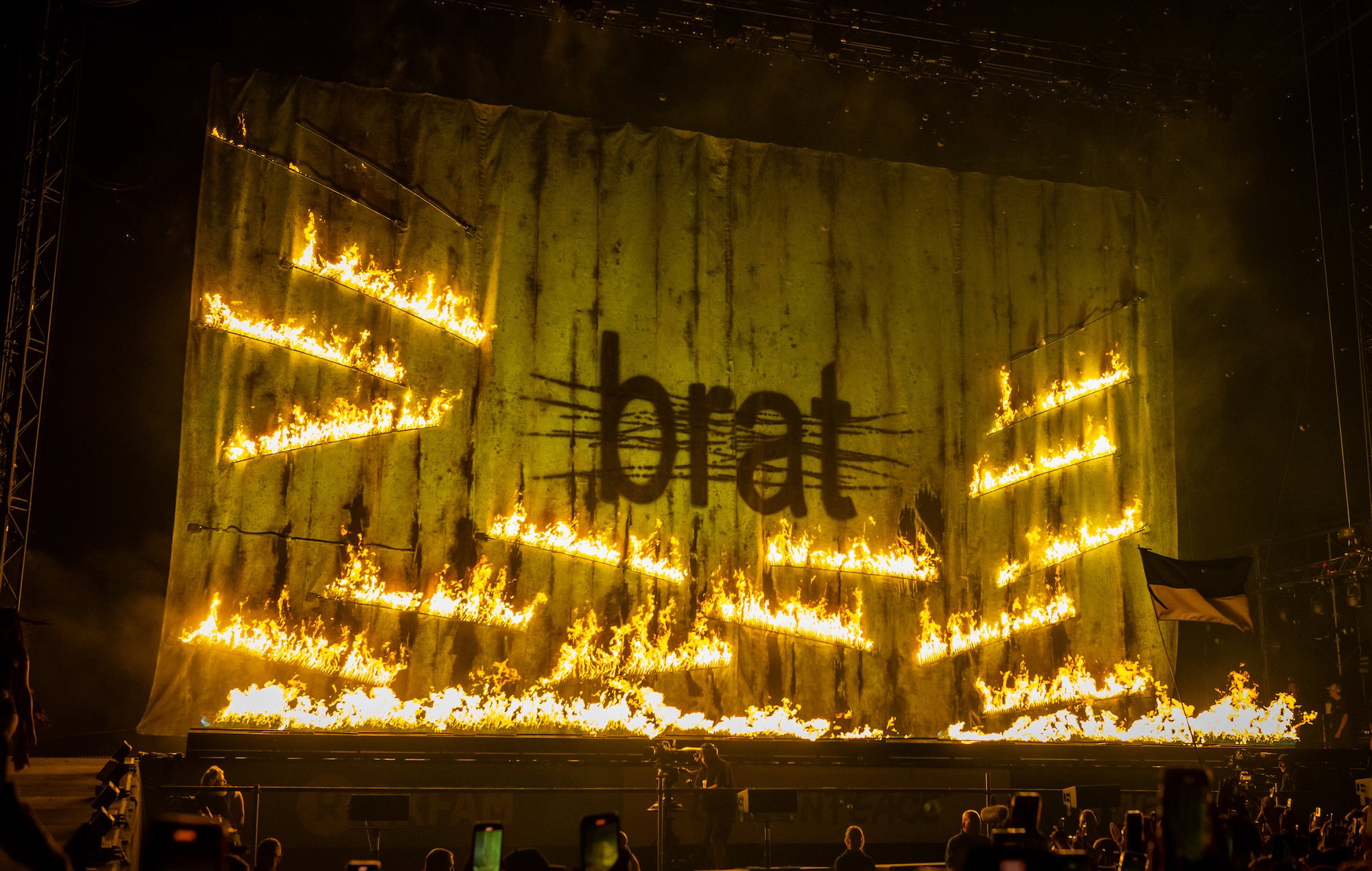
What makes ‘Brat’ era-defining rather than merely era-capturing is the tension at its heart. This is a record made by a woman who wanted to let go of pop; to abandon its conventions, its expectations, its demand for palatability; and embrace dance music, the underground, the rawness of a warehouse at 3 am. By doing that, by refusing to compromise, by making the most aggressive and confrontational record of her career and releasing it into the mainstream without apology, she created something that the mainstream could not resist. The very act of turning away is what drew everyone in.
That is the Charli XCX paradox, and it runs through everything on this list. From ‘I Love It’, written in half an hour and given away, to ‘Track 10’, buried at the end of a free mixtape, to ‘Party 4u’, held back for years because the mythology felt more valuable than the release; she has always understood that the most powerful thing an artist can do is refuse to play the game on anyone else’s terms. ‘Brat’ is the fullest, loudest, most joyful expression of that refusal. It is the sound of an artist who wanted to disappear into the underground and instead ended up on top of the world. She never wanted to be the biggest pop star of her generation. She just wanted to make the music she heard in her head. And it turned out that music was exactly what the world needed to hear.