Song Stories: The Strokes: Ize of the World
It’s the sound of the lights flickering out in a collapsing city.
I wanted to dive into a track that feels like a tipping point. When we talk about the most ambitious moments in modern rock, the conversation usually turns to sprawling concept albums or synth-heavy experiments.
But tucked away toward the end of 'First Impressions of Earth' is a song that manages to be both a technical masterpiece and a bleak, cultural prophecy: 'Ize of the World.'
The Blueprint: 'Is This It'
To understand where The Strokes were heading in 2006, you have to look back at the shadow cast by their debut. In 2001, 'Is This It' essentially reset the musical clock. At a time when the charts were dominated by nu-metal and over-produced pop, five guys from New York in skinny jeans and beat-up Converse changed the trajectory of the decade.
The Strokes were immediately branded as the "saviours of rock." They were the modern heirs to the '70s New York underground, bringing back the sophisticated, urban urgency of Television and The Velvet Underground. They weren't just a band; they were an aesthetic.
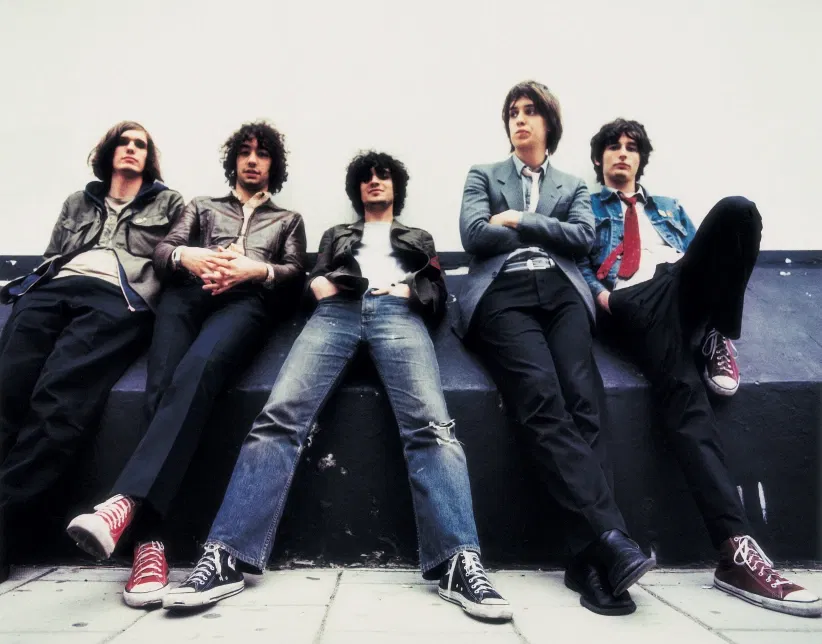
The songs on 'Is This It' were marvels of efficiency. 'The Modern Age' introduced their signature "interlocking" guitar style, while 'Someday' captured a bittersweet, sunny nostalgia that felt instantly timeless. 'Last Nite' became the anthem of the era, built on a jagged rhythm that practically forced people onto the dancefloor. Even the grittier tracks like 'New York City Cops' and 'Hard to Explain' possessed an effortless, cool-guy composure. This perfection, however, became a cage. Every subsequent release was measured against 'Is This It', leading to the creative tension found within their third record.
Expanding the Sound on 'First Impressions of Earth'
'First Impressions of Earth' was the moment the band decided to break out of that cage. It was bigger, louder, and more aggressive than anything they had attempted before. While the album was polarising at launch, it showcased a band hungry to evolve.
The record is packed with sonic shifts. You have 'You Only Live Once,' which carries that classic Strokes drive but with a cleaner, stadium-ready production. Then there is 'Juicebox,' a jagged, bass-heavy track that proved they could be heavy, and 'Heart in a Cage,' a brooding, noir-inspired piece that captures the claustrophobia of fame. Even 'Razorblade' showed Julian Casablancas’ ability to write '80s-inflected New Wave hooks that felt both catchy and deeply melancholic.
The Complexity of 'Ize of the World'
Nestled among these hits is 'Ize of the World.' If their earlier work was about the vibe of a night out, 'Ize' is a fever dream about the state of the world. It swapped the breezy garage rock of 'Is This It' for something orchestral and jagged.
The song is a masterclass in guitar interplay. Albert Hammond Jr. and Nick Valensi weave around each other with a mathematical precision that shouldn't feel this visceral, but it does. This wasn't a song that happened by accident; it was a calculated attempt to push the boundaries of what "indie rock" could sound like. It marked the band’s transition from downtown darlings to a group grappling with existential dread.
The "Impossible" Guitar Solo
One of the most discussed elements of the track is the guitar solo. Unlike the bluesy, melodic solos found on 'Is This It', the solo in 'Ize of the World' is a frantic, chromatic explosion.
Hammond Jr. and Valensi have spoken in interviews about how difficult this song was to record. Casablancas reportedly wanted the guitars to sound like "machines breaking down." The solo doesn't follow a traditional rock scale; instead, it mimics the chaotic energy of the lyrics, spiralling upward in a way that feels like it’s about to fly off the tracks. It’s a moment of pure virtuosity that proved The Strokes were world-class players.
A Play on Words: The "Ize" and the "Eyes"
The title itself is a classic Casablancas pun—a double meaning between the "Eyes of the World" and the suffix "--ize."
Lyrically, this is arguably Julian’s most cynical and broadly sociological piece of writing. The chorus is a relentless, rhythmic list of the ways modern society commodifies the individual: “An egg to fertilise / A pulse to stabilise / A body to deodorise / A life to scrutinise.” He takes aim at the "izes" of the world: modernise, advertise, neutralise, vaporise.

He touches on the hollowness of modern evolution with the startlingly observant line: “Your eyeballs don't change, it's the muscles around your eyes.” He’s suggesting that while we evolve technologically, our core animal instincts remain static. The song paints a picture of a society that is "perfecting" itself into oblivion fertilising and stabilising until no humanity is left.
The Sonic Architecture
The structure of the song is designed to induce anxiety. It begins with a tight, restrained rhythm built on a driving, "motorik" beat that feels like a conveyor belt. In the pre-chorus, the tension ratchets up with discordant chords that signal something is wrong.
By the time you reach the final bridge, the song has transformed from a rock track into an industrial-adjacent anthem. The production is deliberately "cold," lacking the warm, fuzzy distortion of their early work, which perfectly suits the themes of a sterile, over-managed world.
The Anatomy of the Cut-Off
The most iconic moment of the song is its ending. As the band builds to a screaming, high-velocity climax, Julian bellows the final line: “Cities to vapour-i—”
And then, silence.
The track cuts off mid-word, mid-note. It’s a brilliant piece of studio trickery that mirrors the lyrical theme of sudden, apocalyptic finality. It doesn’t fade away; it is extinguished. The first time you hear it, you think your speakers have died; the second time, you realise it’s the only way a song this intense could end.
A Legacy of Influence
The ripple effect of The Strokes’ arrival can’t be overstated. They didn't just influence sounds; they birthed an entire generation of bands.
Arctic Monkeys are perhaps the most famous disciples. While they exploded out of Sheffield with their own riotous energy on 'Whatever People Say I Am, That's What I'm Not', the DNA of The Strokes was everywhere in their early work. Alex Turner has spent his entire career professing his love for the band; most famously, he opened the 2018 album 'Tranquillity Base Hotel & Casino' with the line: “I just wanted to be one of The Strokes, now look at the mess you made me make.”
Beyond the Arctic Monkeys, the influence spread far and wide:
- The Killers & Kings of Leon: Both bands shifted their early trajectories to match the "garage rock revival" spearheaded by the New York quintet. Brandon Flowers famously scrapped almost an entire album's worth of material after hearing 'Is This It', realising the bar had been raised.
- The Libertines & Franz Ferdinand: Across the Atlantic, the UK indie scene exploded as a direct response to the "New York Cool" exported by the band.
Decades later, 'Ize of the World' remains the ultimate "cult" favourite. In an era of social media algorithms and constant surveillance, the idea of a "life to scrutinise" feels more literal than ever. It is a beautiful, terrifying song about the struggle to stay awake in a world that is falling asleep.