Song Stories: George Harrison: All Things Must Pass
George Harrison is comfortably my favourite Beatle. Having watched the exceptional Martin Scorsese directed documentary 'Living in the Material World', I grew a new found appreciation for not only his songwriting but who he was as a man.
While John and Paul were the main songwriters in The Beatles for nearly all of that bands tenure, I truly believe George had the most profound and successful solo career. When he finally stepped out from the shadows of the Lennon-McCartney partnership, he didn't just release a few songs, he released some exceptional era defining pieces that changed music history.
From The Beatles’ Rejection to Solo Triumph
‘All Things Must Pass’ is the title track from George’s 1970 triple-album masterpiece. While technically his third solo outing, following his experimental soundtracks ‘Wonderwall Music’ and ‘Electronic Sound’, it was the first time he truly showcased his ability as a singer-songwriter. For years, George had been limited to only two or three tracks per Beatles album, leading to a massive "backlog" of world-class material that he had been quietly stockpiling since the mid-60s.
The song was famously presented to The Beatles during the tense, cold ‘Let It Be’ sessions at Twickenham Studios in January 1969. Despite the band rehearsing it dozens of times, as seen in the ‘Get Back’ documentary, the track was met with a lukewarm reception from Lennon and McCartney. John Lennon, in particular, was caught on tape suggesting a more "pop" arrangement that didn't fit George’s soulful vision. George even recorded a solo demo of the song at EMI Studios on his 26th birthday (February 25, 1969), which later surfaced on ‘Anthology 3’, proving he already knew the song was a classic even if his bandmates didn't
Ultimately, the band's rejection was a blessing in disguise. If the song had been tucked away on a Beatles record, it might have been overshadowed by the internal bickering of the group. Instead, it became the centerpiece of a project where George had total creative control. By the time he entered the studio with producer Phil Spector, his reservoir of songs was so deep that he made history by releasing rock’s first-ever triple-vinyl box set. This bold move sent a clear message to the world: the "Quiet Beatle" was quiet no more, and he had enough genius to fill three records while his former bandmates were still finding their footing as solo artists.
Ancient Wisdom and the Woodstock Influence
The profound depth of ‘All Things Must Pass’ stems from George’s immersion in Eastern philosophy and his yearning for a simpler musical life. The lyrics were directly inspired by a poem titled ‘All Things Pass’ by Timothy Leary, which George discovered in a book of adaptations of the Tao Te Ching, an ancient Chinese text by Lao Tzu. George took the core message, that change is the only law of the universe, and breathed human warmth into it. He wasn't just singing about philosophy; he was singing about the liberation of letting go.
Musically, the track’s earthy, gospel-inflected sound was heavily influenced by a pivotal trip George took to Woodstock, New York, in late 1968. Spending time with Bob Dylan and The Band was a revelation for him. After years of the high-pressure, often clinical atmosphere of The Beatles' studio sessions, he was enamored by their community style of playing. In Woodstock, there was no frontman or backing band, just a group of friends playing for the soul of the music. This sound translated into 'All Things Must Pass', in the steady patient rhythm, and country like soul.
A Masterclass in Collaboration: The "Wall of Sound"
George always thrived when surrounded by friends who shared his musical language. The recording sessions for ‘All Things Must Pass’ featured a literal "Who’s Who" of rock royalty, creating an atmosphere that felt more like a spiritual retreat than a business transaction. Under the guidance of co-producer Phil Spector, they employed the famous "Wall of Sound" technique. By layering multiple instruments and using heavy reverb, they gave the title track a massive, cathedral-like atmosphere that feels both intimate and infinite. The lineup was truly legendary.
The rhythmic foundation of 'All Things Must Pass' was built on a lifetime of trust, anchored by Ringo Starr. His signature, soulful "behind-the-beat" drumming provided the song with a steady, comforting heartbeat that allowed the melody to breathe. Joining him was Eric Clapton, who lent his unmistakable guitar work to the sessions. Despite the well-documented personal complexities of their friendship at the time, their musical bond remained a sanctuary for both men, resulting in a performance that feels both intimate and legendary.
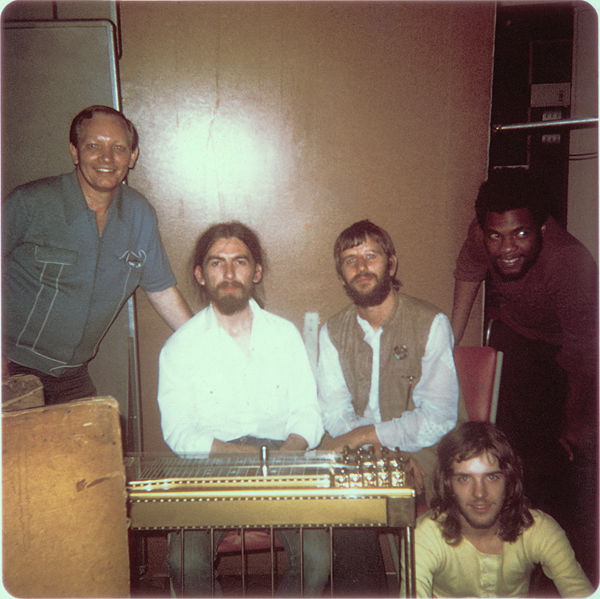
The spiritual atmosphere of the track was further elevated by the "Fifth Beatle" himself, Billy Preston. His gorgeous, swelling organ and piano parts provided the essential gospel lift that makes the song feel like a modern hymn. Providing the low-end support was Klaus Voormann, George’s old friend from the early Hamburg days. Voormann held the foundation together on bass with a melodic, understated style that perfectly complemented George’s vision without ever overcomplicating the arrangement.
To achieve the track's sheer sonic scale, George and producer Phil Spector brought in the Deluxe Horns and a rotating host of other contributors. Interestingly, the sessions even featured a young, pre-fame Phil Collins on percussion. Together, this collective of world-class musicians created a dense, orchestral layers of sound that transformed the song from a simple folk tune into a towering masterpiece of the 1970s.
A Universal Message: Life, Change, and Hope
At its core, ‘All Things Must Pass’ is a masterpiece of perspective. While George once mentioned the lyrics could be applied to the painful end of a relationship, the imagery of "sunrise" and "cloudbursts" elevates it to a universal anthem for the human experience. He avoids being preachy; instead, he uses nature as a gentle metaphor for our internal struggles: "Now the darkness only stays the nighttime / In the morning it will fade away." The song is a realization that nothing, neither our greatest joys nor our deepest sorrows, is permanent. It is a grounded, hopeful reminder that change is the only constant in life.
This philosophy of "letting go" is the heartbeat of the album as a whole. Released as a lavish triple-LP box set, ‘All Things Must Pass’ was a monumental statement that allowed George to finally share the spiritual and musical growth he had been cultivating for years. From the devotional yearning of ‘My Sweet Lord’ to the exuberant joy of ‘What Is Life’, the album explores the full spectrum of human emotion. Even the third disc, ‘Apple Scruffs’, showcases the loose, improvisational freedom George found once he was finally out from under the pressures of being a Beatle.
In the specific context of 1970, with The Beatles officially dissolved and the idealistic 1960s coming to a close, the song and the album served as a grace note for an era. It told the fans that while the "dream" was over, something new and beautiful was already beginning. The record remains a comforting light for anyone navigating a transition, proving that George wasn't just a rock star, he was a modern philosopher. As a complete work, ‘All Things Must Pass’ stands not just as a collection of songs, but as a towering monument to artistic and spiritual liberation.