Song Stories: Billy Joel: Goodnight Saigon
Billy Joel’s haunting ballad 'Goodnight Saigon' stands as one of the most powerful and poignant pieces in his extensive catalogue. Released in 1982 on the album 'The Nylon Curtain', the song offers a cinematic reflection on the Vietnam War, capturing the shared trauma of a generation of soldiers. Unlike many protest songs of the era that focused purely on the politics of the conflict, Joel shifted the lens to the visceral, human experience of those on the front lines, confronting and questioning the broader social elements of the war through the eyes of the men who fought it.
The Architecture of a Soldier’s Journey
The song’s structure follows the tragic arc of a soldier’s journey, moving with a chilling precision from the shared beginnings of basic training to the psychological disintegration caused by combat. One of the most striking couplets—"We met as soulmates on Parris Island / We left as inmates from an asylum", highlights the brutal transformation of young recruits.
By referencing Parris Island, the legendary Marine Corps Recruit Depot, Joel grounds the song in a reality that veterans immediately recognise: the place where their civilian identities were stripped away to be replaced by a collective military persona. This "soulmate" connection suggests a bond deeper than friendship, born of shared hardship, which makes the eventual descent into the "asylum" of war all the more devastating.
As the narrative shifts from the South Carolina coast to the dense jungles of Southeast Asia, the lyrics become increasingly fragmented and sensory, mirroring the confusion of guerrilla warfare. Joel moves from the discipline of the drill instructor to the haunting atmospheric details of the "darkness" and the "boondocks." The transition is marked by a loss of individual identity; the "I" of the early verses is swallowed by a thunderous, collective "we." This shift signifies that the individual has been absorbed into the unit, reflecting the psychological necessity of the military collective while simultaneously mourning the loss of the boys they used to be.
This progression culminates in a landscape where romanticised notions of glory are replaced by the raw mechanics of survival, highlighting the clash between traditional military lore and the gritty, modernised nightmare of Vietnam. By the time the song reaches its crescendo, the arc is complete: the recruits who once stood on the parade grounds of Parris Island have become a singular, traumatised entity, bound by an oath to 'all go down together'. This represents the ultimate arc of the veteran, a journey that begins with a haircut and a uniform and ends with a brotherhood forged in a fire that the civilian world can never fully understand.
The Sound of Solidarity
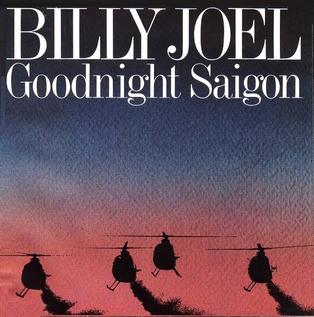
With its solemn, march-like beat and the atmospheric sound of Huey helicopter rotors opening the track, 'Goodnight Saigon' paints a vivid picture of young men thrust into a foreign land. Joel’s decision to write from the collective "we" rather than "I" gives the song a choral, anthemic quality. This perspective emphasises the brotherhood and solidarity formed in the heat of battle, bonds that became the only source of stability in the chaos of the jungle. The musical landscape is further enhanced by heavy, rhythmic piano chords that mimic a funeral march, grounding the listener in the gravity of the soldiers' reality.
The recurring refrain, "And we will all go down together," serves as a sombre tribute to the ultimate sacrifice. It speaks not only to those who lost their lives in the Tet Offensive or the jungles of South Vietnam but also to those who returned home "forever changed," bound to their fellow soldiers by memories that the rest of society could not fully grasp. This line functions as a blood oath, suggesting that the casualties of war are not just those who died on the battlefield, but also the spirits and innocence of those who survived. By the time the chorus reaches its peak, the music swells with a defiance that feels less like a celebration and more like a refusal to let the fallen be forgotten.
A Commitment to Authenticity
Despite never serving in the military himself, Joel felt a deep responsibility to give a voice to the emotional toll of the war. Influenced by his father’s service in World War II, Joel was acutely aware of the "silent" trauma veterans carried. To ensure the song remained respectful and accurate, he actively sought the input of Vietnam veterans, often meeting with them to understand the specific details of their service, the sensory experiences, the fear, and the enduring guilt of survival.
This research transformed the song from a mere musical composition into a piece of oral history. By including specific cultural touchstones of the GI experience, such as 'The Doors' or 'Playboy' centrefolds, Joel bridged the gap between the mundane comforts of home and the terrifying environment of the 'boondocks'. This meticulous attention to detail is why many veterans consider the song an anthem; it speaks their language rather than the language of a distant observer.
Legacy and Impact
'Goodnight Saigon' remains perhaps the most unflinching look at the Vietnam War in popular music. It does not shy away from the divisions the war caused in American society, yet it remains firmly rooted in the perspective of the soldier. In live performances, it has become a tradition for Joel to invite veterans onto the stage to join him during the chorus, turning the song into a living monument to their service. As these men stand together, the song transcends the boundaries of 'The Nylon Curtain' and becomes a public act of healing.
It is a masterpiece of empathy, a song that refuses to pull its punches while providing a bridge of understanding between those who fought and those who watched from afar. Its enduring legacy lies in its ability to force the listener to sit in the darkness of the jungle for seven minutes, emerging not with a political opinion, but with a profound respect for the "soulmates" who went down together.
Thank you for reading
Jack