Top 10 U2 Songs
Fifty years is an extraordinary amount of time for any band to survive. With U2, the remarkable thing is that Bono, The Edge, Adam Clayton and Larry Mullen Jr. are still the four names at the centre of it.
On 25 September 1976, a group of teenagers gathered at Larry Mullen's family home in Artane after he had put a notice on the board at Mount Temple Comprehensive School looking for musicians. They were not yet U2, and there was little reason to imagine that the meeting would lead much further than rehearsals, local gigs and the usual teenage ambition of wanting to be in a band.
Fifty years later, they went back to where it started.
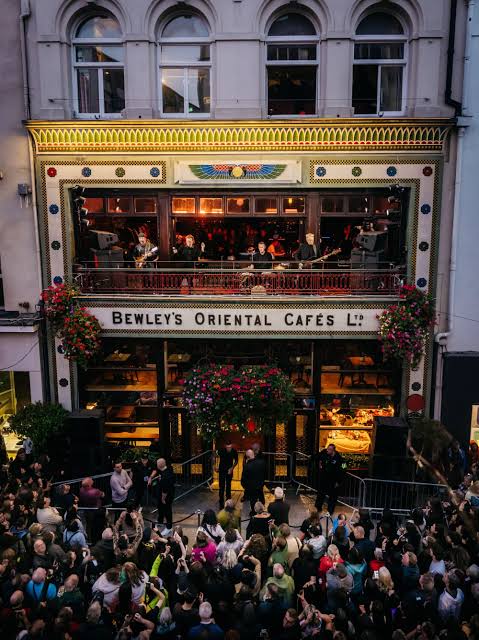
U2 marked the anniversary in September 2026 with two surprise performances in Dublin. First came Mount Temple, followed later by an appearance on the balcony of Bewley's on Grafton Street. For a band associated with some of the biggest concerts ever staged, there was something right about celebrating half a century back at their old school and then above a Dublin street packed with people.
The anniversary also stripped away some of the scale that has surrounded U2 for most of their career. Before the screens, stadiums, political campaigning, alter egos and spectacle, they were four musicians who developed a sound together. Larry Mullen Jr.'s drumming and Adam Clayton's bass gave the early records their momentum, while The Edge found a way of playing guitar that relied as much on delay, repetition and empty space as riffs or solos. Bono had the voice and personality to fill whatever room remained.
'Boy' and 'October' established that identity. 'War' made it bigger, before Brian Eno and Daniel Lanois pulled the band towards atmosphere and experimentation on 'The Unforgettable Fire'. 'The Joshua Tree' brought those sides together in 1987 and turned an Irish post-punk band into one of the biggest groups in the world.
They could easily have spent the next decade trying to reproduce it. Instead came 'Achtung Baby', Berlin, distortion, dance music and Zoo TV. 'Zooropa' and 'Pop' pushed further into experimentation before 'All That You Can't Leave Behind' brought some of the directness back. The sound changed, the scale became absurd and not every experiment worked, but U2 rarely seemed interested in becoming a tribute act to their own past.
Choosing ten means leaving out 'Pride (In the Name of Love)', 'Beautiful Day', 'Until the End of the World', 'Mysterious Ways', 'Vertigo', 'All I Want Is You' and plenty more.
These are my ten favourite U2 songs.
10. 'With or Without You'
'With or Without You' is probably the most obvious song on this list, but leaving it out just to make the ten look more interesting would be ridiculous. I have heard it hundreds of times, and it still gets me.
What I like most is how little U2 actually do for much of it. Adam Clayton's bassline barely needs to change, Larry Mullen Jr. holds everything back, and The Edge spends most of the song creating atmosphere rather than playing anything you would describe as a conventional riff. Remove almost any one of those parts and the whole thing changes, even though none of them sounds especially complicated on its own.
Bono is caught in the same pattern. The title contains the whole problem: he cannot live comfortably with this person and cannot imagine life without them either. There is no clean release because the relationship itself does not have one.
Familiarity has slightly disguised how unusual the song is. This became one of the biggest rock songs of the 1980s without a huge solo, an obvious final explosion, or the band suddenly throwing everything at the arrangement. Even when Bono starts pushing his voice, the others keep holding back.
Live, the audience provides much of the size. U2 can stay inside the same repeating patterns while tens of thousands of people make the song enormous around them. That is one of the things they became very good at: writing songs capable of filling stadiums without simply playing everything louder.
9. 'One Tree Hill'
I have always regarded 'The Joshua Tree' as something greater than its first three songs because of 'One Tree Hill'. By the time you reach it, the album has already moved far beyond the songs everybody knows, and this is one of the moments where the record becomes much more personal.
'One Tree Hill' was written after the death of Greg Carroll, a New Zealander who became close to U2 after meeting them during their 1984 tour and later worked as Bono's personal assistant. Carroll was killed in a motorcycle accident in Dublin in 1986, with members of U2 travelling to New Zealand for his funeral. The title comes from the Auckland landmark Carroll had shown Bono, turning a place associated with their friendship into something that would remain attached to him permanently.
The song never becomes a straightforward memorial, though. It moves through grief, landscape, memory and the hope of somehow meeting somebody again. Even the repeated images of rivers running towards the sea give it a sense of movement. Death has happened, but the song refuses to stand still around it.
The music has a brightness that makes the grief hit harder. The Edge's guitar shines, the rhythm continues moving and Bono does not sing as though all activity has come to a halt. That is much more in line with the kind of grief I know. The world continues while you are still trying to understand why one person is no longer part of it, and 'One Tree Hill' somehow captures both things at once.
Bono also brings Víctor Jara into the song, the Chilean singer and political activist killed following the 1973 military coup. It introduces another form of loss without turning the song into a political detour. U2 could sometimes reach too far when trying to connect personal feeling with something larger, but here Greg Carroll and Jara belong naturally in the same song: two lives cut short, remembered through music long after the violence that ended them.
There is something else that makes 'One Tree Hill' special within U2's catalogue: it has never become an automatic part of the set. It was released as a single only in New Zealand in 1988 and has retained a particularly strong connection to the country ever since. When U2 returned to Auckland in 2006, they brought it back into the set and dedicated it to Carroll, immediately changing the atmosphere around a song already tied so closely to the place.
Its rarity helps. You do not hear the opening notes knowing they are simply another expected stop in a U2 show. When it appears, there is usually a reason. In Chicago in 2011, almost exactly 25 years after Carroll's death, U2 unexpectedly closed the show with it, Bono explaining to the crowd why they had written the song. U2's own account noted how rarely they performed it outside New Zealand.
There are bigger U2 songs and songs that changed their career more dramatically. 'One Tree Hill' does not need to compete with them on those terms. It is one of the most moving songs on 'The Joshua Tree', and I don't think U2 ever wrote many that were more beautiful.
8. 'Sunday Bloody Sunday'
There is no triumph in 'Sunday Bloody Sunday'. Despite the force of Larry Mullen Jr.'s drums and The Edge's guitar, the song is not interested in making conflict sound heroic. It sounds exhausted by it.
Released on 'War' in 1983, it arrived as the Troubles were still part of everyday life in Northern Ireland, and its title inevitably carries the weight of Bloody Sunday in Derry, when British soldiers shot civil rights marchers in 1972. U2 were writing as an Irish band about a conflict that had already produced decades of death, division and reprisals, yet they refused to turn the song into another declaration for one side or the other.
The people inside it are not politicians or paramilitaries. They are those left to live with the aftermath of violence: families grieving, communities divided, and another generation inheriting something it did not create. Bono keeps returning to the numbness that comes when another death is added to all the ones that came before.
The question at the heart of the song sounds less like rhetoric than disbelief. How many times can the same grief be repeated before someone finally decides that enough is enough?
Larry's martial drum pattern initially sounds as though it belongs to a parade or battlefield, yet there is nothing celebratory about it. Adam Clayton's bass remains almost brutally simple, while The Edge's guitar has a brittle quality that suits the song's unease. Steve Wickham's electric violin cuts through it all, bringing a mournful edge that prevents the track from becoming straightforwardly aggressive. Bono knew how easily the anger could be misunderstood. That is why he repeatedly introduced the song live, insisting that it was not a rebel song. U2 did not want 'Sunday Bloody Sunday' turned into the kind of sectarian anthem it was arguing against. Another death could never settle the previous one.
At Red Rocks in 1983, Bono carrying a white flag through the mist became one of the defining images of early U2, but the symbolism matters more than the photograph. It is not a victory flag. It is an admission that nobody wins if the killing simply continues. Four years later, the song became horribly current again. On 8 November 1987, an IRA bomb exploded during a Remembrance Sunday ceremony in Enniskillen, killing eleven people and injuring many more. U2 were playing in Denver that evening, and when they reached 'Sunday Bloody Sunday', the violence was no longer history. It had happened again only hours earlier.
Bono's anger during that performance is difficult to separate from the grief beneath it. He condemns the idea that violence carried out in the name of Ireland could somehow represent everyone in Ireland, and the song feels less like a concert staple than something being reopened in real time.
More than forty years later, the details still belong to Ireland and the Troubles, but the central feeling reaches much further: the horror of people becoming accustomed to violence because it has persisted for long enough.
'Sunday Bloody Sunday' still sounds less like a protest song than a plea for the cycle to stop.
7. 'New Year's Day'
'New Year's Day' announces itself before Bono has sung a word. Adam Clayton's bassline creates the tension, Larry Mullen Jr. locks into it, and The Edge moves between piano and guitar without crowding either. This is also where early U2 begin to sound too big for the rooms they came from. 'Boy' and 'October' had urgency, but 'War' gives it more weight. 'New Year's Day' still carries the coldness and repetition of post-punk, only now something broader is opening up inside it.
Bono had begun with something closer to a love song for Ali before the Polish Solidarity movement entered his thinking. That combination prevents the song from becoming a blunt political statement. The wider subject is division, but its emotional centre remains two people who want to be together yet cannot.
The sense of distance runs through everything. The landscape is cold and almost empty; the world seems paused, and Bono keeps returning to the possibility that the separation will not last forever. There is sadness in it, without complete resignation.
The arrangement never overstates it. The piano is stark; The Edge's guitar opens up the space around the vocal, and Clayton's bass never really loosens its grip. Bono and The Edge inevitably dominate most discussions about U2, but this song simply lacks the same authority without Clayton and Mullen.
Live, it has survived every increase in scale. Even when U2 surrounded themselves with enormous productions, 'New Year's Day' never needed much help. The Edge switching between piano and guitar gives the performance movement, but that bassline still holds everything together.
It sounds like a turning point. U2 had not yet become the band that would make 'The Joshua Tree', but you can hear ambition growing. The post-punk sharpness remained; the songs were beginning to reach much further.
6. 'Bad'
Some U2 songs have two lives: the record and the stage. 'Bad' might be the greatest example.
The studio version on 'The Unforgettable Fire' takes its time. Brian Eno and Daniel Lanois had encouraged U2 to move away from the harder edges of 'War', and 'Bad' is one of the places where that change really takes hold. The Edge repeats the same basic guitar figure while Clayton and Mullen gradually build underneath him, leaving Bono to push against a song that never seems interested in rushing towards the next section.
The subject makes the beauty of the music slightly uncomfortable. Bono has connected it with the heroin addiction he saw affecting people in Dublin, and he sounds less like somebody observing from a distance than somebody trying to reach the person disappearing in front of him.
Then they started playing it live, and the song stopped having fixed edges. Live Aid is the most important performance of the band's career, and 'Bad' took centre stage. Bono climbed down towards the crowd, the song ran much longer than planned, and U2 lost the chance to play 'Pride (In the Name of Love)'. On paper, it sounds like terrible festival discipline. In reality, it became one of the moments that pushed them onto another level.
What happened to 'Bad' afterwards is just as interesting. Bono began dropping other songs into the spaces inside it: The Rolling Stones, Lou Reed, David Bowie, Van Morrison, The Beatles, Leonard Cohen and whoever else suited the night. Sometimes the fragment lasts only a few lines. Sometimes it changes the whole mood of the performance.
Those snippets do more than show which records Bono likes. They make each version slightly different. 'Bad' can suddenly wander into somebody else's song before finding its way back. The other three make that freedom possible. The Edge can keep circling the same guitar figure while Clayton and Mullen hold the pulse, giving Bono room to disappear somewhere else without the song collapsing beneath him. One night it might stretch to ten minutes; another might contain a completely different interlude. The structure is loose enough for the song to change with the room. 'Bad' became far bigger than the record.
5. 'One'
U2 needed Berlin.
By the end of the 1980s, 'The Joshua Tree' had made them one of the biggest bands in the world and 'Rattle and Hum' had pushed their fascination with American music about as far as it could go. Another serious, black-and-white U2 record would have been the safest option imaginable.
Instead, they arrived at Hansa Studios in Berlin in 1990, shortly after German reunification, and struggled to agree on what U2 should sound like next. The city was still adjusting to the fall of the Berlin Wall while the band were trying to pull apart an identity that had carried them through the previous decade.
The Edge wanted stranger guitar sounds, more electronics and greater influence from dance and industrial music. Bono was moving towards irony and characters. Clayton and Mullen were not always convinced by where the experiments were heading, and the sessions became difficult. 'One' came out of that uncertainty.
The breakthrough arrived while they were working on material that eventually became 'Mysterious Ways'. A chord progression from The Edge gave the four members something they could agree on again. It did not suddenly fix everything, but it helped unlock the album.
That background makes the song's later reputation as a straightforward anthem of unity slightly strange. 'One' is much less comforting than that. People can love one another and still be terrible at being together. Obligation, resentment and affection sit beside each other, and nobody gets the easy answer.
The arrangement gives those ideas room. Clayton and Mullen are patient; The Edge decorates rather than dominates, and Bono gradually moves from conversation towards something closer to a plea. Nobody tries to turn it into another '80s U2 anthem. Around it, 'Achtung Baby' became one of the great reinventions. 'Zoo Station', 'The Fly', 'Mysterious Ways' and 'Until the End of the World' brought distortion, electronics, sexuality and humour into a band that had spent the previous decade becoming increasingly serious. The Edge made his guitar less recognisable, Bono put on the sunglasses, and U2 stopped behaving as though sincerity was the only respectable position for a rock band.
Zoo TV then carried that change onto the stage with screens, slogans, television feeds and Bono's characters. The band that had once worried about becoming swallowed by rock spectacle decided to make the spectacle itself part of the joke.
You do not need all of that history to love 'One', but it makes the song more interesting. It was created while U2 were trying to work out whether they could still move forward together. They went to Berlin because repeating the old version of U2 no longer interested them. 'One' helped them work out what could replace it.
4. 'Where the Streets Have No Name'
I don't think U2 ever bettered the opening of 'Where the Streets Have No Name'. The organ slowly appears; The Edge begins building that guitar pattern, and the song keeps getting larger before Bono has even arrived. Clayton and Mullen finally enter, and everything starts moving at once. Everybody in the crowd knows what is coming, yet those opening notes still create the same anticipation.
The Edge is central to that. His style has been copied so often that it is easy to forget how unusual it once sounded. Delay effectively becomes another player, filling the gaps he deliberately leaves between the notes. The actual guitar part is economical; what you hear around it feels enormous.
That approach became part of the vocabulary available to the guitar bands that followed. Coldplay and The Killers found very different sounds of their own, but both understood that alternative music could move into arenas and stadiums without becoming traditional hard rock. Atmosphere could do the work that riffs and solos had done for an earlier generation.
Bono's lyrics came partly from thinking about Belfast, where somebody's street could reveal their religion, background and social position before you had even met them. The title imagines getting beyond that, somewhere an address does not immediately tell everybody who you are supposed to be.
It fits 'The Joshua Tree' perfectly. The record is full of places, borders, landscapes and people attempting to escape circumstances that seem to have been decided for them already. 'Where the Streets Have No Name' opens the album by trying to get somewhere beyond all of it.
The music actually feels like escape. The recording was famously difficult, with the arrangement and changing time signatures causing problems in the studio. None of that survives in the finished version. It sounds completely natural.
By 1987, U2 were becoming a different-sized band, and the rooftop video in Los Angeles captured that change perfectly. They played above the city while crowds gathered below and the surrounding streets came to a standstill. What could have been a straightforward promotional video became another U2 event.
Live, the song grew even further. At Slane Castle in 2001, with Bono having recently lost his father, the performance carried a completely different emotional weight. On the Joshua Tree anniversary tours, Anton Corbijn's enormous imagery surrounded the band and gave the song a scale worthy of its reputation.
3. 'I Will Follow'
Before Zoo TV, Live Aid, 'The Joshua Tree', giant screens, alter egos and decades of reinvention, there was 'I Will Follow'.
It opens 'Boy' and immediately sounds like a band impatient to discover what it might become. Larry Mullen Jr.'s drums push forward, Adam Clayton provides the foundation and The Edge is already searching for guitar sounds that separate him from most of the players who came before him. Bono sounds young because he was young, but there is nothing hesitant about the performance.
Steve Lillywhite's production helps because the band sound raw without becoming indistinct. Every instrument has its own space, which matters with early U2. They were not musicians trying to impress one another with what they could play. The excitement came from what happened when four relatively simple parts collided.
The song was shaped by the death of Bono's mother, Iris, when he was fourteen, a loss he would return to decades later. Yet 'I Will Follow' does not sink into grief. Mullen and Clayton keep dragging the music forward while Bono tries to make sense of something that had happened years earlier.
There is something of Joy Division in that combination of emotional darkness, insistent rhythm and guitar used more for atmosphere than traditional rock virtuosity. The difference is where U2 take it. 'I Will Follow' is almost Joy Division built for stadiums, even though U2 were nowhere near one when they recorded it.
The Edge is particularly important to that difference. He did not possess the vocabulary of the traditional blues-rock guitar heroes and eventually realised that he did not need it. Effects, harmonics, repeated patterns and empty space became his vocabulary instead. What might initially have looked like a limitation helped produce one of the most recognisable guitar styles of the last half-century.
That basic sound was strong enough to survive everything U2 later built around it. 'I Will Follow' never depended on a particular production style or period of the band, which is why it could still sit naturally inside their live shows decades later.
When U2 returned to Mount Temple for their 50th anniversary in 2026, it belonged there. Half a century after Larry Mullen Jr.'s notice had brought the band together, they could return to one of their earliest songs without making it feel like a history lesson.
'I Will Follow' still sounds like U2 want to play it.
2. 'Red Hill Mining Town'
Putting 'Red Hill Mining Town' above almost every famous U2 song is probably the choice on this list that requires the most explanation. It contains almost everything I love about them: an enormous melody, a political backdrop reduced to individual lives, Bono pushing his voice towards its limits and four musicians making something grand without losing the people at the centre of it.
The song emerged in the aftermath of the 1984–85 miners' strike, a year-long industrial dispute centred on pit closures. The confrontation between the National Union of Mineworkers, the National Coal Board and Margaret Thatcher's government became one of the defining industrial conflicts of the decade, but the consequences reached far beyond Westminster and the picket lines. Mining communities faced the prospect of work that had sustained generations disappearing.
Bono did not pretend to understand what spending a working life underground felt like. Speaking to Hot Press in 1987, he described 'Red Hill Mining Town' as a song about the miners' strike, but what interested him most was what happened after somebody heard that another thousand people had lost their jobs. Those workers went home to partners and children, carrying the pressure, damaged pride and uncertainty of unemployment.
That is where the song lives. The mining imagery and the relationship become inseparable. Work is disappearing, confidence goes with it, and two people are trying to hold onto one another while the world around them changes. Instead of reducing the strike to an argument between politicians, unions and management, U2 bring it inside the home.
Musically, 'Red Hill Mining Town' sounds anything but small. Bono's vocal is one of the most demanding performances on 'The Joshua Tree'. He seems permanently on the edge of what his voice can comfortably reach, particularly as the chorus climbs. I would not clean that strain away. He sounds as though he is hanging on while singing about people doing exactly the same thing.
The Edge takes the opposite approach. Rather than matching Bono's desperation with another huge performance, he gives him room. Adam Clayton and Larry Mullen Jr. keep the song moving underneath, stopping the arrangement from becoming overwhelmed by the vocal.
Everything about it sounds as though it should have become an enormous live song in 1987. Strangely, it didn't.
A video was directed by Neil Jordan, and there were serious expectations that 'Red Hill Mining Town' could become a major single, but those plans were abandoned as 'With or Without You', 'I Still Haven't Found What I'm Looking For' and 'Where the Streets Have No Name' took over. More surprisingly, U2 did not perform it during the original Joshua Tree Tour.
That gave it a strange position in their catalogue. One of the most obviously anthemic songs on one of the biggest albums ever made became something close to a deep cut. When U2 decided to perform 'The Joshua Tree' in sequence on its 30th-anniversary tour in 2017, 'Red Hill Mining Town' finally had to become a live song. The band changed the arrangement rather than trying to reproduce 1987 exactly, allowing an older Bono to approach a vocal that had been punishing even when he originally recorded it.
The distance actually suits the song. The younger Bono sounds desperate to hold onto something; the older Bono inevitably brings another perspective to words about work disappearing, relationships changing and a familiar world slipping away. Both versions make sense.
Its long absence also preserved something that the bigger 'Joshua Tree' songs inevitably lost through familiarity. 'Where the Streets Have No Name', 'With or Without You' and 'I Still Haven't Found What I'm Looking For' escaped the album and entered popular culture.
'Red Hill Mining Town' remained inside 'The Joshua Tree'. You had to reach it, and that is part of why it still feels special. It takes a national industrial conflict and brings it down to the fear of losing the person standing next to you.
Most of the time, that is when I like U2 best: when the huge subject becomes something small enough to feel.
Honourable mention: 'I Still Haven't Found What I'm Looking For'
Before reaching No. 1, there is one omission that needs explaining because on another day 'I Still Haven't Found What I'm Looking For' could easily be somewhere inside the ten.
Its position on 'The Joshua Tree' is still ridiculous when you think about it. 'Where the Streets Have No Name' opens the album; this follows it and then 'With or Without You' comes next. Plenty of bands would spend an entire career hoping to write one song of that stature. U2 put three of them next to each other.
What I love about it is that it never really behaves like a conventional rock anthem. The gospel influence gives it warmth and lift, Adam Clayton's bass and Larry Mullen Jr.'s rhythm let it roll rather than charge forward, and The Edge understands that the song does not need filling with guitar.
The title tells you almost everything. Bono moves through love, experience and Christian imagery, sounding convinced by what he believes while still admitting that belief has not answered everything. U2 are often caricatured as a band with absolute certainty about themselves and the world around them, yet one of their biggest songs is about still searching.
Live, Bono can hand most of the chorus over to the crowd, and suddenly thousands of people are singing about not having found what they are looking for. Something that begins as an admission of incompleteness becomes one of the most communal moments in a U2 show.
The New Voices of Freedom performances took it somewhere else again. The gospel influence had always been inside the studio recording, but surrounding Bono with a gospel choir brought it completely to the surface. It stopped sounding like a rock band borrowing from gospel and moved closer to the music that had inspired it in the first place.
That flexibility is one of U2's great strengths live. 'Bad' can absorb somebody else's song, 'Sunday Bloody Sunday' can change according to what is happening outside the venue and 'I Still Haven't Found What I'm Looking For' can become gospel, a stadium singalong or something much quieter.
There are days when I could probably put it in the top five. Somehow, it does not even make this ten.
1. 'Out of Control'
After 50 years of U2, my favourite song is still one of the first they ever released. I think that says quite a lot about what I like most about them. Before 'The Joshua Tree', Live Aid, Zoo TV, Berlin, stadiums and everything else that eventually became attached to the name U2, they were four young musicians in Dublin trying to work out whether the band was any good.
'Out of Control' sounds like that.
Bono started writing it around his eighteenth birthday, thinking about the fact that two of the biggest things that happen to any of us, being born and dying, are completely outside our control. It is a huge idea for somebody that young to write about, but the song does not get bogged down in it. They simply play it at full speed.
It appeared on 'Three', U2's first release, alongside 'Stories for Boys' and 'Boy/Girl'. Listeners to Dave Fanning's radio show were asked to choose the lead track and picked 'Out of Control', before both it and 'Stories for Boys' were recorded again for 'Boy'.
What strikes me now is how recognisably U2 it already sounds. Larry Mullen Jr. drives the whole thing. Adam Clayton's bass gives it more weight than you might expect from such an early recording, while The Edge is already avoiding the obvious guitar choices. He was never going to become the guitarist standing at the front waiting for his solo. Even here, he seems more interested in rhythm, repetition and making the guitar sound slightly unlike everybody else's.
Bono is rougher than he would become later, but I prefer that here. He sounds young, overexcited and completely committed to every line. Nobody is holding anything back because there is nothing to protect yet.
Once you become one of the biggest bands in the world, every new record arrives with history attached to it. 'Out of Control' has none of that. They are not wondering how to follow 'The Joshua Tree', whether the last experiment went too far or what people expect a U2 record to sound like. They are trying to get through the song without losing any of its energy.
It sits naturally alongside 'I Will Follow', but it feels even more primitive. If 'I Will Follow' is Joy Division built for stadiums, 'Out of Control' comes from the point when nobody involved had any reason to think a stadium would ever enter the conversation.
That has helped it age brilliantly live. Some early songs start to sound like homework once a band has been around for decades, played because everybody knows they are supposed to be there. 'Out of Control' rarely feels like that. Larry counts it in, the band go, and for a few minutes most of the machinery surrounding U2 disappears.
Bono wrote a song about how little control we have over the biggest events in our lives before any of them had the slightest idea what would happen to the band. If somebody had told that version of U2 that the same four people would still be playing it 50 years later, it would have sounded absurd. But they still are.
Final Thoughts
Looking at the finished list, it probably says as much about the U2 I prefer as it does about their catalogue. 'The Joshua Tree' dominates, but four of the ten songs come from before they had become the biggest band in the world. That early urgency matters just as much to me as everything they learned to do with scale later.
Fifty years also puts the anniversary performances in Dublin into perspective. Bono, The Edge, Adam Clayton and Larry Mullen Jr. went back to Mount Temple with a catalogue that had travelled through post-punk, American roots music, Berlin, electronic music, stadiums and plenty of wrong turns in between. Then they played songs written when none of that existed.
That is what I keep coming back to with U2. The career became enormous, but the best songs rarely depend on the mythology surrounding it. 'Bad' can still stretch according to the night, 'Where the Streets Have No Name' still changes a room with its opening notes and 'I Will Follow' still sounds impatient more than four decades later.
And after all of it, my favourite remains 'Out of Control'.
Fifty years of U2, and I still end up back near the beginning.