A Generation United: Inside the Landmark ‘HELP(2)’ Compilation for War Child

While the first new material from Arctic Monkeys in four years has rightfully dominated the headlines (you can read our full deep-dive on that here), their return is just one piece of a much larger cultural puzzle. The arrival of ‘HELP(2)’ today, January 22nd, 2026, marks a monumental shift for War Child Records. More than just a charity compilation, this release is a massive humanitarian undertaking, designed to bridge the creative gap between the Britpop legends of the 1995 original and the modern vanguard of 2026.
The Legacy of Help
The spirit of spontaneity is baked into the very DNA of this project. In 1995, the original ‘Help’ compilation became a cultural phenomenon by capturing the peak of the 1990s guitar boom in a single, breathless moment. Spearheaded by Tony Crean of Go! Discs and the War Child founders, the record was born from an absolute sense of urgency regarding the Bosnian conflict. Its hallmark was the legendary "24-hour rule": every track had to be recorded on Monday, September 4th, to ensure the physical albums reached shop shelves by Saturday. It was a logistical miracle in a pre-digital age, proving that the music industry could move faster and do more than the rigid political structures of the time.
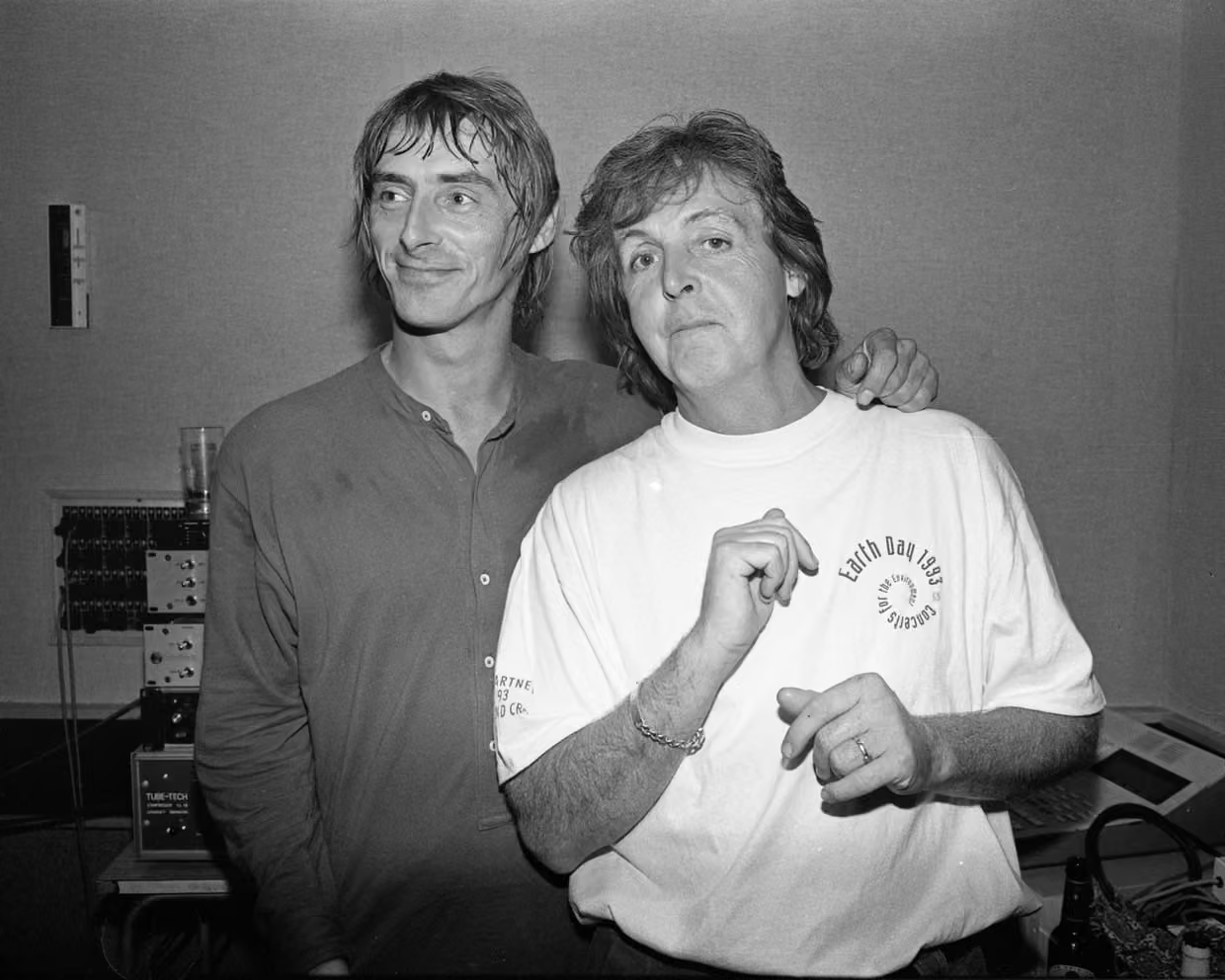
The lineup was a definitive "who’s who" of the Britpop explosion, featuring artists who stepped well outside their usual boundaries. At Abbey Road, a one-off supergroup dubbed The Smokin’ Mojo Filters saw Paul McCartney, Paul Weller, and Noel Gallagher record ‘Come Together’, a symbolic passing of the torch that cemented the lineage between The Beatles and the Britpop elite. Oasis contributed ‘Fade Away’, a loose, high-energy session featuring Johnny Depp on slide guitar and Kate Moss on backing vocals, while The Stone Roses offered ‘Love Spreads’, a monumental, blues-drenched swan song that would be their final studio appearance before their initial disbandment.
While many brought high-octane energy, others provided moments of profound artistic evolution and emotional weight. Radiohead recorded ‘Lucky’ in just five hours with producer Nigel Godrich; its haunting, expansive sound was so advanced that it eventually became the emotional centrepiece of the epochal ‘OK Computer’ two years later. For the Manic Street Preachers, their choice of ‘Raindrops Keep Fallin’ on My Head’ marked a brave and bittersweet return to the studio, their first recording following the tragic disappearance of guitarist Richey Edwards. The tracklist was further bolstered by the likes of Suede, The Charlatans, and Blur, who momentarily set aside their fierce chart rivalry with Oasis to contribute to the cause
The visual identity of the project was as raw and immediate as the music itself, thanks to a cover designed by John Squire. As the guitarist for The Stone Roses and a celebrated Pollock-inspired painter, Squire’s "splatter" aesthetic was a deliberate choice to reflect the chaotic, grassroots nature of the undertaking. Ultimately, the bands participated to prove that the "arrogant" Britpop era could unite for a shared humanitarian goal, transcending the headlines of the day.
As War Child’s head of music, Rich Clarke, notes, War Child was set up in 1993 by two film-makers, David Wilson and Bill Leeson, who had seen the effects of war in the former Yugoslavia first-hand. The charity had tried putting on gigs, arranging a fashion show and an art exhibition curated by Brian Eno and David Bowie, but the release of Help “suddenly gained national and even international press, and put over £1m in the bank” The landscape of 2026 is vastly different. With the digital era making fundraising via streaming nearly impossible, ‘HELP(2)’ relies on a resurgence of physical media and the belief that a new generation of artists can capture that same lightning in a bottle.
The decision to record a sequel has, Clarke says, “been kicking around for two or three years”, inspired partly by the original Help album’s 30th anniversary, partly by the severity of the crises in Gaza, Sudan, Ukraine and Syria.
A Masterclass in Collaboration
Produced and stewarded by James Ford, the record was captured during an intensive, high-energy week at Abbey Road Studios in November 2025.
The project’s curator, James Ford, faced a staggering personal crisis just as the project began: a diagnosis of leukaemia.
"The week of the Abbey Road sessions, I was in the ICU with a pipe coming out of my neck," Ford reveals. "But because of technology, I could be in the hospital on my laptop, listening to what they were doing on the desk." From his hospital bed, Ford remotely produced the tracks, guiding Olivia Rodrigo through vocal takes for ‘The Book of Love’ while receiving a blood transfusion. "It was one of the most bizarre experiences of my life," he says, "but it kept me sane. It was a life-saver, really.
The process was a deliberate homage to the 'Instant Karma' philosophy of John Lennon, who famously believed the best records were "recorded on Monday, cut on Tuesday, pressed on Wednesday, packaged on Thursday, distributed on Friday, and in the shops on Saturday."
It is a breakneck pace that mirrors the urgency of the cause. In 1995, the original ‘Help’ made history by being recorded on Monday, September 4th, and hitting shelves just five days later on Saturday, the 9th. For ‘HELP(2)’, the music industry has once again mobilised with that same frantic, vital energy to ensure these songs reach the public while the need is most dire.
Not everyone was willing to help, though. James Ford said that curating the record was “actually a great insight into the industry, which people are willing to do something. People who you’d think would be into it flat-out refused because they saw it as too political or something like that. It was fascinating.”
Icons, Newcomers, and Unexpected Alliances
The tracklist for ‘HELP(2)’ is a testament to the album’s ability to unite the global pop world with indie-rock royalty. One of the most anticipated highlights, ‘Flags’, serves as the record’s experimental heart, seeing Damon Albarn joined by Johnny Marr, Kae Tempest, and Grian Chatten of Fontaines D.C. (who also contribute a haunting, stripped-back cover of Sinéad O’Connor’s ‘Black Boys On Mopeds’).
For Tempest, the project was about more than just the star power; after seven solo albums, he was craving the "true collaboration" of a shared studio. The night before the session, he and Chatten repaired to Albarn’s studio to write verses in real-time, responding to one another’s energy. The actual recording, however, proved to be a "baptism of fire" once they reached Abbey Road. The studio was a whirlwind of virtuosity and unexpected scale. “Johnny Marr was on guitar, Femi Koleoso from Ezra Collective was drumming,” Tempest laughs. “Plus, there was a children’s choir.”
This sense of organized chaos defined the week, as the halls of Abbey Road teemed with cross-generational life. While Jarvis Cocker was in one room completing a new Pulp song, ‘Begging for Change’, the band English Teacher were in another, overcoming the shock of having Graham Coxon play guitar on ‘Parasite’—a track frontwoman Lily Fontaine had written while she was still at university. “Blur are a massive influence on English Teacher,” she says. “When Graham walked in, a nervous hush came over the room.” These concurrent recordings led to a unique "open-door" policy; English Teacher eventually lent their voices to Albarn’s children’s choir, a group that Cocker also co-opted to add a raw, visceral energy to the Pulp track.
The surprises continue with Foals, who offer their first new material since 2022’s ‘Life Is Yours’ with the devastating ‘When The War is Finally Done’. Frontman Yannis Philippakis revealed that the track was born from a period where he was immersed in the works of "Trench Poets" like Wilfred Owen and Rupert Brooke. “The song is sung from the afterlife; a young soldier sent to war and expected to endure the unendurable,” Philippakis shared on Instagram. “Watching the world return to normalcy from above after the shelling stops... through the lens of current world events, it feels as if the song has been waiting for this moment to be released.”
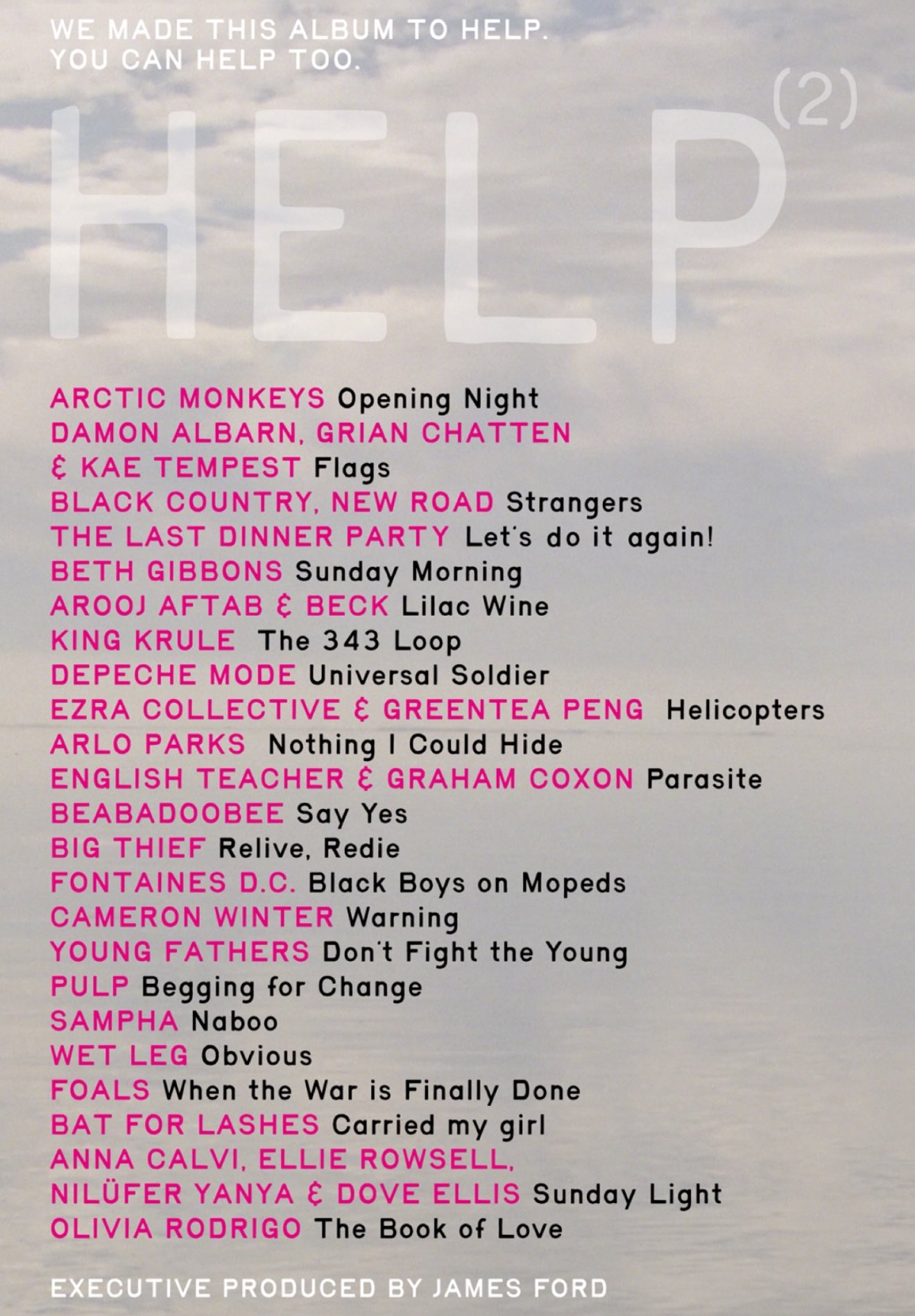
Elsewhere, the record bridges generational divides with a standout pairing of Olivia Rodrigo and Graham Coxon for a cover of ‘The Book of Love’, while Depeche Mode provide a sombre, electronic reimagining of Buffy Sainte-Marie’s ‘Universal Soldier’. This sprawling 23-track collection serves as a definitive map of modern music, moving from high-octane studio collaborations to intimate, stripped-back acoustic moments.
The sheer scale of the talent involved represents a rare moment of total industry alignment, from the heavyweights of the '90s to the defining voices of the 2020s.
- Arctic Monkeys – ‘Opening Night’
- Damon Albarn, Johnny Marr, Kae Tempest & Grian Chatten – ‘Flags’
- Olivia Rodrigo & Graham Coxon – ‘The Book of Love’
- Depeche Mode – ‘Universal Soldier’
- Fontaines D.C. – ‘Black Boys On Mopeds’
- Pulp – ‘Begging for Change’
- Foals – ‘When The War is Finally Done’
- English Teacher & Graham Coxon – ‘Parasite’
The Centrepiece: Arctic Monkeys' Opening Night’
Anchoring this massive project is the lead single, ‘Opening Night’, the first new material from Arctic Monkeys in four years. By stepping out of their hiatus to lead such an urgent collection, the band sets a sophisticated tone for a record that refuses to look away from the global crisis.
Sonically, ‘Opening Night’ is a fascinating synthesis of the band’s evolution. It certainly doesn’t share the polished, leather-jacket swagger of ‘AM’. Instead, it opens with wiry, robotic percussion and fingerpicked, clean guitar, low-key and intimate.
As the track unfolds across its four-minute runtime, it begins to harken back to the lush, cinematic orchestration of ‘The Car’, with sweeping strings that add a sense of grand drama. Yet, beneath that elegance lies a grit we haven't seen in years. There are flashes of murky, sinister guitar work that feel pulled straight from the ‘Humbug’ era, providing a dark counterpoint to the orchestral swells.
Through the Eyes of a Child
The presence of children wasn't limited to the choir. Under the supervision of Oscar-winning director Jonathan Glazer, local primary school students documented the sessions with Sony Handycams. Glazer, tasked with filming the project, wanted to reflect the "joy and freedom of childhood" that War Child fights to protect.
"We had eight nine-year-olds running around," Glazer says. "It was every bit as chaotic and wonderful as you can imagine. One boy was filming Johnny Marr, then decided he wanted to see something behind him, so he just pushed Johnny’s guitar neck out of the way to get the shot."
This youthful energy bled into the music. English Teacher ended up singing with Albarn’s children’s choir, a group Cocker also co-opted to "scream" on the Pulp track. "When you think of children’s choirs, you think of boring, grown-up songs like 'There’s No One Quite Like Grandma'," Cocker notes. "I thought it’d be better to just get them to make a noise."
However, the scope of the project reaches well beyond the walls of Abbey Road. Glazer’s team collaborated with fixers and filmmakers in Ukraine, Gaza, Yemen, and Sudan to gather footage captured by children living on the front lines of these conflict zones. As the press release notes, the results are a "stunning piece of work" that creates an unbreakable link between the recording booth and the reality on the ground.
“It has been such a privilege to be part of bringing a team together to film this incredible collective effort,” Glazer added, highlighting a project that serves as a constant, flickering reminder of why this music exists in the first place.
A Call to Collective Action
‘HELP(2)’ is more than just a snapshot of the current musical landscape; it is a vital intervention. By reviving the breakneck urgency of the 1995 original and centring the voices and lenses of children caught in the crossfire, War Child has created something that transcends the typical charity compilation.
The necessity of this project is underscored by a sobering reality. In a statement regarding the record's importance, the charity noted that when the original ‘HELP’ was released, roughly 10% of the world’s children were affected by conflict. Today, that figure has nearly doubled to 1 in 5, representing 520 million children worldwide, more than at any time since the Second World War.
“With conflicts escalating and funding cuts hitting hard, War Child’s work has never been more urgent,” the charity continued. “The need for these artists to carry forward the original album’s spirit of collective action could not be more vital.
Rich Clarke, Head of Music at War Child UK, added: “‘HELP(2)’ is more than an album. It’s a powerful example of what can happen when the music industry comes together around a shared purpose. We are immensely grateful to all the artists and teams who have donated their voices, talent, and time. We hope this record not only raises vital funds, but also awareness of the urgent need to turn compassion into action.”
Whether it’s the long-awaited return of Arctic Monkeys with ‘Opening Night’ or the surprising alchemy of a Rodrigo-Coxon collaboration, every note on this record serves a singular, urgent purpose.
‘HELP(2)’ will be released on Friday, March 6th via War Child Records and is available for available for pre order/pre-save here